AI · SL · Number & Algebra

Sequences & Series

Arithmetic and geometric sequences and series

DifficultyAll difficulties
Exam modePaper 1 & 2

Question 1

MildNo calculator
[Maximum mark: 5]

Consider the sequence unu_n: 2,5,10,3,7,4,…2,5,10,3,7,4,\ldots

(notice that there is no particular pattern in this sequence)

(a) Write down the values of u1u_1 and S1S_1.[2]

(b) Write down the values of u2u_2 and S2S_2.[2]

(c) Find S5S_5.[1]

Worked solution

Question 1 mark scheme

(a)

u1=2u_1=2, S1=2S_1=2.

(b)

u1=5u_1=5, S2=7S_2=7.

(c)

S5=2+5+10+3+7=27S_5=2+5+10+3+7=27.

Use the mark scheme after attempting the question yourself.

Question 2

MildNo calculator
[Maximum mark: 5]

Consider the (simplest) sequence unu_n: 1,2,3,4,5,6,…1,2,3,4,5,6,\ldots

(a) Write down the values of u2u_2 and u20u_{20}.[2]

(b) Find the value of S5S_5.[2]

(c) Express the value of unu_n in terms of nn.[1]

Worked solution

Question 2 mark scheme

(a)

u2=2u_2=2, u20=20u_{20}=20.

(b)

S5=1+2+3+4+5=15S_5=1+2+3+4+5=15.

(c)

un=nu_n=n.

Use the mark scheme after attempting the question yourself.

Question 3

MildNo calculator
[Maximum mark: 6]

Consider the sequence unu_n given by un=10nu_n=10n

(a) Find the first three terms.[2]

(b) Find u10u_{10}[1]

(c) Find S1S_1, S2S_2 and S3S_3.[3]

Worked solution

Question 3 mark scheme

(a)

10,20,3010,20,30

(b)

u10=100u_{10}=100

(c)

S1=10S_1=10, S2=30S_2=30, S3=60S_3=60

Use the mark scheme after attempting the question yourself.

Question 4

MildNo calculator
[Maximum mark: 6]

Consider the sequence unu_n given by un=10n2u_n=10n^2

(a) Find the first three terms.[2]

(b) Find u10u_{10}[1]

(c) Find S1S_1, S2S_2 and S3S_3.[3]

Worked solution

Question 4 mark scheme

(a)

10,40,9010,40,90

(b)

u10=1000u_{10}=1000

(c)

S1=10S_1=10, S2=40S_2=40, S3=100S_3=100

Use the mark scheme after attempting the question yourself.

Question 5

MildNo calculator
[Maximum mark: 6]

Consider the sequence unu_n given by un=10nu_n=10^n

(a) Find the first three terms.[2]

(b) Find u10u_{10}[1]

(c) Find S1S_1, S2S_2 and S3S_3.[3]

Worked solution

Question 5 mark scheme

(a)

10,100,100010,100,1000

(b)

u10=10,000,000,000u_{10}=10{,}000{,}000{,}000

(c)

S1=10S_1=10, S2=110S_2=110, S3=1110S_3=1110

Use the mark scheme after attempting the question yourself.

Question 6

MildNo calculator
[Maximum mark: 6]

Consider the sequence unu_n given by the recursive definition

u1=10u_1=10, un+1=un+10u_{n+1}=u_n+10

(a) Find the first three terms.[3]

(b) Find S1S_1, S2S_2 and S3S_3.[3]

Worked solution

Question 6 mark scheme

(a)

10,20,3010,20,30

(b)

S1=10S_1=10, S2=30S_2=30, S2=60S_2=60

Use the mark scheme after attempting the question yourself.

Question 7

MildNo calculator
[Maximum mark: 6]

Consider the sequence unu_n given by the recursive definition

u1=10u_1=10, un+1=2un+10u_{n+1}=2u_n+10

(a) Find the first three terms.[3]

(b) Find S1S_1, S2S_2 and S3S_3.[3]

Worked solution

Question 7 mark scheme

(a)

10,30,7010,30,70

(b)

S1=10S_1=10, S2=40S_2=40, S3=110S_3=110

Use the mark scheme after attempting the question yourself.

Question 8

MildNo calculator
[Maximum mark: 6]

(a) Express ∑r=13(2r)\sum_{r=1}^3(2r) as a sum of three terms and find the result.[2]

(b) Express ∑r=13r2\sum_{r=1}^3r^2 as a sum of three terms and find the result.[2]

(c) Express ∑r=132r\sum_{r=1}^32^r as a sum of three terms and find the result.[2]

Worked solution

Question 8 mark scheme

(a)

∑r=13(2r)=2+4+6=12\sum_{r=1}^3(2r)=2+4+6=12

(b)

∑r=13r2=1+4+9=14\sum_{r=1}^3r^2=1+4+9=14

(c)

∑r=132r=2+4+8=14\sum_{r=1}^32^r=2+4+8=14

Use the mark scheme after attempting the question yourself.

Question 9

MildNo calculator
[Maximum mark: 5]

(a) Find A=∑r=110(2r2+1)A=\sum_{r=1}^{10}(2r^2+1), B=∑r=120(2r2+1)B=\sum_{r=1}^{20}(2r^2+1), C=∑r=1120(2r2+1)C=\sum_{r=11}^{20}(2r^2+1) [by GDC][3]

(b) Find a relation between AA, BB and CC.[2]

Worked solution

Question 9 mark scheme

(a)

A=∑r=110(2r2+1)=780A=\sum_{r=1}^{10}(2r^2+1)=780, B=∑r=120(2r2+1)=5760B=\sum_{r=1}^{20}(2r^2+1)=5760,

C=∑r=1120(2r2+1)=4980C=\sum_{r=11}^{20}(2r^2+1)=4980

(b)

A+C=BA+C=B or C=B−AC=B-A

Use the mark scheme after attempting the question yourself.

Question 10

MildNo calculator
[Maximum mark: 11]

Consider the arithmetic sequence 11,15,19,23,…11,15,19,23,\ldots

(a) Write down the first term u1u_1 and the common difference dd.[1]

(b) Find u101u_{101} and S101S_{101}[4]

(c) Find the sum of the first 20 terms.[2]

(d) Express the general term unu_n in the form un=an+bu_n=an+b[2]

(e) Hence find the value of nn given that un=51u_n=51[2]

Worked solution

Question 10 mark scheme

(a)

u1=11u_1=11, d=4d=4.

(b)

u101=11+100×4=411u_{101}=11+100\times4=411, S101=1012(11+411)=21311S_{101}=\dfrac{101}2(11+411)=21311

(c)

S20=202(2×11+19×4)=980S_{20}=\dfrac{20}2(2\times11+19\times4)=980

(d)

un=11+(n−1)4=11+4n−4=4n+7u_n=11+(n-1)4=11+4n-4=4n+7

(e)

un=51⇔4n+7=51⇔4n=44⇔n=11u_n=51\Leftrightarrow4n+7=51\Leftrightarrow4n=44\Leftrightarrow n=11

Use the mark scheme after attempting the question yourself.

Question 11

MildNo calculator
[Maximum mark: 6]

(a) Write down the first three terms of the sequence un=3nu_n=3n, for n≥1n\geq1.[1]

(b) Find

(i) ∑n=1203n\sum_{n=1}^{20}3n;

(ii) ∑n=211003n\sum_{n=21}^{100}3n.[5]

Worked solution

Question 11 mark scheme

(a)

3,6,93,6,9

(b)

(i) METHOD 1 By GDC ∑n=1203n=630\sum_{n=1}^{20}3n=630

METHOD 2 S20=202  2×3+(20−1)×3=630S_{20}=\dfrac{20}2\;2\times3+(20-1)\times3=630

(ii) METHOD 1 By GDC ∑n=211003n=14520\sum_{n=21}^{100}3n=14520

METHOD 2 AS with u1=3u_1=3, d=3d=3  S100−S20=15150−630=14520S_{100}-S_{20}=15150-630=14520

METHOD 3 AS with u1=63u_1=63, d=3d=3  S80=14520S_{80}=14520

Use the mark scheme after attempting the question yourself.

Question 12

MildNo calculator
[Maximum mark: 6]

Let un=3−2nu_n=3-2n.

(a) Write down the value of u1u_1, u2u_2, and u3u_3.[3]

(b) Find ∑n=120(3−2n)\sum_{n=1}^{20}(3-2n).[3]

Worked solution

Question 12 mark scheme

(a)

u1=1u_1=1, u2=−1u_2=-1, u3=−3u_3=-3

(b)

By GDC ∑n=120(3−2n)=−360\sum_{n=1}^{20}(3-2n)=-360 or by formula S20=202(2×1+19×−2)=−360S_{20}=\dfrac{20}2(2\times1+19\times-2)=-360

Use the mark scheme after attempting the question yourself.

Question 13

MildNo calculator
[Maximum mark: 4]

The first three terms of an arithmetic sequence are 7,9.5,127,9.5,12.

(a) What is the 41st term of the sequence?[2]

(b) What is the sum of the first 101 terms of the sequence?[2]

Worked solution

Question 13 mark scheme

(a)

u1=7u_1=7, d=2.5d=2.5

u41=u1+(n−1)d=7+(41−1)2.5=107u_{41}=u_1+(n-1)d=7+(41-1)2.5=107

(b)

S101=n2[2u1+(n−1)d]=1012[2(7)+(101−1)2.52]=101(264)2=13332S_{101}=\dfrac n2[2u_1+(n-1)d]=\dfrac{101}2[2(7)+(101-1)2.52]=\dfrac{101(264)}2=13332

Use the mark scheme after attempting the question yourself.

Question 14

MildNo calculator
[Maximum mark: 4]

An arithmetic series has five terms. The first term is 2 and the last term is 32. Find the sum of the series.

Worked solution

Question 14 mark scheme

S5=52{2+32}=85S_5=\dfrac52\{2+32\}=85

Use the mark scheme after attempting the question yourself.

Question 15

MildNo calculator
[Maximum mark: 6]

In an arithmetic sequence, u1=2u_1=2 and u3=8u_3=8.

(a) Find dd.[2]

(b) Find u20u_{20}.[2]

(c) Find S20S_{20}.[2]

Worked solution

Question 15 mark scheme

(a)

8=2+2d⇒d=38=2+2d\Rightarrow d=3

(b)

u20=2+19×3=59u_{20}=2+19\times3=59

(c)

S20=202(2+59)=610S_{20}=\dfrac{20}2(2+59)=610 or S20=202(2×2+19×3)=610S_{20}=\dfrac{20}2(2\times2+19\times3)=610

Use the mark scheme after attempting the question yourself.

Question 16

MildNo calculator
[Maximum mark: 4]

In an arithmetic sequence, the first term is 5 and the fourth term is 40. Find the second term.

Worked solution

Question 16 mark scheme

u4=40⇒u1+3d=40⇒d=353u_4=40\Rightarrow u_1+3d=40\Rightarrow d=\dfrac{35}3

u2=5+353=1623u_2=5+\dfrac{35}3=16\dfrac23 or 503\dfrac{50}3 or 16.7 (3 s.f.)

Use the mark scheme after attempting the question yourself.

Question 17

MildNo calculator
[Maximum mark: 5]

Consider the arithmetic sequence 2,5,8,11,…2,5,8,11,\ldots.

(a) Find u101u_{101}.[2]

(b) Find the value of nn so that un=152u_n=152.[3]

Worked solution

Question 17 mark scheme

(a)

d=3d=3

u101=2+100×3=302u_{101}=2+100\times3=302

(b)

un=152⇔152=2+(n−1)×3⇔n=51u_n=152\Leftrightarrow152=2+(n-1)\times3\Leftrightarrow n=51

Use the mark scheme after attempting the question yourself.

Question 18

MildNo calculator
[Maximum mark: 6]

Consider the arithmetic sequence 3,9,15,…,13533,9,15,\ldots,1353.

(a) Write down the common difference.[1]

(b) Find the number of terms in the sequence.[3]

(c) Find the sum of the sequence.[2]

Worked solution

Question 18 mark scheme

(a)

d=6d=6

(b)

un=1353⇔1353=3+(n−1)6⇔n=226u_n=1353\Leftrightarrow1353=3+(n-1)6\Leftrightarrow n=226

(c)

S226=226(3+1353)2=153  228S_{226}=\dfrac{226(3+1353)}2=153\;228 (accept 153 000)

Use the mark scheme after attempting the question yourself.

Question 19

MildNo calculator
[Maximum mark: 6]

The nnth term of an arithmetic sequence is given by un=5+2nu_n=5+2n.

(a) Write down the common difference.[1]

(b) (i) Given that the nnth term of this sequence is 115, find the value of nn.

(ii) For this value of nn, find the sum of the sequence.[5]

Worked solution

Question 19 mark scheme

(a)

d=2(u1=7)d=2\quad(u_1=7)

(b)

(i) 5+2n=115⇔n=555+2n=115\Leftrightarrow n=55

(ii) S55=552(7+115)=3355S_{55}=\dfrac{55}2(7+115)=3355  OR

S55=552(2(7)+54(2)),=3355S_{55}=\dfrac{55}2(2(7)+54(2)),=3355  OR

∑k=155(5+2k)=3355\sum_{k=1}^{55}(5+2k)=3355

Use the mark scheme after attempting the question yourself.

Question 20

MildNo calculator
[Maximum mark: 6]

An arithmetic sequence, u1,u2,u3,…u_1,u_2,u_3,\ldots, has d=11d=11 and u27=263u_{27}=263.

(a) Find u1u_1.[2]

(b) (i) Given that un=516u_n=516, find the value of nn.

(ii) For this value of nn, find SnS_n.[4]

Worked solution

Question 20 mark scheme

(a)

u27=u1+26d⇔263=u1+26×11⇔u1=−23u_{27}=u_1+26d\Leftrightarrow263=u_1+26\times11\Leftrightarrow u_1=-23

(b)

(i) 516=−23+(n−1)×11⇔n=50516=-23+(n-1)\times11\Leftrightarrow n=50

(ii) S50=50(−23+516)2=12325S_{50}=\dfrac{50(-23+516)}2=12325  OR

S50=50(2×(−23)+49×11)2=12325S_{50}=\dfrac{50(2\times(-23)+49\times11)}2=12325 (accept 12300)

Use the mark scheme after attempting the question yourself.

Question 21

MildNo calculator
[Maximum mark: 5]

Find the sum of the arithmetic series 17+27+37+…+41717+27+37+\ldots+417.

Worked solution

Question 21 mark scheme

un=417⇔17+(n−1)10=417⇔n=41u_n=417\Leftrightarrow17+(n-1)10=417\Leftrightarrow n=41 OR directly n=41n=41 (by observation)

S41=412(2(17)+40(10))=8897S_{41}=\dfrac{41}2(2(17)+40(10))=8897  OR

S41=412(17+417)=412(434)=8897S_{41}=\dfrac{41}2(17+417)=\dfrac{41}2(434)=8897

Use the mark scheme after attempting the question yourself.

Question 22

MildNo calculator
[Maximum mark: 6]

Calculate the sums

(a) 7+10+13+16+L+1577+10+13+16+L+157

(b) ∑r=151(3r+4)\sum_{r=1}^{51}(3r+4)

Worked solution

Question 22 mark scheme

(a)

n=51n=51, S51=4182S_{51}=4182

(b)

∑r=151(3r+4)=4182\sum_{r=1}^{51}(3r+4)=4182 (it is same sum!)

Use the mark scheme after attempting the question yourself.

Question 23

MildNo calculator
[Maximum mark: 4]

Consider the arithmetic series 2+5+8+…2+5+8+\ldots

(a) Find an expression for SnS_n, the sum of the first nn terms.[2]

(b) Find the value of nn for which Sn=1365S_n=1365.[2]

Worked solution

Question 23 mark scheme

(a)

Sn=n2(2×2+3(n−1))=n2(3n+1)S_n=\dfrac n2(2\times2+3(n-1))=\dfrac n2(3n+1)

(b)

n2(3n+1)=1365⇒3n2+n−2730=0=>n=30\dfrac n2(3n+1)=1365\Rightarrow3n^2+n-2730=0=>n=30 or n=−913n=\dfrac{-91}3, hence n=30n=30

Use the mark scheme after attempting the question yourself.

Question 24

MildNo calculator
[Maximum mark: 6]

Let SnS_n be the sum of the first nn terms of an arithmetic sequence, whose first three terms are u1u_1, u2u_2 and u3u_3. It is known that S1=7S_1=7, and S2=18S_2=18.

(a) Write down u1u_1.[1]

(b) Calculate the common difference[3]

(c) Calculate u4u_4.[2]

Worked solution

Question 24 mark scheme

(a)

u1=S1=7u_1=S_1=7

(b)

u2=S2−u1=18−7=11u_2=S_2-u_1=18-7=11

d=11−7=4d=11-7=4

(c)

u4=u1+3d=7+3×4=19u_4=u_1+3d=7+3\times4=19  (OR directly 7, 11, 15, 19 so u4=19u_4=19)

Use the mark scheme after attempting the question yourself.

Question 25

MildNo calculator
[Maximum mark: 8]

In an arithmetic sequence, the first term is −5-5, while the fifth term is 27.

(a) Find the common difference dd.[2]

(b) Find the eleventh term of the sequence.[1]

(c) Find the sum of the first eleven terms.[2]

(d) Given that the nn-th term is 155, find the value of nn.[3]

Worked solution

Question 25 mark scheme

(a)

d=8d=8

(b)

u11=75u_{11}=75

(c)

S11=385S_{11}=385

(d)

n=21n=21

Use the mark scheme after attempting the question yourself.

Question 26

MildNo calculator
[Maximum mark: 6]

In an arithmetic sequence, the first term is -2, the fourth term is 16, and the nnth term is 11 998.

(a) Find the common difference dd.[3]

(b) Find the value of nn.[3]

Worked solution

Question 26 mark scheme

(a)

u4=u1+3du_4=u_1+3d or 16=−2+3d⇔d=616=-2+3d\Leftrightarrow d=6

(b)

un=u1+(n−1)d⇔11998=−2+(n−1)6⇔n=11998+26+1=2001u_n=u_1+(n-1)d\Leftrightarrow11998=-2+(n-1)6\Leftrightarrow n=\dfrac{11998+2}6+1=2001

Use the mark scheme after attempting the question yourself.

Question 27

MildNo calculator
[Maximum mark: 5]

In an arithmetic sequence u1=7u_1=7, u20=64u_{20}=64 and un=3709u_n=3709.

(a) Find the value of the common difference.[3]

(b) Find the value of nn.[2]

Worked solution

Question 27 mark scheme

(a)

u20=u1+19d⇔64=7+19d,⇔d=3u_{20}=u_1+19d\Leftrightarrow64=7+19d,\Leftrightarrow d=3

(b)

3709=7+3(n−1)⇔3709=3n+4⇔n=12353709=7+3(n-1)\Leftrightarrow3709=3n+4\Leftrightarrow n=1235

Use the mark scheme after attempting the question yourself.

Question 28

MildNo calculator
[Maximum mark: 7]

The 5th term of an arithmetic sequence is 30, while the 13th term is 70.

(a) Find the first term u1u_1 and the common difference dd.[3]

(b) Find the general term unu_n in terms of nn.[1]

(c) Find the sum of the first nn terms in terms of nn.[1]

(d) Find the 20th term of the sequence and the sum of the first 20 terms.[2]

Worked solution

Question 28 mark scheme

(a)

u1+4d=30u1+12d=70u_1+4d=30\quad u_1+12d=70

u1=10d=5u_1=10\quad d=5

(b)

un=5n+5u_n=5n+5

(c)

Sn=n2(5n+15)S_n=\dfrac n2(5n+15)

(d)

u20=105u_{20}=105 and S20=1150S_{20}=1150

Use the mark scheme after attempting the question yourself.

Question 29

MildNo calculator
[Maximum mark: 7]

In an arithmetic sequence u21=−37u_{21}=-37 and u4=−3u_4=-3.

(a) Find

(i) the common difference;

(ii) the first term.[4]

(b) Find S10S_{10}.[3]

Worked solution

Question 29 mark scheme

(a)

(i) −37=u1+20d-37=u_1+20d and −3=u1+3d⇔d=−2u1=3-3=u_1+3d\Leftrightarrow d=-2\quad u_1=3

(b)

S10=102(2×3+9(−2))=−60S_{10}=\dfrac{10}2(2\times3+9(-2))=-60

Use the mark scheme after attempting the question yourself.

Question 30

MildNo calculator
[Maximum mark: 5]

In an arithmetic series, the first term is -7 and the sum of the first 20 terms is 620.

(a) Find the common difference.[3]

(b) Find the value of the 78th term.[2]

Worked solution

Question 30 mark scheme

(a)

202{2(−7)+19d}=620⇔d=4\dfrac{20}2\{2(-7)+19d\}=620\Leftrightarrow d=4

(b)

u78=−7+77(4)=301u_{78}=-7+77(4)=301

Use the mark scheme after attempting the question yourself.

Question 31

MildNo calculator
[Maximum mark: 6]

In an arithmetic sequence, S40=1900S_{40}=1900 and u40=106u_{40}=106. Find the value of u1u_1 and of dd.

Worked solution

Question 31 mark scheme

METHOD 1

substituting into formula for S401900=40(u1+106)2⇔u1=−11S_{40}\quad1900=\dfrac{40(u_1+106)}2\Leftrightarrow u_1=-11

substituting into formula for u40106=−11+39d⇔d=3u_{40}\quad106=-11+39d\Leftrightarrow d=3

METHOD 2

substituting into formula for S4020(2u1+39d)=1900S_{40}\quad20(2u_1+39d)=1900

substituting into formula for u40106=u1+39du_{40}\quad106=u_1+39d

Solve the system u1=−11u_1=-11, d=3d=3

Use the mark scheme after attempting the question yourself.

Question 32

MildNo calculator
[Maximum mark: 6]

In an arithmetic sequence, let S1=10S_1=10, and S2=25S_2=25

(a) Write down u1u_1 and u2u_2.[2]

(b) Find the common difference dd.[1]

(c) Find S3S_3 and S4S_4.[2]

(d) Express SnS_n in terms of nn.[1]

Worked solution

Question 32 mark scheme

(a)

u1=10u2=15u_1=10\quad u_2=15

(b)

d=5d=5

(c)

S3=45S4=70S_3=45\quad S_4=70

(d)

Sn=n2(5n+15)S_n=\dfrac n2(5n+15)

Use the mark scheme after attempting the question yourself.

Question 33

MildNo calculator
[Maximum mark: 7]

Consider the arithmetic sequence 11,15,19,23,…11,15,19,23,\ldots

(a) Find the number of terms which are less than 100.[3]

(b) Find the last term which is less than 100.[2]

(c) Find the sum of all terms which are less than 100.[2]

Worked solution

Question 33 mark scheme

(a)

23

(b)

99

(c)

1265

Use the mark scheme after attempting the question yourself.

Question 34

MildNo calculator
[Maximum mark: 5]

Find the sum of the positive terms of the arithmetic sequence 85,78,71,…85,78,71,\ldots

Worked solution

Question 34 mark scheme

Arithmetic progression: 85,78,71,…85,78,71,\ldots

u1=85u_1=85, d=−7d=-7

un=85−7(n−1)=92−7nun>0⇒n≤13u_n=85-7(n-1)=92-7n\quad u_n>0\Rightarrow n\leq13.

S13=132(u1+u13)=132(85+1)=559S_{13}=\dfrac{13}2(u_1+u_{13})=\dfrac{13}2(85+1)=559

Use the mark scheme after attempting the question yourself.

Question 35

MildNo calculator
[Maximum mark: 5]

Consider the arithmetic series −6+1+8+15+L-6+1+8+15+L

Find the least number of terms so that the sum of the series is greater than 10 000.

Worked solution

Question 35 mark scheme

u1=−6u_1=-6 and d=7d=7

Sn=n2(2u1+(n−1)d)⇒Sn=n2(7n−19)S_n=\dfrac n2(2u_1+(n-1)d)\Rightarrow S_n=\dfrac n2(7n-19)

Solving Sn>10000⇒n>54.8S_n>10000\Rightarrow n>54.8, The least number of terms is 55

Use the mark scheme after attempting the question yourself.

Question 36

MildNo calculator
[Maximum mark: 5]

The first three terms of an arithmetic sequence are a+3a+3, 2a+42a+4 and a+9a+9.

(a) Find the value of aa.[3]

(b) Confirm the result.[2]

Worked solution

Question 36 mark scheme

(a)

(2a+4)−(a+3)=(a+9)−(2a+4)⇔2a=4⇔a=2(2a+4)-(a+3)=(a+9)-(2a+4)\Leftrightarrow2a=4\Leftrightarrow a=2

(b)

the terms are 5, 9, 11 which are indeed in AS with d=2d=2

Use the mark scheme after attempting the question yourself.

Question 37

MildNo calculator
[Maximum mark: 5]

Gwendolyn added the multiples of 3, from 3 to 3750 and found that

3+6+9+…+3750=s.3+6+9+\ldots+3750=s.

Calculate ss.

Worked solution

Question 37 mark scheme

Arithmetic sequence d=3d=3

n=1250S=12502(3+3750)=2  345  625n=1250\quad S=\dfrac{1250}2(3+3750)=2\;345\;625

Use the mark scheme after attempting the question yourself.

Question 38

MildNo calculator
[Maximum mark: 6]

Arturo goes swimming every week. He swims 200 metres in the first week.

Each week he swims 30 metres more than the previous week. He continues for one year (52 weeks).

(a) How far does Arturo swim in the final week?[3]

(b) How far does he swim altogether?[3]

Worked solution

Question 38 mark scheme

Arithmetic sequence u1=200d=30u_1=200\quad d=30

(a)

Distance in final week =200+51×30=1730=200+51\times30=1730 m

(b)

Total distance =522[2.200+51.30]=50180=\dfrac{52}2[2.200+51.30]=50180m

Use the mark scheme after attempting the question yourself.

Question 39

MildNo calculator
[Maximum mark: 6]

A theatre has 20 rows of seats. There are 15 seats in the first row, 17 seats in the second row, and each successive row of seats has two more seats in it than the previous row.

(a) Calculate the number of seats in the 20th row.[4]

(b) Calculate the total number of seats.[2]

Worked solution

Question 39 mark scheme

(a)

AS with u1=15d=2n=20u_1=15\quad d=2\quad n=20

u20=15+(20−1)×2=53u_{20}=15+(20-1)\times2=53 (that is, 53 seats in the 20th row)

(b)

S20=202(15+53)=680S_{20}=\dfrac{20}2(15+53)=680 (that is, 680 seats in total)

Use the mark scheme after attempting the question yourself.

Question 40

MildNo calculator
[Maximum mark: 4]

Each day a runner trains for a 10 km race. On the first day she runs 1000 m, and then increases the distance by 250 m on each subsequent day.

(a) On which day does she run a distance of 10 km in training?[2]

(b) What is the total distance she will have run in training by the end of that day? Give your answer exactly.[2]

Worked solution

Question 40 mark scheme

(a)

u1=1000⇔un=1000+(n−1)250=10  000⇔n=37u_1=1000\Leftrightarrow u_n=1000+(n-1)250=10\;000\Leftrightarrow n=37. She runs 10 km on the 37th day.

(b)

S37=372(1000+10  000)S_{37}=\dfrac{37}2(1000+10\;000)  She has run a total of 203.5 km

Use the mark scheme after attempting the question yourself.

Question 41

MildNo calculator
[Maximum mark: 6]

An 81 metre rope is cut into nn pieces of increasing lengths that form an arithmetic sequence with a common difference of dd metres. Given that the lengths of the shortest and longest pieces are 1.5m and 7.5m respectively, find the values of nn and dd

Worked solution

Question 41 mark scheme

81=n2(1.5+7.5)⇒n=1881=\dfrac n2(1.5+7.5)\Rightarrow n=18

1.5+17d=7.5⇒d=6171.5+17d=7.5\Rightarrow d=\dfrac6{17}

Use the mark scheme after attempting the question yourself.

Question 42

MildNo calculator
[Maximum mark: 4]

A woman deposits $100 into her son’s savings account on his first birthday. On his second birthday she deposits $125, $150 on his third birthday, and so on.

(a) How much money would she deposit into her son’s account on his 17th birthday?[2]

(b) How much in total would she have deposited after her son’s 17th birthday?[2]

Worked solution

Question 42 mark scheme

(a)

T1=100d=25T_1=100\quad d=25

T17=100+(17−1)×25=T_{17}=100+(17-1)\times25=$500

(b)

S17=172(100+500)=S_{17}=\dfrac{17}2(100+500)=$5100

Use the mark scheme after attempting the question yourself.

Question 43

MildNo calculator
[Maximum mark: 6]

A teacher earns an annual salary of 45 000 USD for the first year of her employment

Her annual salary increases by 1750 USD each year.

(a) Calculate the annual salary for the fifth year of her employment.[3]

She remains in this employment for 10 years.

(b) Calculate the total salary she earns in this employment during these 10 years.[3]

Worked solution

Question 43 mark scheme

(a)

45000+4×1750=5200045000+4\times1750=52000 USD

(b)

102(2(45000)+9×(1750))=528750\dfrac{10}2(2(45000)+9\times(1750))=528750 USD  (Accept 529000)

Use the mark scheme after attempting the question yourself.

Question 44

MildNo calculator
[Maximum mark: 6]

A concert choir is arranged, per row, according to an arithmetic sequence. There are 20 singers in the fourth row and 32 singers in the eighth row.

(a) Find the common difference of this arithmetic sequence.[3]

There are 10 rows in the choir and 11 singers in the first row.

(b) Find the total number of singers in the choir.[3]

Worked solution

Question 44 mark scheme

(a)

20=u1+3d20=u_1+3d

32=u1+7d32=u_1+7d

d=3d=3 (and u1=11u_1=11)

(b)

102(2×11+9×3)=245\dfrac{10}2(2\times11+9\times3)=245

Use the mark scheme after attempting the question yourself.

Question 45

MildNo calculator
[Maximum mark: 6]

Mr Jones decides to increase the amount of money he spends on food by dd GBP every year. In the first year he spends aa GBP. In the 8th year he spends twice as much as in the 4th year. In the 20th year he spends 4000 GBP. Find the value of dd.

Worked solution

Question 45 mark scheme

4th term =a+3d=a+3d

8th term =a+7d=a+7d

20th term =a+19d=a+19d

We have two relations:

a+7d=2(a+3d)a+7d=2(a+3d)

a+19d=4000a+19d=4000

The solution is d=200d=200 (and a=200a=200)

Use the mark scheme after attempting the question yourself.

Question 46

MildNo calculator
[Maximum mark: 4]

A tree begins losing its leaves in October. The number of leaves that the tree loses each day increases by the same number on each successive day.

Date in October 1 2 3 4 .....................
Number of leaves lost 24 40 56 72 .....................

(a) Calculate the number of leaves that the tree loses on the 21st October.[2]

(b) Find the total number of leaves that the tree loses in the 31 days of the month of October.[2]

Worked solution

Question 46 mark scheme

(a)

u21=24+20×(16)=344u_{21}=24+20\times(16)=344

(b)

S31=312[2(24)+(31−1)(16)]=8184S_{31}=\dfrac{31}2[2(24)+(31-1)(16)]=8184

Use the mark scheme after attempting the question yourself.

Question 47

MediumCalculator
[Maximum mark: 14]

Clara organizes cans in triangular piles, where each row has one less can than the row below. For example, the pile of 15 cans shown has 5 cans in the bottom row and 4 cans in the row above it.
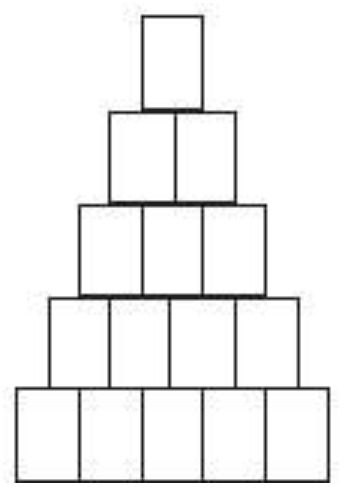
Triangular pile of 15 cans in five rows

(a) A pile has 20 cans in the bottom row. Show that the pile contains 210 cans.[4]

(b) There are 3240 cans in a pile. How many cans are in the bottom row?[4]

(c) (i) There are SS cans and they are organized in a triangular pile with nn cans in the bottom row. Show that n2+n−2S=0n^2+n-2S=0.

(ii) Clara has 2100 cans. Explain why she cannot organize them in a triangular pile.[6]

Worked solution

Question 47 mark scheme

(a)

u1=1u_1=1, n=20n=20, u20=20u_{20}=20 (u1=1u_1=1, n=20n=20, d=1d=1)

S20=(1+20)202(or S=202(2×1+19×1))=210S_{20}=\dfrac{(1+20)20}2\quad\left(\text{or }S=\dfrac{20}2(2\times1+19\times1)\right)=210

(b)

Let there be nn cans in bottom row

Sn=3240⇔(1+n)n2=3240⇔n2+n−6480=0⇔n=80S_n=3240\Leftrightarrow\dfrac{(1+n)n}2=3240\Leftrightarrow n^2+n-6480=0\Leftrightarrow n=80 or n=−81n=-81

So n=80n=80

(c)

(i) S=(1+n)n2⇔2S=n2+n⇔n2+n−2S=0S=\dfrac{(1+n)n}2\Leftrightarrow2S=n^2+n\Leftrightarrow n^2+n-2S=0

(ii) METHOD 1

Substituting S=2100S=2100: n2+n−4200=0⇔n=64.3n^2+n-4200=0\Leftrightarrow n=64.3, n=−65.3n=-65.3

nn must be a (positive) integer, this equation does not have integer solutions.

METHOD 2

Trial and error: S64=2080S_{64}=2080, S65=2145S_{65}=2145 integer not possible here

Use the mark scheme after attempting the question yourself.

Question 48

MediumCalculator
[Maximum mark: 10]

Consider the arithmetic sequence 1,4,7,10,13,…1,4,7,10,13,\ldots

(a) Find the value of the eleventh term.[2]

(b) Show that the sum of the first nn terms of this sequence is n2(3n−1)\dfrac n2(3n-1).[2]

(c) Hence find the sum of the first 100 terms in this arithmetic sequence.[2]

(d) The sum of the first nn terms is 477.

(i) Show that 3n2−n−954=03n^2-n-954=0.

(ii) Using your graphic display calculator find the number of terms, nn.[4]

Worked solution

Question 48 mark scheme

(a)

u1=1u_1=1, d=3u11=31d=3\quad u_{11}=31

(b)

Sn=n2(2+(n−1)×3)=n2(2+3n−3)=n2(3n−1)S_n=\dfrac n2(2+(n-1)\times3)=\dfrac n2(2+3n-3)=\dfrac n2(3n-1).

(c)

(i) 1002(3×100−1)=14950\dfrac{100}2(3\times100-1)=14950

(d)

(i) n2(3n−1)=477⇔3n2−n=954⇔3n2−n−954=0\dfrac n2(3n-1)=477\Leftrightarrow3n^2-n=954\Leftrightarrow3n^2-n-954=0

(ii) 18

Use the mark scheme after attempting the question yourself.

Question 49

MediumCalculator
[Maximum mark: 10]

The first three terms of an arithmetic sequence are

2k+32k+3, 5k−25k-2 and 10k−1510k-15.

(a) Show that k=4k=4.[3]

(b) Find the values of the first three terms of the sequence.[2]

(c) Write down the value of the common difference.[1]

(d) Calculate the 20th term of the sequence.[2]

(e) Find the sum of the first 15 terms of the sequence.[2]

Worked solution

Question 49 mark scheme

(a)

(5k−2)−(2k+3)=(10k−15)−(5k−2)(5k-2)-(2k+3)=(10k-15)-(5k-2)

⇔5k−2−2k−3=10k−15−5k+2\Leftrightarrow5k-2-2k-3=10k-15-5k+2

⇔3k−5=5k−13⇔−2k=−8\Leftrightarrow3k-5=5k-13\Leftrightarrow-2k=-8 or 2k=82k=8

⇔k=4\Leftrightarrow k=4

OR

(2k+3+10k−15)÷2=5k−2(2k+3+10k-15)\div2=5k-2

⇔2k+3+10k−15=10k−4\Leftrightarrow2k+3+10k-15=10k-4

⇔k=4\Leftrightarrow k=4

(b)

11,18,2511,18,25 (A1)

(c)

7 (A1)

(d)

U20=11+19×7=144U_{20}=11+19\times7=144

(e)

S15=152(2×11+14×7)=900S_{15}=\dfrac{15}2(2\times11+14\times7)=900

Use the mark scheme after attempting the question yourself.

Question 50

MediumCalculator
[Maximum mark: 12]

The first three terms of an arithmetic sequence are

x2−3x^2-3, x2x^2 and 4x4x

(a) When x=3x=3, the sequence is arithmetic.

(i) Write down the first three terms.

(ii) Find the common difference.[3]

(c) Find the other value of xx for which the sequence is arithmetic.[4]

(d) For this value of xx (found in question (c))

(i) write down the first three terms.

(ii) find the common difference.

(iii) find the sum of the first 4 terms[5]

Worked solution

Question 50 mark scheme

(a)

(i) 6,9,126,9,12

(ii) 3

(b)

x2−(x2−3)=4x−x2⇔x2−4x2+3=0⇔x=1x^2-(x^2-3)=4x-x^2\Leftrightarrow x^2-4x^2+3=0\Leftrightarrow x=1 or x=3x=3

So the other value is 1.

(d)

(i) −2,1,4-2,1,4

(ii) 3

(iii) −2+1+4+7=10-2+1+4+7=10

Use the mark scheme after attempting the question yourself.

Question 51

MediumNo calculator
[Maximum mark: 8]

(a) The population of village A increases by 8% every year. If the population today is 1000 people find

(i) the population after 5 years;

(ii) the population 5 years ago;

(iii) the number of full years after the population will exceed 2000.[4]

(b) The population of village B decreases by 8% every year. If the population today is 1000 people find

(i) the population after 5 years;

(ii) the population 5 years ago;

(iii) the number of full years after the population will fall under 500.[4]

Worked solution

Question 51 mark scheme

METHOD A: By using the formula

(a)

FV=1000(1+8100)n=1000(1.08)nFV=1000\left(1+\dfrac{8}{100}\right)^n=1000(1.08)^n

(a) FV=1000(1.08)5=1469FV=1000(1.08)^5=1469

(b) FV=1000(1.08)−5=681FV=1000(1.08)^{-5}=681

(c) Solve for nn: 1000(1.08)n=20001000(1.08)^n=2000, n=9.0064n=9.0064 so n=10n=10

(b)

FV=1000(1−8100)n=1000(0.92)nFV=1000\left(1-\dfrac{8}{100}\right)^n=1000(0.92)^n

(i) FV=1000(0.92)5=659FV=1000(0.92)^5=659

(ii) FV=1000(0.92)−5=1517FV=1000(0.92)^{-5}=1517

(iii) Solve for nn: 1000(0.92)n=5001000(0.92)^n=500, n=8.31n=8.31 so n=9n=9

METHOD B: By using GDC-financial mode

(a)

I%=8, PV=−1000,\mathrm{I}\%=8,\ \mathrm{PV}=-1000, [PMT=0, P/Y=1, C/Y=1][\mathrm{PMT}=0,\ \mathrm{P/Y}=1,\ \mathrm{C/Y}=1]

(i) Set n=5n=5 then FV=1469\mathrm{FV}=1469

(ii) Set n=−5n=-5 then FV=681\mathrm{FV}=681

(iii) Set FV=2000\mathrm{FV}=2000 then n=9.0064n=9.0064 and so n=10n=10

(b)

I%=−8, PV=−1000\mathrm{I}\%=-8,\ \mathrm{PV}=-1000 [PMT=0, P/Y=1, C/Y=1][\mathrm{PMT}=0,\ \mathrm{P/Y}=1,\ \mathrm{C/Y}=1]

(i) Set n=5n=5 then FV=659\mathrm{FV}=659

(ii) Set n=−5n=-5 then FV=1517\mathrm{FV}=1517

(iii) Set FV=500\mathrm{FV}=500 then n=8.31n=8.31 and so n=9n=9

Use the mark scheme after attempting the question yourself.

Question 52

MediumNo calculator
[Maximum mark: 7]

The population of a city at the end of 1972 was 250 000. The population increases by 1.3% per year.

(a) Write down the population at the end of 1973.[1]

(b) Find the population at the end of 2002.[3]

(c) How long will it take for the size of the population to exceed 400 000?[3]

Extra question

Sketch a graph of Population (P) in terms of years (t) after 1972

Show the information found in questions (b) and (c)
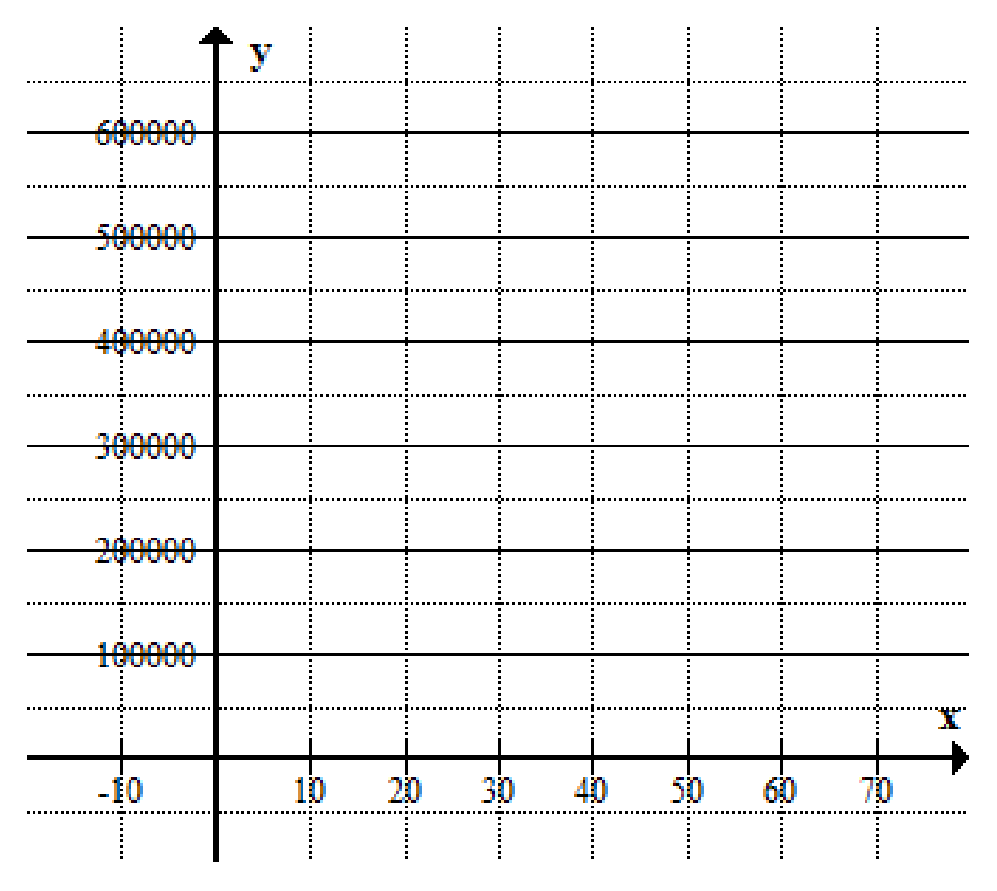
Coordinate grid for population against years after 1972

Worked solution

Question 52 mark scheme

(a)

253250 (accept 253000)

(b)

1972→20021972\rightarrow2002 is 30 years, increase of 1.3%→1.0131.3\%\rightarrow1.013

368000 (accept 368318)

(c)

250000×1.013n>400000250000\times1.013^n>400000

EITHER by GDC-SolveN or Graph

OR ⇒1.013n>40/25⇒1.013n>1.6\Rightarrow1.013^n>40/25\Rightarrow1.013^n>1.6

⇒nlog⁡1.013>log⁡1.6⇒n>log⁡1.6/log⁡1.013⇒n>36.4\Rightarrow n\log1.013>\log1.6\Rightarrow n>\log1.6/\log1.013\Rightarrow n>36.4

Use the mark scheme after attempting the question yourself.

Question 53

MildNo calculator
[Maximum mark: 4]

A population of bacteria is growing at the rate of 2.3% per minute. How long will it take for the size of the population to double? Give your answer to the nearest minute.

Extra question

Sketch a graph of Population bacteria (b) in terms of minutes (t)

Show the information found above

Worked solution

Question 53 mark scheme

1.023t=21.023^t=2 EITHER GDC-SolveN

OR t=ln⁡2ln⁡1.023=30.48…t=\dfrac{\ln2}{\ln1.023}=30.48\ldots

30 minutes (nearest minute) Note: Do not accept 31 minutes.

Use the mark scheme after attempting the question yourself.

Question 54

MildNo calculator
[Maximum mark: 4]

Each year for the past five years the population of a certain country has increased at a steady rate of 2.7% per annum. The present population is 15.2 million.

(a) What was the population one year ago?[2]

(b) What was the population five years ago?[2]

Extra question

Sketch a graph of Population (P) in millions in terms of years (t)

Show the information found in questions (a) and (b)

Worked solution

Question 54 mark scheme

(a)

15.21.027=14.8\dfrac{15.2}{1.027}=14.8 million, (OR 15.2(1.027)−115.2(1.027)^{-1}

(b)

15.2(1.027)5=13.3\dfrac{15.2}{(1.027)^5}=13.3 million (OR 15.2(1.027)−515.2(1.027)^{-5}

Use the mark scheme after attempting the question yourself.

Question 55

MediumNo calculator
[Maximum mark: 7]

An initial amount of $ 10 000 and an extra $ 10 000 at the end of each year are deposited into a savings account at an annual interest rate of 5%.

(a) Find the value of the investment

(i) at the end of the 1st year

(ii) at the end of the 2nd year

(iii) at the end of the 10th year[5]

(b) Find the least number of full years for the value of investment to exceed 200 000[2]

METHOD A: By using the formula of FV

METHOD B: By using GDC - Financial mode

Extra question

Explain why the value of the investment at the end of the nthn^{\text{th}} year is given by

FV=10000×(1.05n+1−10.05)FV=10000\times\left(\dfrac{1.05^{n+1}-1}{0.05}\right)

[if last payment is not included we subtract 10000]

Worked solution

Question 55 mark scheme

(a)

METHOD A: By using the formulas

(i) 10000(1.05)+10000=2050010000(1.05)+10000=20500

(ii) 10000(1.05)2+10000(1.05)+10000=3152510000(1.05)^2+10000(1.05)+10000=31525

(iii) 10000(1.0511−11.05−1)=142067.8710000\left(\dfrac{1.05^{11}-1}{1.05-1}\right)=142067.87

[if the last payment is not included we subtract 10000 from each result]

METHOD B: By using GDC-financial mode

I%=5, PV=−10000, PMT=−10000, P/Y=1, C/Y=1.\mathrm{I}\%=5,\ \mathrm{PV}=-10000,\ \mathrm{PMT}=-10000,\ \mathrm{P/Y}=1,\ \mathrm{C/Y}=1.

(i) Set n=1n=1 then FV gives 20500

(ii) Set n=2n=2 then FV gives 31525

(iii) Set n=10n=10 then FV gives 142067.87

[if the last payment is not included we subtract 10000 from each result]

(b)

By using GDC-financial mode FV=200000\mathrm{FV}=200000 gives n=13.2n=13.2 so n=14n=14

(c)
The 1st 10000 runs for nn yearsFV1=10000×1.05nFV_1=10000\times1.05^n
The 2nd 10000 runs for n−1n-1 yearsFV2=10000×1.05n−1FV_2=10000\times1.05^{n-1}
…
The last but one 10000 runs for 1 yearFVn=10000×1.051FV_n=10000\times1.05^1
The last payment is 10000FVn+1=10000FV_{n+1}=10000

The total sum is 10000(1+1.05+1.052+1.053+…+1.05n)=10000×(1.05n+1−11.05−1)10000(1+1.05+1.05^2+1.05^3+\ldots+1.05^n)=10000\times\left(\dfrac{1.05^{n+1}-1}{1.05-1}\right)

[if the last payment is not included we subtract 10000 the result]

Use the mark scheme after attempting the question yourself.

Question 56

MediumNo calculator
[Maximum mark: 7]

An amount of $10 000 is deposited into a savings account at an annual interest rate of 5%. An extra amount of $ 1 000 is deposited at the end of each year.

(a) Find the value of the investment

(i) at the end of the 1st year

(ii) at the end of the 2nd year

(iii) at the end of the 10th year[5]

(b) Find the least number of full years for the value of investment to exceed 50 000[2]

METHOD A: By using the formula of FV

METHOD B: By using GDC - Financial mode

Extra question

Explain why the value of the investment at the end of the nthn^{\text{th}} year is given by

FV=10000×1.05n+1000×(1.05n−10.05)FV=10000\times1.05^n+1000\times\left(\dfrac{1.05^n-1}{0.05}\right)

[if last payment is not included we subtract 1000]

Worked solution

Question 56 mark scheme

(a)

METHOD A: By using the formulas

(i) 10000(1.05)+1000=1150010000(1.05)+1000=11500

(ii) 10000×1.052+[1000×1.05+1000]=1307510000\times1.05^2+[1000\times1.05+1000]=13075

(iii) 10000×1.0510+1000×(1.0510−11.05−1)=28866.8410000\times1.05^{10}+1000\times\left(\dfrac{1.05^{10}-1}{1.05-1}\right)=28866.84

[if the last payment is not included we subtract 1000 from each result]

METHOD B: By using GDC: financial

I%=5, PV=−10000, PMT=−1000, P/Y=1, C/Y=1.\mathrm{I}\%=5,\ \mathrm{PV}=-10000,\ \mathrm{PMT}=-1000,\ \mathrm{P/Y}=1,\ \mathrm{C/Y}=1.

(i) Set n=1n=1 then FV gives 11500

(ii) Set n=2n=2 then FV gives 13075

(iii) Set n=10n=10 then FV gives 28866.84

[if the last payment is not included we subtract 1000 from each result]

(b)

By using GDC: financial FV=50000\mathrm{FV}=50000 gives n=17.36n=17.36 so n=18n=18

(c)
The 1st 10000 runs for nn years10000×1.05n10000\times1.05^n
The 1st 1000 runs for n−1n-1 years1000×1.05n−11000\times1.05^{n-1}
…
The last but one 1000 runs for 1 year1000×1.0511000\times1.05^1
The last payment is 100010001000

Sum of the last nn terms =1000(1+1.05+1.052+1.053+…+1.05n−1)=1000×(1.05n−11.05−1)=1000(1+1.05+1.05^2+1.05^3+\ldots+1.05^{n-1})=1000\times\left(\dfrac{1.05^n-1}{1.05-1}\right)

FV=10000×1.05n+1000×(1.05n−10.05)FV=10000\times1.05^n+1000\times\left(\dfrac{1.05^n-1}{0.05}\right)

[if the last payment is not included we subtract 10000 the result]

Use the mark scheme after attempting the question yourself.

Question 57

MediumNo calculator
[Maximum mark: 6]

$1000 is invested at the beginning of each year for 10 years.

The rate of interest is fixed at 7.5% per annum. Interest is compounded annually.

Calculate, giving your answers to the nearest dollar

(a) how much the first $1000 is worth at the end of the ten years;[2]

(b) the total value of the investments at the end of the ten years.[4]

Worked solution

Question 57 mark scheme

(a)

$ 1000×1.07510=1000\times1.075^{10}= $ 2061 (nearest dollar)

(b)

1000(1.07510+1.0759+…+1.075)=1000(1.075)(1.07510−1)1.075−1=1000(1.075^{10}+1.075^9+\ldots+1.075)=\dfrac{1000(1.075)(1.075^{10}-1)}{1.075-1}= $ 15 208 (nearest dollar)

Use the mark scheme after attempting the question yourself.

Question 58

MildNo calculator
[Maximum mark: 8]

Consider the geometric sequence 10,20,40,80,…10,20,40,80,\ldots

(a) Write down the first term u1u_1 and the common ratio rr.[1]

(b) Find the 10th term of the sequence.[2]

(c) Find the sum of the first 10 terms.[2]

(d) Express the general term unu_n in terms of nn.[1]

(e) Hence find the value of nn given that un=20480u_n=20480[2]

Worked solution

Question 58 mark scheme

(a)

u1=10u_1=10, r=2r=2

(b)

51205120

(c)

1023010230

(d)

10×2n−110\times2^{n-1} (=5×2n)(=5\times2^n)

(e)

n=12n=12

Use the mark scheme after attempting the question yourself.

Question 59

MildNo calculator
[Maximum mark: 8]

Consider the geometric sequence 10,5,2.5,1.25,…10,5,2.5,1.25,\ldots

(a) Write down the first term u1u_1 and the common ratio rr.[1]

(b) Find the 10th term of the sequence.[2]

(c) Find the sum of the first 10 terms.[2]

(d) Express the general term unu_n in terms of nn.[1]

(e) Hence find the value of nn given that un=0.3125u_n=0.3125[2]

Worked solution

Question 59 mark scheme

(a)

u1=10u_1=10, r=0.5r=0.5

(b)

0.01950.0195

(c)

19.9819.98

(d)

10×0.5n−110\times0.5^{n-1} (=20×0.5n)(=20\times0.5^n)

(e)

n=6n=6

Use the mark scheme after attempting the question yourself.

Question 60

MildNo calculator
[Maximum mark: 6]

The first four terms of a sequence are 18,54,162,48618,54,162,486.

(a) Use all four terms to show that this is a geometric sequence.[2]

(b) (i) Find an expression for the nnth term of this geometric sequence.

(ii) If the nnth term of the sequence is 1062 8821062\,882, find the value of nn.[4]

Worked solution

Question 60 mark scheme

(a)

5418=16254=486162\frac{54}{18}=\frac{162}{54}=\frac{486}{162} (=3)(=3)

(b)

(i) r=3r=3

un=18×3n−1u_n=18\times3^{n-1}

(ii) 18×3n−1=106288218\times3^{n-1}=1062882

n=11n=11

Use the mark scheme after attempting the question yourself.

Question 61

MildNo calculator
[Maximum mark: 6]

Let un=3×2nu_n=3\times2^n.

(a) Write down the value of u1u_1, u2u_2, and u3u_3.[3]

(b) Express ∑n=13(3×2n)\displaystyle\sum_{n=1}^{3}(3\times2^n) as a sum of three terms and find the result.[2]

(c) Find ∑n=112(3×2n)\displaystyle\sum_{n=1}^{12}(3\times2^n).[1]

Worked solution

Question 61 mark scheme

(a)

6,12,246,12,24

(b)

∑n=13(3×2n)=6+12+24=42\displaystyle\sum_{n=1}^{3}(3\times2^n)=6+12+24=42

(c)

∑n=112(3×2n)=24570\displaystyle\sum_{n=1}^{12}(3\times2^n)=24570.

Use the mark scheme after attempting the question yourself.

Question 62

MildNo calculator
[Maximum mark: 6]

Consider the geometric sequence 8,a,2,…8,a,2,\ldots for which the common ratio is 12\frac12.

(a) Find the value of aa.[1]

(b) Find the value of the eighth term.[2]

(c) Find the sum of the first twelve terms.[3]

Worked solution

Question 62 mark scheme

(a)

a8=12⇔a=4\frac{a}{8}=\frac12\Leftrightarrow a=4

OR

2a=12⇔a=4\frac2a=\frac12\Leftrightarrow a=4

(b)

8(12)7=0.06258\left(\frac12\right)^7=0.0625

(c)

8((12)12−1)12−1=16.0\displaystyle\frac{8\left(\left(\frac12\right)^{12}-1\right)}{\frac12-1}=16.0 (3 s.f.) (=4095/256)(=4095/256)

Use the mark scheme after attempting the question yourself.

Question 63

MildNo calculator
[Maximum mark: 6]

Consider the geometric sequence 16,8,a,2,b,…16,8,a,2,b,\ldots

(a) Write down the common ratio.[1]

(b) Write down the value of

(i) aa;

(ii) bb.[2]

(c) The sum of the first nn terms is 31.937531.9375. Find the value of nn.[3]

Worked solution

Question 63 mark scheme

(a)

0.50.5 (12)\left(\frac12\right)

(b)

(i) a=4a=4

(ii) b=1b=1

(c)

16(1−0.5n)(1−0.5)=31.9375\displaystyle\frac{16(1-0.5^n)}{(1-0.5)}=31.9375

n=9n=9

Use the mark scheme after attempting the question yourself.

Question 64

MildNo calculator
[Maximum mark: 6]

A geometric sequence has all its terms positive. The 1st term is 77 and the 3rd term is 2828.

(a) Find the common ratio.[3]

(b) Find the sum of the first 14 terms.[3]

Worked solution

Question 64 mark scheme

(a)

28=7r228=7r^2

r=2r=2

(b)

114681114681

Use the mark scheme after attempting the question yourself.

Question 65

MildNo calculator
[Maximum mark: 6]

The seventh term, u7u_7, of a geometric sequence is 108108. The eighth term, u8u_8, of the sequence is 3636.

(a) Write down the common ratio of the sequence.[1]

(b) Find u1u_1.[2]

The sum of the first kk terms in the sequence is 118 096118\,096.

(c) Find the value of kk.[3]

Worked solution

Question 65 mark scheme

(a)

r=36108r=\frac{36}{108} (13)\left(\frac13\right)

(b)

u1(13)7=36u_1\left(\frac13\right)^7=36

u1=78732u_1=78732

(c)

118096=78732(1−(13)k)(1−13)\displaystyle118096=\frac{78732\left(1-\left(\frac13\right)^k\right)}{\left(1-\frac13\right)}

k=10k=10

Use the mark scheme after attempting the question yourself.

Question 66

MildNo calculator
[Maximum mark: 6]

Consider the infinite geometric sequence

3000,−1800,1080,−648,… .3000,-1800,1080,-648,\ldots\ .

(a) Find the common ratio.[2]

(b) Find the 10th term.[2]

(c) Find the sum of the first 10 terms correct to 2 decimal places.

Worked solution

Question 66 mark scheme

(a)

−18003000=−0.6\frac{-1800}{3000}=-0.6

(b)

u10=3000(−0.6)9=−30.2u_{10}=3000(-0.6)^9=-30.2 (accept the exact value −30.233088-30.233088)

(c)

S=1863.66S=1863.66

Use the mark scheme after attempting the question yourself.

Question 67

MildNo calculator
[Maximum mark: 6]

A geometric sequence has a first term of 22 and a common ratio of 1.051.05.

Find the value of the smallest term that is greater than 500500.

Worked solution

Question 67 mark scheme

2×1.05n−1>5002\times1.05^{n-1}>500 so 1.05n−1>2501.05^{n-1}>250

METHOD A: Trial and error;

The smallest integer that satisfies the inequality is n=115n=115. Then u115=521u_{115}=521

METHOD B: By using GDC SolveN or Graphical solution

The smallest integer that satisfies the inequality is n=115n=115. Then u115=521u_{115}=521

METHOD C: Using logarithms;

n−1>log⁡250log⁡1.05⇔n−1>113.1675…n-1>\frac{\log250}{\log1.05}\Leftrightarrow n-1>113.1675\ldots so n=115n=115. Then u115=521u_{115}=521

Use the mark scheme after attempting the question yourself.

Question 68

MildNo calculator
[Maximum mark: 8]

The first term of a geometric sequence is 55 while the fourth term is 4040. Find

(a) Find the common ratio rr.[2]

(b) Find the fifth term.[1]

(c) Find the sum of the first ten terms.[2]

(d) Fins the smallest value of nn given that the nn-th term exceeds 10001000.[2]

(e) Find the first term that exceeds 10001000.[1]

Worked solution

Question 68 mark scheme

(a)

22

(b)

8080

(c)

51155115

(d)

99

(e)

12801280

Use the mark scheme after attempting the question yourself.

Question 69

MildNo calculator
[Maximum mark: 8]

The first term of a geometric sequence is 500500 while the fourth term is 62.562.5. Find

(a) Find the common ratio rr.[2]

(b) Find the fifth term.[1]

(c) Find the sum of the first ten terms correct to 3 decimal places.

(d) Find the smallest value of nn given that the nn-th term is less than 1010.[2]

(e) Find the first term which is less than 1010.[1]

Worked solution

Question 69 mark scheme

(a)

0.50.5

(b)

31.2531.25

(c)

999.023999.023

(d)

77

(e)

7.81257.8125

Use the mark scheme after attempting the question yourself.

Question 70

MediumNo calculator
[Maximum mark: 8]

In a geometric series, u1=181u_1=\frac1{81} and u4=13u_4=\frac13.

(a) Find the value of rr.[3]

(b) Find the smallest value of nn for which Sn>40S_n>40.[3]

(c) Confirm the result in (b) by finding the appropriate consecutive sums.[2]

Worked solution

Question 70 mark scheme

(a)

u4=u1r3⇔181r3=13⇔r=3u_4=u_1r^3\Leftrightarrow\frac1{81}r^3=\frac13\Leftrightarrow r=3

(b)

181(3n−1)2>40;⇔n>7.9888…\displaystyle\frac{\frac1{81}(3^n-1)}{2}>40;\Leftrightarrow n>7.9888\ldots So n=8n=8

(c)

if n=7n=7, S7=13.49…S_7=13.49\ldots; if n=8n=8, S8=40.49…S_8=40.49\ldots which is >40>40

Use the mark scheme after attempting the question yourself.

Question 71

MediumNo calculator
[Maximum mark: 9]

A geometric sequence has second term 1212 and fifth term 324324.

(a) Calculate the value of the common ratio.[3]

(b) Calculate the 10th term of this sequence.[3]

(c) The kkth term is the first term that is greater than 20002000. Find the value of kk.[3]

Worked solution

Question 71 mark scheme

(a)

u1r4=324⇔u1r=12⇔r3=27⇔r=3u_1r^4=324\Leftrightarrow u_1r=12\Leftrightarrow r^3=27\Leftrightarrow r=3

(b)

4×39=787324\times3^9=78732 or 12×38=7873212\times3^8=78732

(c)

4×3k−1>20004\times3^{k-1}>2000

k>6k>6, So k=7k=7

Use the mark scheme after attempting the question yourself.

Question 72

MediumNo calculator
[Maximum mark: 9]

A geometric sequence has first term u1u_1 and common ratio rr. Find the values of u1u_1 and of rr in each of the following cases:

(a) if u7=3645u_7=3645 and u10=98415u_{10}=98415[3]

(b) if u7=98415u_7=98415 and u10=3645u_{10}=3645[3]

(c) if S2=20S_2=20 and S4=200S_4=200[3]

Worked solution

Question 72 mark scheme

(a)

r=3r=3, u1=5u_1=5

(b)

r=13r=\frac13, u1=71,744,535u_1=71,744,535

(c)

r=3r=3, u1=5u_1=5 OR r=−3r=-3, u1=−5u_1=-5

Use the mark scheme after attempting the question yourself.

Question 73

MediumNo calculator
[Maximum mark: 6]

Let 5,x,45,y5,x,45,y be consecutive terms of a geometric sequence.

(a) Find the possible values of xx.[3]

(b) Hence find the possible values of yy.[3]

Worked solution

Question 73 mark scheme

(a)

x5=45x⇔x2=225⇔x=15\frac{x}{5}=\frac{45}{x}\Leftrightarrow x^2=225\Leftrightarrow x=15 or x=−15x=-15

(b)

if x=15x=15, then y=135y=135, if x=−15x=-15, then y=−135y=-135

Use the mark scheme after attempting the question yourself.

Question 74

MediumNo calculator
[Maximum mark: 8]

Let k,2k,k+60k,2k,k+60 be consecutive terms of a sequence. Find the value of kk

(a) if the sequence is arithmetic.[3]

(b) if the sequence is geometric.[3]

(c) Confirm the results (a) and (b).[2]

Worked solution

Question 74 mark scheme

(a)

2k−k=k+60−2k⇔2k=60⇔k=302k-k=k+60-2k\Leftrightarrow2k=60\Leftrightarrow k=30

(b)

2kk=k+602k⇔2=k+602k⇔4k=k+60⇔3k=60⇔k=20\frac{2k}{k}=\frac{k+60}{2k}\Leftrightarrow2=\frac{k+60}{2k}\Leftrightarrow4k=k+60\Leftrightarrow3k=60\Leftrightarrow k=20

(c)

For k=30k=30 the sequence is 30,60,9030,60,90 (arithmetic with d=30d=30)

For k=20k=20 the sequence is 20,40,8020,40,80 (geometric with r=2r=2)

Use the mark scheme after attempting the question yourself.

Question 75

MediumNo calculator
[Maximum mark: 6]

The three terms a,1,ba,1,b are in arithmetic progression. The three terms 1,a,b1,a,b are in geometric progression. Find the value of aa and of bb given that a≠ba\ne b.

Worked solution

Question 75 mark scheme

1−a=b−11-a=b-1 and b=a2⇔a2+a−2=0⇔a=−2b=a^2\Leftrightarrow a^2+a-2=0\Leftrightarrow a=-2, b=4b=4

Use the mark scheme after attempting the question yourself.

Question 76

MediumNo calculator
[Maximum mark: 7]

(a) The first term of an arithmetic sequence is −16-16 and the eleventh term is 3939. Calculate the value of the common difference.[3]

(b) The third term of a geometric sequence is 1212 and the fifth term is 163\frac{16}{3}. All the terms in the sequence are positive. Calculate the value of the common ratio.[4]

Worked solution

Question 76 mark scheme

(a)

u11=u1+10d⇔−16+10d=39⇔10d=55⇔d=5.5u_{11}=u_1+10d\Leftrightarrow-16+10d=39\Leftrightarrow10d=55\Leftrightarrow d=5.5

(b)

u3=u1r2⇔u1r2=12u_3=u_1r^2\Leftrightarrow u_1r^2=12

u5=u1r4⇔u1r4=163u_5=u_1r^4\Leftrightarrow u_1r^4=\frac{16}{3}

r2=(163)12=1636=49⇔r=23r^2=\frac{\left(\frac{16}{3}\right)}{12}=\frac{16}{36}=\frac49\Leftrightarrow r=\frac23

Use the mark scheme after attempting the question yourself.

Question 77

MediumNo calculator
[Maximum mark: 8]

The first term of an arithmetic sequence is 00 and the common difference is 1212.

(a) Find the value of the 96th term of the sequence. [2[

The first term of a geometric sequence is 66. The 6th term of the geometric sequence is equal to the 17th term of the arithmetic sequence given above.

(b) Write down an equation using this information and hence calculate the common ratio of the geometric sequence.[3]

The nn-th term of the arithmetic sequence is equal to the nn-th term of the geometric sequence above.

(c) Find the possible value of nn.[3]

Worked solution

Question 77 mark scheme

(a)

u96=u1+95d=0+95×12=1140u_{96}=u_1+95d=0+95\times12=1140

(b)

6r5=16d⇔6r5=16×12⇔6r5=1926r^5=16d\Leftrightarrow6r^5=16\times12\Leftrightarrow6r^5=192

(c)

r5=32⇔r=2r^5=32\Leftrightarrow r=2

(d)

0+(n−1)×12=6×2n−1⇔n=20+(n-1)\times12=6\times2^{n-1}\Leftrightarrow n=2 or n=3n=3

(Indeed, the 2nd term of each sequence is 12, the 3rd term of each sequence is 24)

Use the mark scheme after attempting the question yourself.

Question 78

MildNo calculator
[Maximum mark: 6]

The annual fees paid to a school for the school years 2000, 2001 and 2002 increase as a geometric progression. The table below shows the fee structure.

Year Fees (USD)
2000 8000.00
2001 8320.00
2002 8652.80

(a) Calculate the common ratio for the increasing sequence of fees.[2]

In parts (b) and (c) give your answer correct to 2 decimal places.

The fees continue to increase in the same ratio.

(b) Find the fees paid for 2006.[2]

A student attends the school for eight years, starting in 2000.

(c) Find the total fees paid for these eight years.[2]

Worked solution

Question 78 mark scheme

(a)

r=83208000⇔r=1.04r=\frac{8320}{8000}\Leftrightarrow r=1.04

(b)

Fees =8000(1.04)6=10122.55=8000(1.04)^6=10122.55 USD (USD not required)

(c)

Total =8000(1.048−1)1.04−1=73713.81=\frac{8000(1.04^8-1)}{1.04-1}=73713.81 USD (USD not required)

Financial penalty (FP) for no 2 dp applies in parts (b) and (c)

Use the mark scheme after attempting the question yourself.

Question 79

MediumNo calculator
[Maximum mark: 10]

Ann and John go to a swimming pool.

They both swim the first length of the pool in 2 minutes.

The time John takes to swim a length is 6 seconds more than he took to swim the previous length.

The time Ann takes to swim a length is 1.05 times that she took to swim the previous length.

(a) (i) Find the time John takes to swim the third length.

(ii) Show that Ann takes 2.205 minutes to swim the third length.[3]

(b) Find the time taken for Ann to swim a total of 10 lengths of the pool.[3]

(c) Find the time taken for John to swim a total of 10 lengths of the pool.[4]

Worked solution

Question 79 mark scheme

(a)

(i) 2 minutes + 6 seconds + 6 seconds = 2 minutes 12 seconds

(or 2.2 minutes)

(ii) 2(1.05)2=2.2052(1.05)^2=2.205

(b)

S10=2(1.0510−1)(1.05−1)=25.2S_{10}=\frac{2(1.05^{10}-1)}{(1.05-1)}=25.2 minutes (or 25 minutes 12 seconds)

(c)

the common difference for John is 6 seconds = 0.1 minutes

S10=102(2×2+9×0.1)=24.5S_{10}=\frac{10}{2}(2\times2+9\times0.1)=24.5 minutes

(or 24 minutes 30 seconds)

Use the mark scheme after attempting the question yourself.

Question 80

MildNo calculator
[Maximum mark: 4]

The tuition fees for the first three years of high school are given in the table below.

Year Tuition fees (in dollars)
1 2000
2 2500
3 3125

These tuition fees form a geometric sequence.

(a) Find the common ratio, rr, for this sequence.[2]

(b) If fees continue to rise at the same rate, calculate (to the nearest dollar) the total cost of tuition fees for the first six years of high school.[2]

Worked solution

Question 80 mark scheme

(a)

r=25002000=1.25r=\frac{2500}{2000}=1.25

(b)

S6=2000(1.256−1)1.25−1=22517.57813……=22518S_6=\frac{2000(1.25^6-1)}{1.25-1}=22517.57813\ldots\ldots=22518 (to the nearest dollar)

Use the mark scheme after attempting the question yourself.

Question 81

MildNo calculator
[Maximum mark: 5]

The population of Bangor is growing each year. At the end of 1996, the population was 40 000. At the end of 1998, the population was 44 100. Assuming that these annual figures follow a geometric progression, calculate

(a) the population of Bangor at the end of 1997;[2]

(b) the population of Bangor at the end of 1992.[3]

Worked solution

Question 81 mark scheme

(a)

Let the population at the end of 1999 be xx.

44100x=x40000⇔x=42 000\frac{44100}{x}=\frac{x}{40000}\Leftrightarrow x=42\,000

(b)

r=4410042000=1.05r=\frac{44100}{42000}=1.05

un=u1rn−1u_n=u_1r^{n-1}

METHOD A

Assume that u1u_1 if for 1992 and u5=40 000u_5=40\,000 is for 1996

40 000=u1(1.05)440\,000=u_1(1.05)^4

u1=32 908u_1=32\,908 (or 32 90032\,900 to 3 s.f.)

METHOD B

For 4 years before 1996 we divide 40 00040\,000 by (1.05)4(1.05)^4

40000(1.05)4=32908\frac{40000}{(1.05)^4}=32908

Use the mark scheme after attempting the question yourself.

Question 82

MediumCalculator
[Maximum mark: 11]

Portable telephones are first sold in the country Cellmania in 1990. During 1990, the number of units sold is 160. In 1991, the number of units sold is 240 and in 1992, the number of units sold is 360.

In 1993 it was noticed that the annual sales formed a geometric sequence with first term 160, the 2nd and 3rd terms being 240 and 360 respectively.

(a) What is the common ratio of this sequence?[1]

Assume that this trend in sales continues.

(b) How many units will be sold during 2002?[3]

(c) In what year does the number of units sold first exceed 5000?[4]

Between 1990 and 1992, the total number of units sold is 760.

(d) What is the total number of units sold between 1990 and 2002?[2]

During this period, the total population of Cellmania remains approximately 80 000.

(e) Use this information to suggest a reason why the geometric growth in sales would not continue.[1]

Worked solution

Question 82 mark scheme

r=360240=240160=32=1.5r=\frac{360}{240}=\frac{240}{160}=\frac32=1.5

(b)

2002 is the 13th year.

u13=160(1.5)13−1=20759u_{13}=160(1.5)^{13-1}=20759 (Accept 20760 or 20800.)

(c)

5000=160(1.5)n−15000=160(1.5)^{n-1}

5000160=(1.5)n−1⇒n=9.49⇒10th year⇒1999\frac{5000}{160}=(1.5)^{n-1}\Rightarrow n=9.49\Rightarrow10\text{th year}\Rightarrow1999

OR

Using a gdc recursion with u1=160u_1=160, uk+1=32uku_{k+1}=\frac32u_k, u9=4100u_9=4100, u10=6150u_{10}=6150 So 1999

(d)

S13=160[1.513−11.5−1]=61958S_{13}=160\left[\frac{1.5^{13}-1}{1.5-1}\right]=61958 (Accept 61960 or 62 000)

(e)

Nearly everyone would have bought a portable telephone so there would be fewer people left wanting to buy one.

OR Sales would saturate.

Use the mark scheme after attempting the question yourself.

Question 83

MediumCalculator
[Maximum mark: 12]

(a) Consider the geometric sequence −3,6,−12,24,…-3,6,-12,24,\ldots.

(i) Write down the common ratio.

(ii) Find the 15th term.[3]

Consider the sequence x−3,x+1,2x+8,…x-3,x+1,2x+8,\ldots.

(b) When x=5x=5, the sequence is geometric.

(i) Write down the first three terms.

(ii) Find the common ratio.[2]

(c) Find the other value of xx for which the sequence is geometric.[4]

(d) For this value of xx,

(i) write down the first three terms of the geometric sequence.

(ii) find the common ratio of the geometric sequence.[3]

Worked solution

Question 83 mark scheme

(a)

(i) r=−2r=-2

(ii) u15=−3(−2)14=−49152u_{15}=-3(-2)^{14}=-49152 (accept −49200-49200)

(b)

(i) 2,6,182,6,18

(ii) r=3r=3

(c)

x+1x−3=2x+8x+1⇔x2+2x+1=2x2+2x−24⇔x2=25⇔x=5\frac{x+1}{x-3}=\frac{2x+8}{x+1}\Leftrightarrow x^2+2x+1=2x^2+2x-24\Leftrightarrow x^2=25\Leftrightarrow x=5 or x=−5x=-5

So x=−5x=-5

(d)

(i) −8,−4,−2-8,-4,-2

(ii) r=12r=\frac12

Use the mark scheme after attempting the question yourself.

Question 84

MediumCalculator
[Maximum mark: 10]

A geometric progression G1G_1 has 11 as its first term and 33 as its common ratio.

(a) The sum of the first nn terms of G1G_1 is 29 52429\,524. Find nn.[3]

A second geometric progression G2G_2 has the form 1,13,19,127…1,\frac13,\frac19,\frac1{27}\ldots

(b) State the common ratio for G2G_2.[1]

(c) Calculate the sum of the first 10 terms of G2G_2.[2]

(d) Explain why the sum of the first 1000 terms of G2G_2 will give the same answer as the sum of the first 10 terms, when corrected to three significant figures.[1]

(e) Using your results from parts (a) to (c), or otherwise, calculate the sum of the first 10 terms of the sequence 2,313,919,27127…2,3\frac13,9\frac19,27\frac1{27}\ldots

Give your answer correct to one decimal place.[3]

Worked solution

Question 84 mark scheme

(a)

1−3n1−3=29 524⇔n=10\frac{1-3^n}{1-3}=29\,524\Leftrightarrow n=10.

(b)

Common ratio is 13\frac13, (0.333(3 s.f.)

(c)

1−(13)101−13=1.50\displaystyle\frac{1-\left(\frac13\right)^{10}}{1-\frac13}=1.50 (3s.f.)

(d)

Both (13)10\left(\frac13\right)^{10} and (13)1000\left(\frac13\right)^{1000} (or those numbers divided by 2/3) are 0 when corrected to 3s.f., so they make no difference to the final answer.

Notes: Accept any valid explanation

(e)

The sequence given is G1+G2G_1+G_2

The sum is 29 524+1.50=29 525.529\,524+1.50=29\,525.5

Use the mark scheme after attempting the question yourself.

Question 85

MediumCalculator
[Maximum mark: 12]

A geometric sequence has 10241024 as its first term and 128128 as its fourth term.

(a) Show that the common ratio is 12\frac12.[2]

(b) Find the value of the eleventh term.[2]

(c) Find the sum of the first eight terms.[2]

(d) Find the number of terms in the sequence for which the sum first exceeds 2047.9682047.968.[4]

(e) Confirm the result in (d) by finding the appropriate sums.[2]

Worked solution

Question 85 mark scheme

(a)

1024r3=128⇔r3=18⇔r=12=0.51024r^3=128\Leftrightarrow r^3=\frac18\Leftrightarrow r=\frac12=0.5

(b)

1024×0.510=11024\times0.5^{10}=1

(c)

S8=1024(1−(12)8)1−12=2040\displaystyle S_8=\frac{1024\left(1-\left(\frac12\right)^8\right)}{1-\frac12}=2040

(d)

1024(1−(12)n)1−12>2047.968\displaystyle\frac{1024\left(1-\left(\frac12\right)^n\right)}{1-\frac12}>2047.968

n=16n=16

(e)

S15=2047.9375S_{15}=2047.9375

S16=2047.96875S_{16}=2047.96875

So n=16n=16

Use the mark scheme after attempting the question yourself.

Question 86

MediumCalculator
[Maximum mark: 12]

A National Lottery is offering prizes in a new competition. The winner may choose one of the following.

Option one: $1000 each week for 10 weeks.

Option two: $250 in the first week, $450 in the second week, $650 in the third week, increasing by $200 each week for a total of 10 weeks.

Option three: $10 in the first week, $20 in the second week, $40 in the third week continuing to double for a total of 10 weeks.

(a) Calculate the amount you receive in the tenth week, if you select

(i) option two;

(ii) option three.[6]

(b) What is the total amount you receive if you select option two?[2]

(c) Which option has the greatest total value? Justify your answer by showing all appropriate calculations.[4]

Worked solution

Question 86 mark scheme

(a)

(i) T1=T_1=$250

d=d=$200

T10=250+9×200=2050T_{10}=250+9\times200=2050

(ii) T1=T_1=$10

r=2r=2

T10=10×29=5120T_{10}=10\times2^9=5120

(b)

S10=102(250+2050)=11500S_{10}=\frac{10}{2}(250+2050)=11500 OR S10=102{2×250+(10−1)×200}=11500S_{10}=\frac{10}{2}\{2\times250+(10-1)\times200\}=11500

(c)

Option One: $10000

Option Two: $11500

Option Three: S10=10(210−1)2−1=10 230S_{10}=\frac{10(2^{10}-1)}{2-1}=10\,230

Therefore, Option Two would be best.

Use the mark scheme after attempting the question yourself.

Question 87

MediumCalculator
[Maximum mark: 13]

An arithmetic sequence is defined as un=135+7nu_n=135+7n, n=1,2,3,…n=1,2,3,\ldots

(a) Calculate u1u_1, the first term in the sequence.[2]

(b) Show that the common difference is 7.[2]

SnS_n is the sum of the first nn terms of the sequence.

(c) Find an expression for SnS_n. Give your answer in the form Sn=An2+BnS_n=An^2+Bn, where AA and BB are constants.[3]

The first term, v1v_1, of a geometric sequence is 2020 and its fourth term v4v_4 is 67.567.5.

(d) Show that the common ratio, rr, of the geometric sequence is 1.51.5.[2]

TnT_n is the sum of the first nn terms of the geometric sequence.

(e) Calculate T7T_7, the sum of the first seven terms of the geometric sequence.[2]

(f) Use your GSC to find the smallest value of nn for which Tn>SnT_n>S_n.[2]

Worked solution

Question 87 mark scheme

(a)

u1=135+7(1)=142u_1=135+7(1)=142

(b)

u2=135+7(2)=149u_2=135+7(2)=149

d=149−142=7d=149-142=7 (OR alternatives)

(c)

Sn=n[2(142)+7(n−1)]2=n[277+7n]2=7n22+277n2S_n=\frac{n[2(142)+7(n-1)]}{2}=\frac{n[277+7n]}{2}=\frac{7n^2}{2}+\frac{277n}{2} (=3.5n2+138.5n)(=3.5n^2+138.5n)

(d)

20r3=67.5⇔r3=3.375⇔r=1.520r^3=67.5\Leftrightarrow r^3=3.375\Leftrightarrow r=1.5

(e)

T7=20(1.57−1)(1.5−1)=643T_7=\frac{20(1.5^7-1)}{(1.5-1)}=643 (accept 643.4375)

(f)

20(1.5n−1)(1.5−1)>7n22+277n2\frac{20(1.5^n-1)}{(1.5-1)}>\frac{7n^2}{2}+\frac{277n}{2}

n=10n=10

Use the mark scheme after attempting the question yourself.