Standard Level · Calculus

Introduction to calculus

Limits, derivatives rates of change concepts

DifficultyAll difficulties
Exam modePaper 1 & 2

Question 1

MildNo calculator
[Maximum mark: 4]

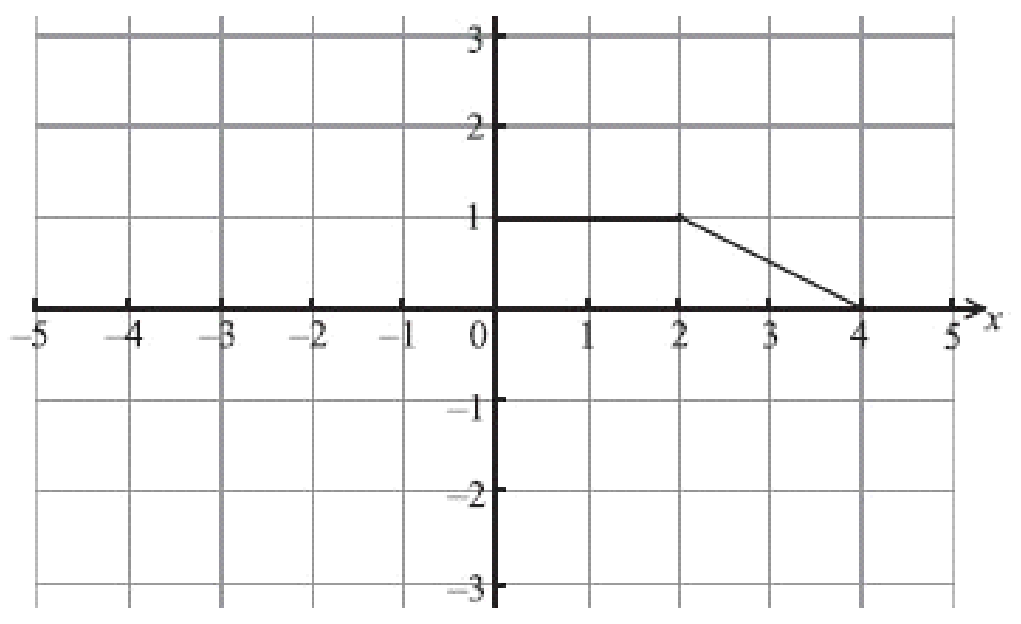
The graph of the function y=f(x)y=f(x), 0≤x≤40\leq x\leq4, is shown below.

Piecewise linear graph with a horizontal segment and a decreasing segment

(a) Write down the value of

(i) f(1)f(1)

(ii) f(3)f(3)

(b) Write down the value of

(i) f′(1)f'(1)

(ii) f′(3)f'(3)

Worked solution

Question 1 mark scheme

(a)

(i) 1

(ii) 0.5

(b)

(i) 0

(ii) −12-\dfrac12

Use the mark scheme after attempting the question yourself.

Question 2

MildNo calculator
[Maximum mark: 6]

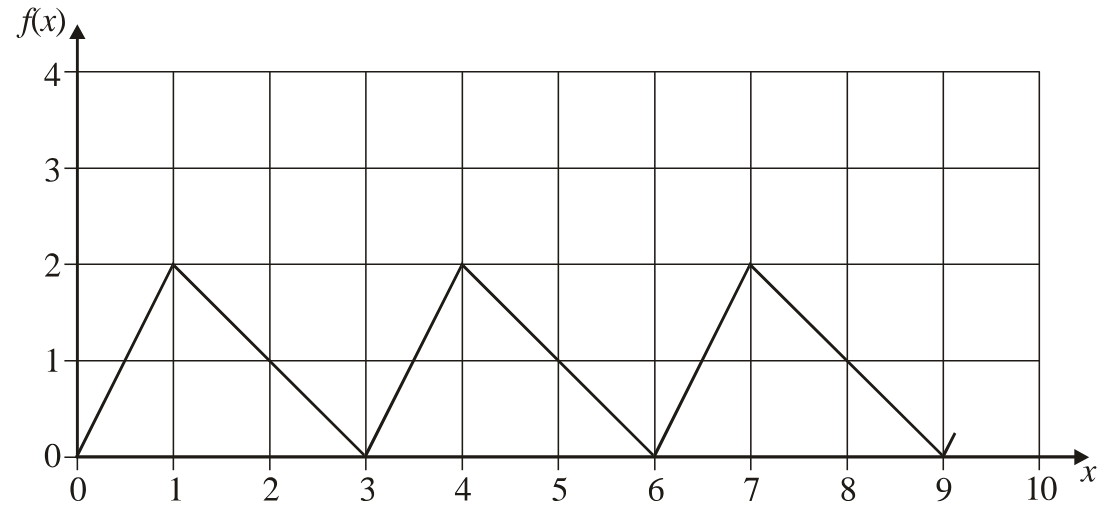
Part of the graph of the periodic function ff is shown below. The domain of ff is 0≤x≤150\leq x\leq15 and the period is 3.

Periodic piecewise linear graph with period 3

(a) Find

(i) f(2)f(2)

(ii) f′(6.5)f'(6.5)

(iii) f′(14)f'(14)

(b) How many solutions are there to the equation f(x)=1f(x)=1 over the given domain?

Worked solution

Question 2 mark scheme

(a)

(i) 1

(ii) 2

(iii) f′(14)=f′(2)f'(14)=f'(2) (or f′(5)f'(5) or f′(8)f'(8)) =−1=-1

(b)

There are five repeated periods of the graph, each with two solutions,

ie number of solutions is 5×2=105\times2=10

Use the mark scheme after attempting the question yourself.

Question 3

MildNo calculator
[Maximum mark: 5]

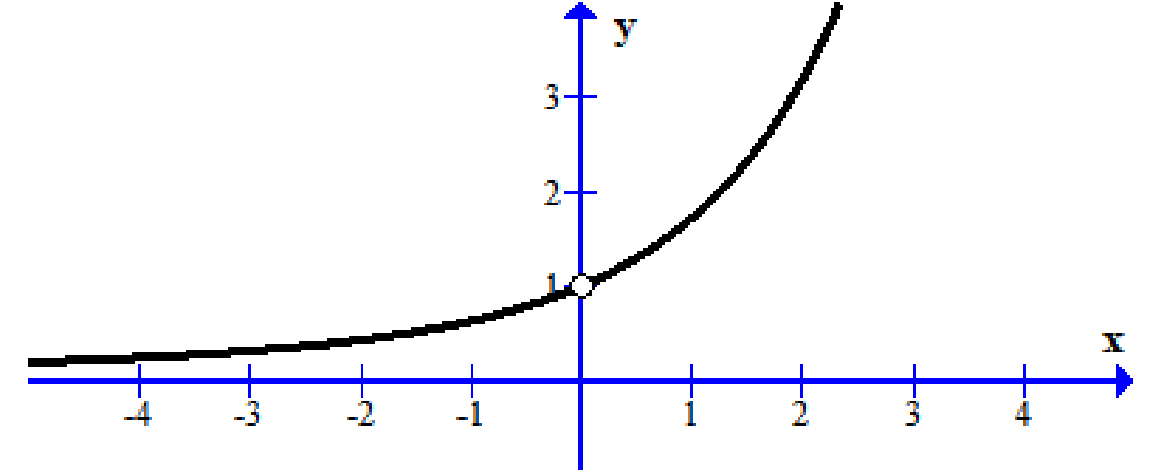
Part of the graph of f(x)=ex−1xf(x)=\dfrac{e^x-1}{x} is shown below. The function is not defined at x=0x=0.

Graph of f with an open point at x equals zero

(a) Complete the values of ff, correct to 4 decimal places, on the tables below:

For positive values of xx near 0 (i.e. 0+0^+)

xx f(x)f(x)
0.10.1
0.010.01
0.0010.001

For negative values of xx near 0 (i.e. 0−0^-)

xx f(x)f(x)
−0.1-0.1
−0.01-0.01
−0.001-0.001

[4]

(b) Deduce the value of the limit: lim⁡x→0ex−1x\displaystyle \lim_{x\to0}\dfrac{e^x-1}{x}[1]

Worked solution

Question 3 mark scheme

(a)

For positive values of xx near 0 (i.e. 0+0^+)

xx f(x)f(x)
0.10.1 1.05171.0517
0.010.01 1.00501.0050
0.0010.001 1.00051.0005

For negative values of xx near 0 (i.e. 0−0^-)

xx f(x)f(x)
−0.1-0.1 0.95160.9516
−0.01-0.01 0.99500.9950
−0.001-0.001 0.99950.9995
(b)

lim⁡x→0ex−1x=1\displaystyle \lim_{x\to0}\dfrac{e^x-1}{x}=1

Use the mark scheme after attempting the question yourself.

Question 4

MediumNo calculator
[Maximum mark: 7]

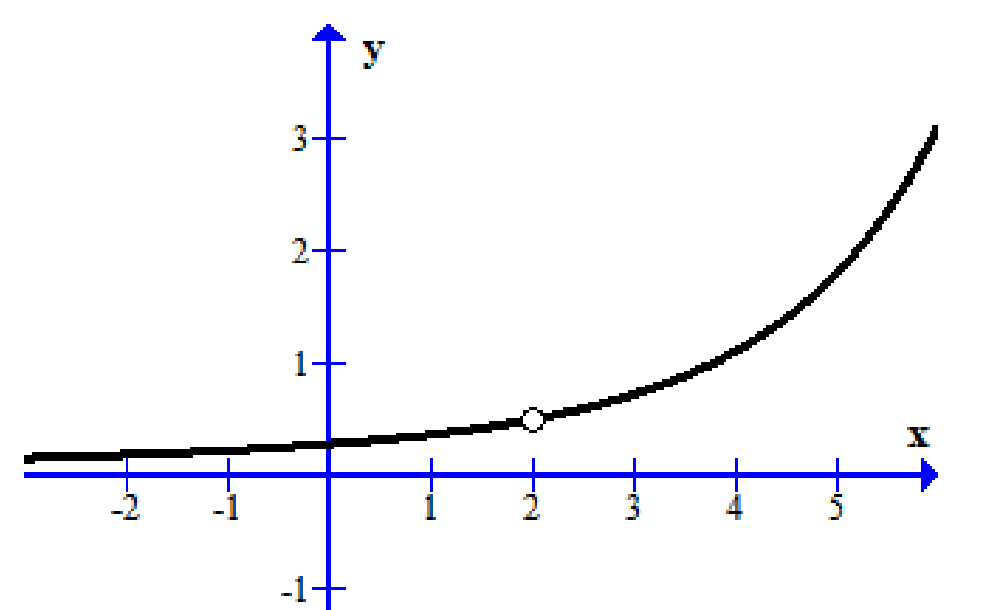
Part of the graph of f(x)=ex−2−x+1(x−2)2f(x)=\dfrac{e^{x-2}-x+1}{(x-2)^2} is shown below:

Graph of f with an open point at x equals two

(a) Write down, correct to 4 s.f., the value of f(0)f(0)[1]

(b) Explain why f(2)f(2) is not defined.[1]

(c) Complete the values of ff, correct to 4 s.f. on the tables below:

For values of xx near 2+2^+:

xx f(x)f(x)
2.12.1
2.012.01
2.0012.001

For values of xx near 2−2^-

xx f(x)f(x)
1.91.9
1.991.99
1.9991.999

[4]

(d) Deduce the value of the limit: lim⁡x→2ex−2−x+1(x−2)2\displaystyle \lim_{x\to2}\dfrac{e^{x-2}-x+1}{(x-2)^2}[1]

Worked solution

Question 4 mark scheme

(a)

f(1)=0.2838f(1)=0.2838

(b)

because the denominator is 0.

(c)

For values of xx near 2+2^+:

xx f(x)f(x)
2.12.1 0.51710.5171
2.012.01 0.50170.5017
2.0012.001 0.50020.5002

For values of xx near 2−2^-

xx f(x)f(x)
1.91.9 0.48370.4837
1.991.99 0.49830.4983
1.9991.999 0.49980.4998
(d)

lim⁡x→2ex−2−x+1(x−2)2=0.5\displaystyle \lim_{x\to2}\dfrac{e^{x-2}-x+1}{(x-2)^2}=0.5

Use the mark scheme after attempting the question yourself.

Question 5

MediumNo calculator
[Maximum mark: 7]

Let P=4Q−4ln⁡(1+Q)Q2P=\dfrac{4Q-4\ln(1+Q)}{Q^2}, Q≠0Q\neq0, −0.5≤Q≤4-0.5\leq Q\leq4,

(a) Write down the values of P for

(i) Q=−0.5Q=-0.5

(ii) Q=1Q=1,

(iii) Q=4Q=4.[3]

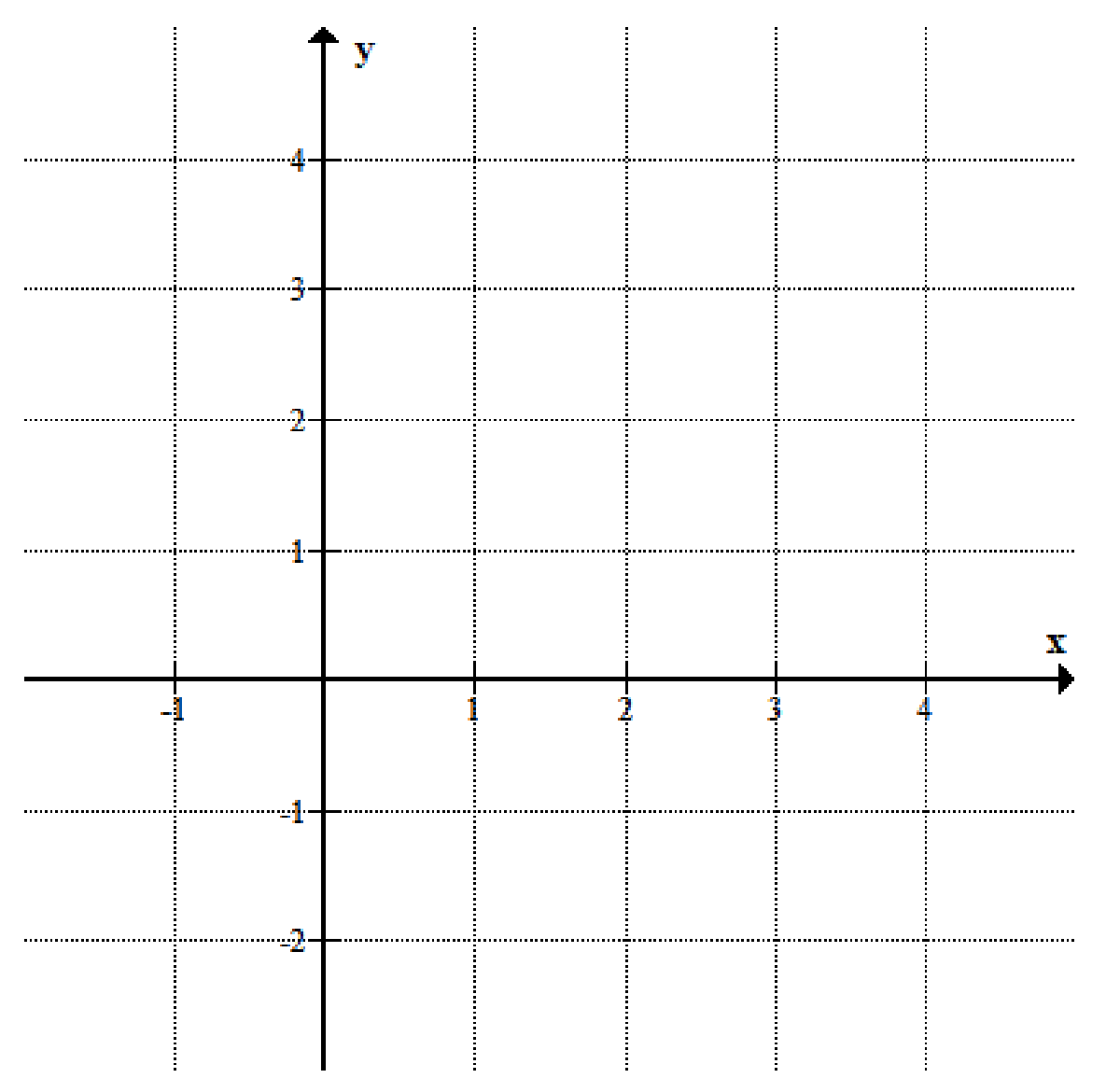
(b) On the following diagram, sketch the graph of P vs Q, for −0.5≤Q≤4-0.5\leq Q\leq4[2]

Blank coordinate grid for P against Q

(c) P is not defined for Q=0Q=0. By investigating the values of P corresponding to values of Q near zero, deduce the value of lim⁡Q→0P\displaystyle \lim_{Q\to0}P.[2]

Worked solution

Question 5 mark scheme

(a)

(i) 3.093.09 (ii) 1.231.23 (ii) 0.5980.598

(b)

Completed graph of P against Q

(c)

lim⁡Q→0P=2\displaystyle \lim_{Q\to0}P=2.

Use the mark scheme after attempting the question yourself.

Question 6

MildNo calculator
[Maximum mark: 8]

Let f(x)=3x+2x+5f(x)=\dfrac{3x+2}{x+5}

(a) Complete the values of ff, correct to 6 s.f. on the table below:

xx f(x)f(x)
100100
1 0001\ 000
1 000 0001\ 000\ 000

[2]

(b) Deduce the value of the limit: lim⁡x→∞3x+2x+5\displaystyle \lim_{x\to\infty}\dfrac{3x+2}{x+5}[1]

(c) Complete the values of ff, correct to 6 s.f. on the table below:

xx f(x)f(x)
−100-100
−1 000-1\ 000
−1 000 000-1\ 000\ 000

[2]

(d) Deduce the value of the limit: lim⁡x→−∞3x+2x+5\displaystyle \lim_{x\to-\infty}\dfrac{3x+2}{x+5}.[1]

(e) By using a similar rationale deduce the value of the limits: lim⁡x→±∞3x+22x+5\displaystyle \lim_{x\to\pm\infty}\dfrac{3x+2}{2x+5}.[2]

Worked solution

Question 6 mark scheme

(a)
xx f(x)f(x)
100100 2.876192.87619
1 0001\ 000 2.987062.98706
1 000 0001\ 000\ 000 2.999992.99999
(b)

lim⁡x→∞3x+2x+5=3\displaystyle \lim_{x\to\infty}\dfrac{3x+2}{x+5}=3

(c)
xx f(x)f(x)
−100-100 3.136843.13684
−1 000-1\ 000 3.013073.01307
−1 000 000-1\ 000\ 000 3.000013.00001
(d)

lim⁡x→−∞3x+2x+5=3\displaystyle \lim_{x\to-\infty}\dfrac{3x+2}{x+5}=3

(e)

lim⁡x→±∞3x+22x+5=1.5\displaystyle \lim_{x\to\pm\infty}\dfrac{3x+2}{2x+5}=1.5

Use the mark scheme after attempting the question yourself.

Question 7

MediumNo calculator
[Maximum mark: 7]

(a) By observing the graph of the function f(x)=x+3x−2f(x)=\dfrac{x+3}{x-2} on your GDC, or otherwise find the values of the following limits

(i) lim⁡x→3x+3x−2\displaystyle \lim_{x\to3}\dfrac{x+3}{x-2}

(ii) lim⁡x→+∞x+3x−2\displaystyle \lim_{x\to+\infty}\dfrac{x+3}{x-2}

(iii) lim⁡x→−∞x+3x−2\displaystyle \lim_{x\to-\infty}\dfrac{x+3}{x-2}[3]

(b) Investigate whether each of the following side limits is +∞+\infty or −∞-\infty:

(i) lim⁡x→2+x+3x−2\displaystyle \lim_{x\to2^+}\dfrac{x+3}{x-2}

(ii) lim⁡x→2−x+3x−2\displaystyle \lim_{x\to2^-}\dfrac{x+3}{x-2}

(iii) lim⁡x→2+x−3x−2\displaystyle \lim_{x\to2^+}\dfrac{x-3}{x-2}

(iv) lim⁡x→2−x−3x−2\displaystyle \lim_{x\to2^-}\dfrac{x-3}{x-2}[4]

Worked solution

Question 7 mark scheme

(a)

(i) lim⁡x→3x+3x−2=6\displaystyle \lim_{x\to3}\dfrac{x+3}{x-2}=6 (ii) lim⁡x→+∞x+3x−2=1\displaystyle \lim_{x\to+\infty}\dfrac{x+3}{x-2}=1 (iii) lim⁡x→−∞x+3x−2=1\displaystyle \lim_{x\to-\infty}\dfrac{x+3}{x-2}=1

(b)

(i) lim⁡x→2+x+3x−2=+∞\displaystyle \lim_{x\to2^+}\dfrac{x+3}{x-2}=+\infty (ii) lim⁡x→2−x+3x−2=−∞\displaystyle \lim_{x\to2^-}\dfrac{x+3}{x-2}=-\infty

(iii) lim⁡x→2+x−3x−2=−∞\displaystyle \lim_{x\to2^+}\dfrac{x-3}{x-2}=-\infty (iv) lim⁡x→2−x−3x−2=+∞\displaystyle \lim_{x\to2^-}\dfrac{x-3}{x-2}=+\infty

Use the mark scheme after attempting the question yourself.

Question 8

MediumNo calculator
[Maximum mark: 8]

The gradient of the curve f(x)=x2f(x)=x^2 at point x=ax=a is defined by the limit

ma=lim⁡h→0(a+h)2−a2hm_a=\lim_{h\to0}\frac{(a+h)^2-a^2}{h}

For example, the gradient at x=1x=1 is m1=2m_1=2 since lim⁡h→0(1+h)2−12h=2\displaystyle \lim_{h\to0}\frac{(1+h)^2-1^2}{h}=2.

(a) By using the graph mode on your GDC, find

(i) lim⁡h→0(2+h)2−22h\displaystyle \lim_{h\to0}\frac{(2+h)^2-2^2}{h} and hence the gradient m2m_2.

(ii) lim⁡h→0(3+h)2−32h\displaystyle \lim_{h\to0}\frac{(3+h)^2-3^2}{h} and hence the gradient m3m_3.[4]

(b) Find the gradient of the curve

(i) at x=5x=5. (ii) x=−5x=-5[3]

(c) Deduce the value of the gradient mam_a in terms of aa in general.[1]

Worked solution

Question 8 mark scheme

(a)

(i) lim⁡h→0(2+h)2−22h=4\displaystyle \lim_{h\to0}\frac{(2+h)^2-2^2}{h}=4, m2=4m_2=4

(ii) lim⁡h→0(3+h)2−32h=6\displaystyle \lim_{h\to0}\frac{(3+h)^2-3^2}{h}=6, m3=6m_3=6

(b)

(i) m5=10m_5=10, (ii) m−5=−10m_{-5}=-10

(c)

ma=2am_a=2a

Use the mark scheme after attempting the question yourself.

Question 9

MediumNo calculator
[Maximum mark: 8]

The gradient of the curve f(x)=ln⁡xf(x)=\ln x at point x=ax=a is defined by the limit

ma=lim⁡h→0ln⁡(a+h)−ln⁡ahm_a=\lim_{h\to0}\frac{\ln(a+h)-\ln a}{h}

For example, the gradient at x=1x=1 is m1=1m_1=1 since lim⁡h→0ln⁡(1+h)−ln⁡1h=1\displaystyle \lim_{h\to0}\frac{\ln(1+h)-\ln1}{h}=1.

(a) By using the graph mode on your GDC, find

(i) lim⁡h→0ln⁡(2+h)−ln⁡2h\displaystyle \lim_{h\to0}\frac{\ln(2+h)-\ln2}{h} and hence the gradient m2m_2.

(ii) lim⁡h→0ln⁡(5+h)−ln⁡5h\displaystyle \lim_{h\to0}\frac{\ln(5+h)-\ln5}{h} and hence the gradient m5m_5.[4]

(b) Find the gradient m10m_{10} of the curve at x=10x=10.[2]

(c) Deduce the value of the gradient mam_a in terms of aa in general.[2]

Worked solution

Question 9 mark scheme

(a)

(i) lim⁡h→0ln⁡(2+h)−ln⁡2h=0.5\displaystyle \lim_{h\to0}\frac{\ln(2+h)-\ln2}{h}=0.5, m2=0.5=12m_2=0.5=\dfrac{1}{2}

(ii) lim⁡h→0ln⁡(5+h)−ln⁡5h=0.2\displaystyle \lim_{h\to0}\frac{\ln(5+h)-\ln5}{h}=0.2, m3=0.2=15m_3=0.2=\dfrac{1}{5}

(b)

m5=0.1=110m_5=0.1=\dfrac{1}{10}

(c)

ma=1am_a=\dfrac{1}{a}

Use the mark scheme after attempting the question yourself.

Question 10

MildNo calculator
[Maximum mark: 8]

(a) Write down the value of e2e^2 correct to 5 s.f.[1]

(b) Write down, correct to 5 s.f., the values of the expression (1+2n)n\left(1+\dfrac{2}{n}\right)^n for the values of nn shown on the following table:

nn (1+2n)n\left(1+\dfrac{2}{n}\right)^n
11
1010
100100
1 0001\ 000
1 000 0001\ 000\ 000

[3]

(c) Hence, guess the value of lim⁡n→+∞(1+2n)n\displaystyle \lim_{n\to+\infty}\left(1+\dfrac{2}{n}\right)^n[1]

(d) By following a similar rationale guess the value of lim⁡n→+∞(1+3n)n\displaystyle \lim_{n\to+\infty}\left(1+\dfrac{3}{n}\right)^n[3]

Worked solution

Question 10 mark scheme

(a)

e2≅7.3891e^2\cong7.3891

(b)
nn (1+2n)n\left(1+\dfrac{2}{n}\right)^n
11 3.00003.0000
1010 6.19176.1917
100100 7.24467.2446
1 0001\ 000 7.37437.3743
1 000 0001\ 000\ 000 7.38907.3890
(c)

lim⁡n→+∞(1+2n)n=e2\displaystyle \lim_{n\to+\infty}\left(1+\dfrac{2}{n}\right)^n=e^2

(d)

lim⁡n→+∞(1+3n)n=e3\displaystyle \lim_{n\to+\infty}\left(1+\dfrac{3}{n}\right)^n=e^3

Use the mark scheme after attempting the question yourself.

Question 11

SpicyCalculator
[Maximum mark: 15]

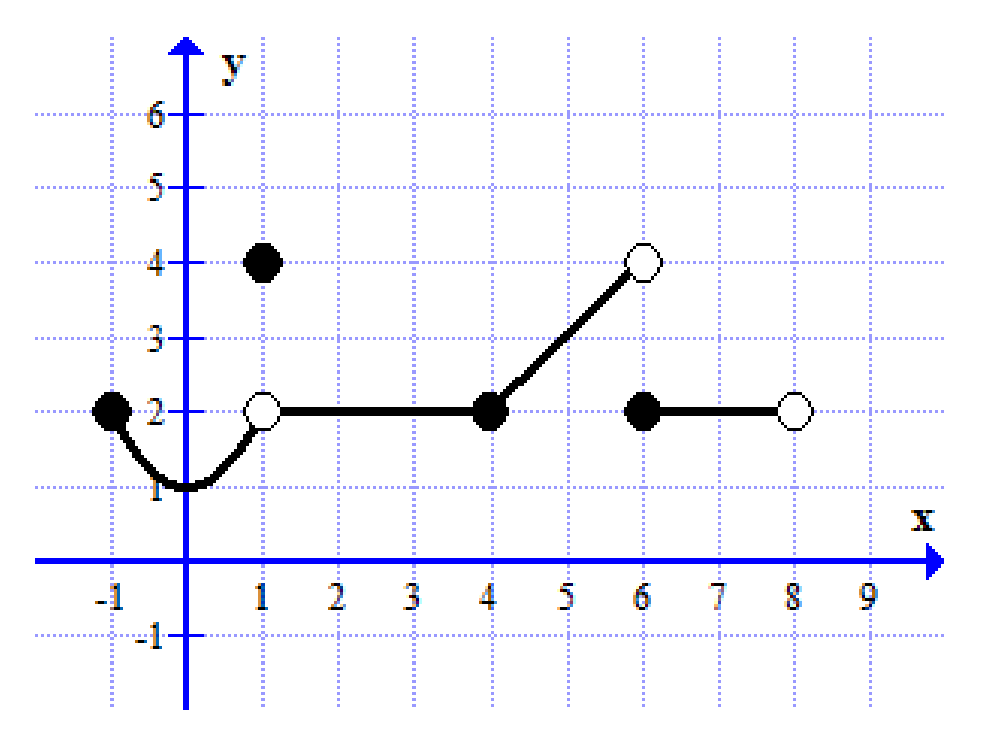
The graph of the function ff is shown below

Piecewise graph of the function f

(a) Write down the domain and the range of the function.

Domain of ff:

Range of ff:

[2]

(b) Complete the following table of values (if there exist)

f(−1)=f(-1)= f(1)=f(1)= f(2)=f(2)= f(4)=f(4)=
f(5)=f(5)= f(6)=f(6)= f(7)=f(7)= f(8)=f(8)=

[4]

(c) Complete the following table of limits (if there exist)

lim⁡x→1−f(x)=\displaystyle \lim_{x\to1^-}f(x)= lim⁡x→1+f(x)=\displaystyle \lim_{x\to1^+}f(x)= lim⁡x→1f(x)=\displaystyle \lim_{x\to1}f(x)=
lim⁡x→4−f(x)=\displaystyle \lim_{x\to4^-}f(x)= lim⁡x→4+f(x)=\displaystyle \lim_{x\to4^+}f(x)= lim⁡x→4f(x)=\displaystyle \lim_{x\to4}f(x)=
lim⁡x→6−f(x)=\displaystyle \lim_{x\to6^-}f(x)= lim⁡x→6+f(x)=\displaystyle \lim_{x\to6^+}f(x)= lim⁡x→6f(x)=\displaystyle \lim_{x\to6}f(x)=

[9]

Worked solution

Question 11 mark scheme

(a)

Domain of ff: x∈[−1,8[x\in[-1,8[

Range of ff: y∈[1,4]y\in[1,4]

(b)

f(−1)=2f(-1)=2 f(1)=4f(1)=4 f(4)=2f(4)=2 f(6)=2f(6)=2 f(8)f(8) not defined

(c)
lim⁡x→1−f(x)=2\displaystyle \lim_{x\to1^-}f(x)=2 lim⁡x→1+f(x)=2\displaystyle \lim_{x\to1^+}f(x)=2 lim⁡x→1f(x)=2\displaystyle \lim_{x\to1}f(x)=2
lim⁡x→4−f(x)=2\displaystyle \lim_{x\to4^-}f(x)=2 lim⁡x→4+f(x)=2\displaystyle \lim_{x\to4^+}f(x)=2 lim⁡x→4f(x)=2\displaystyle \lim_{x\to4}f(x)=2
lim⁡x→6−f(x)=4\displaystyle \lim_{x\to6^-}f(x)=4 lim⁡x→6+f(x)=2\displaystyle \lim_{x\to6^+}f(x)=2 lim⁡x→6f(x)\displaystyle \lim_{x\to6}f(x) does not exist

Use the mark scheme after attempting the question yourself.

Question 12

SpicyCalculator
[Maximum mark: 14]

Let

f(x)={x2+1−1≤x<14x=121<x≤4x−24<x<626≤x<8f(x)=\begin{cases}x^2+1&-1\leq x<1\\4&x=1\\2&1<x\leq4\\x-2&4<x<6\\2&6\leq x<8\end{cases}

(a) Write down the domain of the function.

Domain of ff:

[2]

(b) Complete the following table of values (if there exist)

f(−1)=f(-1)= f(1)=f(1)= f(2)=f(2)= f(4)=f(4)=
f(5)=f(5)= f(6)=f(6)= f(7)=f(7)= f(8)=f(8)=

[4]

(c) Complete the following table of limits (if there exist)

lim⁡x→1−f(x)=lim⁡x→1−(x2+1)=2\displaystyle \lim_{x\to1^-}f(x)=\lim_{x\to1^-}(x^2+1)=2

lim⁡x→1+f(x)=\displaystyle \lim_{x\to1^+}f(x)=

lim⁡x→1f(x)=\displaystyle \lim_{x\to1}f(x)=

lim⁡x→4−f(x)=\displaystyle \lim_{x\to4^-}f(x)=

lim⁡x→4+f(x)=\displaystyle \lim_{x\to4^+}f(x)=

lim⁡x→4f(x)=\displaystyle \lim_{x\to4}f(x)=

lim⁡x→6−f(x)=\displaystyle \lim_{x\to6^-}f(x)=

lim⁡x→6+f(x)=\displaystyle \lim_{x\to6^+}f(x)=

lim⁡x→6f(x)=\displaystyle \lim_{x\to6}f(x)=

[8]

Worked solution

Question 12 mark scheme

In fact, it is the same function as in exercise 9.

(a)

and (b) as in exercise 9

(c)

lim⁡x→1−f(x)=lim⁡x→1−(x2+1)=2\displaystyle \lim_{x\to1^-}f(x)=\lim_{x\to1^-}(x^2+1)=2

lim⁡x→1+f(x)=lim⁡x→1+2=2\displaystyle \lim_{x\to1^+}f(x)=\lim_{x\to1^+}2=2

lim⁡x→1f(x)=2\displaystyle \lim_{x\to1}f(x)=2

lim⁡x→4−f(x)=lim⁡x→4−2=2\displaystyle \lim_{x\to4^-}f(x)=\lim_{x\to4^-}2=2

lim⁡x→4+f(x)=lim⁡x→4+(x−2)=2\displaystyle \lim_{x\to4^+}f(x)=\lim_{x\to4^+}(x-2)=2

lim⁡x→4f(x)=2\displaystyle \lim_{x\to4}f(x)=2

lim⁡x→6−f(x)=lim⁡x→6−(x−2)=4\displaystyle \lim_{x\to6^-}f(x)=\lim_{x\to6^-}(x-2)=4

lim⁡x→6+f(x)=lim⁡x→6+2=2\displaystyle \lim_{x\to6^+}f(x)=\lim_{x\to6^+}2=2

lim⁡x→6f(x)\displaystyle \lim_{x\to6}f(x) does not exist

Use the mark scheme after attempting the question yourself.