AA · SL · Number & Algebra

Sequences & Series

Arithmetic/Geometric, Sigma notation, Financial Applications

DifficultyAll difficulties
Exam modePaper 1 & 2

Question 1

MildNo calculator
[Maximum mark: 4]

An arithmetic sequence has first term 77 and common difference 33.

(a) Find the twelfth term.[2]

(b) Find the sum of the first twelve terms.[2]

Worked solution

Question 1 mark scheme

(a)

Use un=a+(n−1)du_n=a+(n-1)d: u12=7+11(3)u_{12}=7+11(3).

u12=40u_{12}=40.

(b)

Use S12=122(7+40)S_{12}=\dfrac{12}{2}(7+40).

S12=282S_{12}=282.

Use the mark scheme after attempting the question yourself.

Question 2

MildNo calculator
[Maximum mark: 5]

The fourth and ninth terms of an arithmetic sequence are 1919 and 4444 respectively.

(a) Find the first term and the common difference.[3]

(b) Find the fifteenth term.[2]

Worked solution

Question 2 mark scheme

(a)

Write a+3d=19a+3d=19 and a+8d=44a+8d=44, and subtract to obtain 5d=255d=25.

d=5d=5.

a=19−3(5)=4a=19-3(5)=4.

(b)

Substitute into u15=a+14d=4+14(5)u_{15}=a+14d=4+14(5).

u15=74u_{15}=74.

Use the mark scheme after attempting the question yourself.

Question 3

MildNo calculator
[Maximum mark: 4]

An arithmetic sequence has first term 1818 and common difference −52-\dfrac52. Its terms are indexed by positive integers nn.

(a) Write down unu_n in terms of nn.[1]

(b) Determine which term is equal to −37-37.[2]

(c) Explain why −38-38 is not a term of the sequence.[1]

Worked solution

Question 3 mark scheme

(a)

un=18−52(n−1)u_n=18-\dfrac52(n-1), or un=41−5n2u_n=\dfrac{41-5n}{2}.

(b)

Solve 18−52(n−1)=−3718-\dfrac52(n-1)=-37.

n=23n=23, so −37-37 is the twenty-third term.

(c)

Setting un=−38u_n=-38 gives n=1175n=\dfrac{117}{5}, which is not an integer; hence −38-38 is not a term.

Use the mark scheme after attempting the question yourself.

Question 4

MildNo calculator
[Maximum mark: 4]

A geometric sequence has first term 9696 and common ratio −12-\dfrac12.

(a) Find the fifth term.[2]

(b) Find the sum of the first four terms.[2]

Worked solution

Question 4 mark scheme

(a)

u5=96(−12)4u_5=96\left(-\dfrac12\right)^4.

u5=6u_5=6.

(b)

S4=961−(−1/2)41−(−1/2)S_4=96\dfrac{1-(-1/2)^4}{1-(-1/2)}, or explicitly sum 96−48+24−1296-48+24-12.

S4=60S_4=60.

Use the mark scheme after attempting the question yourself.

Question 5

MildNo calculator
[Maximum mark: 4]

The first three terms of a geometric sequence are xx, 1212 and 4848, where x>0x>0.

(a) Find xx.[2]

(b) Find the sum of these three terms.[2]

Worked solution

Question 5 mark scheme

(a)

The common ratio is r=48/12=4r=48/12=4, so 12=4x12=4x.

x=3x=3.

(b)

Sum the three terms: S3=3+12+48S_3=3+12+48.

S3=63S_3=63.

Use the mark scheme after attempting the question yourself.

Question 6

MildNo calculator
[Maximum mark: 5]

Consider the sum ∑k=312(4k−1)\displaystyle\sum_{k=3}^{12}(4k-1).

(a) State the first term, the last term and the number of terms.[3]

(b) Evaluate the sum.[2]

Worked solution

Question 6 mark scheme

(a)

The first term is 4(3)−1=114(3)-1=11.

The last term is 4(12)−1=474(12)-1=47.

There are 12−3+1=1012-3+1=10 terms.

(b)

Use the arithmetic-sum formula: 102(11+47)\dfrac{10}{2}(11+47).

∑k=312(4k−1)=290\displaystyle\sum_{k=3}^{12}(4k-1)=290.

Use the mark scheme after attempting the question yourself.

Question 7

MediumNo calculator
[Maximum mark: 8]

A designer makes T-shaped patterns from identical square tiles. The first three stages are shown.
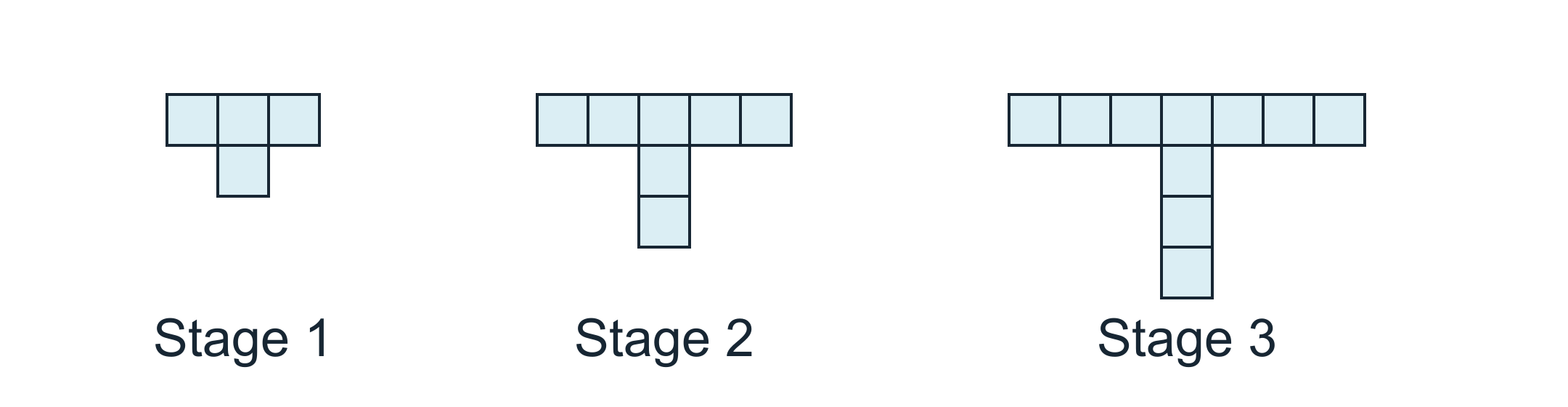
T-shaped tile patterns labelled Stage 1, Stage 2 and Stage 3

To obtain the next stage, one tile is added to each end of the horizontal bar and one tile is added to the bottom of the vertical stem. No tiles overlap. Let unu_n be the number of tiles in stage nn, with the first diagram representing stage 11.

(a) State the number of tiles in stage 44.[1]

(b) Find an expression for unu_n.[2]

(c) One separate pattern is made for each stage from 11 to 2020, with no tiles reused between patterns. Find the total number of tiles needed.[3]

(d) Find the first stage containing more than 100100 tiles.[2]

Worked solution

Question 7 mark scheme

(a)

Stage 44 contains 1313 tiles.

(b)

Stage 11 has 44 tiles and each step adds 33, so un=4+3(n−1)u_n=4+3(n-1).

un=3n+1u_n=3n+1.

(c)

The number in stage 2020 is u20=61u_{20}=61.

Sum all twenty separate patterns: S20=202(4+61)S_{20}=\dfrac{20}{2}(4+61).

S20=650S_{20}=650 tiles.

(d)

3n+1>1003n+1>100 gives n>33n>33.

The first such stage is 3434.

Use the mark scheme after attempting the question yourself.

Question 8

MediumNo calculator
[Maximum mark: 8]

A geometric sequence has real, non-zero common ratio rr. Its third term is 1212 and its fifth term is 4848.

(a) Find all possible values of rr.[3]

(b) Find the first term for each value of rr.[2]

(c) For each possible sequence, find the sum of the first four terms.[3]

Worked solution

Question 8 mark scheme

(a)

Write ar2=12ar^2=12 and ar4=48ar^4=48, then divide to obtain r2=4r^2=4.

r=2r=2.

r=−2r=-2. Both signs arise because r2=4r^2=4.

(b)

Substitute into a=12/r2a=12/r^2.

a=3a=3 for both ratios.

(c)

Use S4=3(1−r4)/(1−r)S_4=3(1-r^4)/(1-r), or sum four terms for each ratio.

For r=2r=2, S4=3+6+12+24=45S_4=3+6+12+24=45.

For r=−2r=-2, S4=3−6+12−24=−15S_4=3-6+12-24=-15.

Use the mark scheme after attempting the question yourself.

Question 9

MediumCalculator
[Maximum mark: 5]

At the start of an experiment, a sample contains 400400 mg of a substance. Its mass is multiplied by 0.730.73 after each complete day. Let mnm_n be the mass after nn complete days, so that m0=400m_0=400.

(a) Find m8m_8, in mg, correct to three significant figures.[2]

(b) Find the smallest whole number of complete days after which the mass is less than 1010 mg.[3]

Worked solution

Question 9 mark scheme

(a)

m8=400(0.73)8m_8=400(0.73)^8.

m8=32.3m_8=32.3 mg, to three significant figures.

(b)

Solve 400(0.73)n<10400(0.73)^n<10, using logarithms or a calculator-generated table.

n>ln⁡(10/400)ln⁡0.73=11.72149…\displaystyle n>\frac{\ln(10/400)}{\ln0.73}=11.72149\ldots. The inequality reverses on division because ln⁡0.73<0\ln0.73<0.

The smallest integer is n=12n=12 days.

Use the mark scheme after attempting the question yourself.

Question 10

MediumNo calculator
[Maximum mark: 5]

Consider ∑k=275×2k−1\displaystyle\sum_{k=2}^{7}5\times2^{k-1}.

(a) State the first term and the number of terms.[2]

(b) Evaluate the sum exactly.[3]

Worked solution

Question 10 mark scheme

(a)

The first term is 5×22−1=105\times2^{2-1}=10.

There are 7−2+1=67-2+1=6 terms.

(b)

Identify the common ratio 22 and use S6=1026−12−1S_6=10\dfrac{2^6-1}{2-1}.

S6=10(64−1)S_6=10(64-1).

The sum is 630630.

Use the mark scheme after attempting the question yourself.

Question 11

MediumCalculator
[Maximum mark: 8]

An infinite geometric series has first term 1818 and common ratio 0.820.82. Let SnS_n be the sum of its first nn terms.

(a) Explain why the infinite series converges.[1]

(b) Find its sum to infinity.[2]

(c) Express SnS_n in terms of nn.[2]

(d) Find the least positive integer nn for which the difference between the sum to infinity and SnS_n is less than 0.050.05.[3]

Worked solution

Question 11 mark scheme

(a)

The series converges because ∣0.82∣<1|0.82|<1.

(b)

Use S∞=18/(1−0.82)S_\infty=18/(1-0.82).

S∞=100S_\infty=100.

(c)

Use Sn=18(1−0.82n)/(1−0.82)S_n=18(1-0.82^n)/(1-0.82).

Sn=100(1−0.82n)S_n=100(1-0.82^n).

(d)

The positive remainder is 100−Sn=100(0.82)n100-S_n=100(0.82)^n, so solve 100(0.82)n<0.05100(0.82)^n<0.05.

n>ln⁡(0.0005)ln⁡0.82=38.30116…\displaystyle n>\frac{\ln(0.0005)}{\ln0.82}=38.30116\ldots.

The least integer is n=39n=39.

Use the mark scheme after attempting the question yourself.

Question 12

MediumNo calculator
[Maximum mark: 8]

Let x=0.27‾=0.272727…x=0.\overline{27}=0.272727\ldots. For each positive integer nn, define Tn=∑k=1n27100kT_n=\displaystyle\sum_{k=1}^{n}\dfrac{27}{100^k}.

(a) Write out the four terms in T4T_4.[2]

(b) Using an infinite geometric series, show that x=311x=\dfrac3{11}.[3]

(c) Find an exact expression for x−Tnx-T_n in terms of nn.[3]

Worked solution

Question 12 mark scheme

(a)

T4=27100+2710000+271000000+27100000000.\begin{aligned}T_4={}&\dfrac{27}{100}+\dfrac{27}{10000}\\&+\dfrac{27}{1000000}+\dfrac{27}{100000000}.\end{aligned}

(b)

Identify first term 27/10027/100 and common ratio 1/1001/100, with ∣1/100∣<1|1/100|<1.

x=27/1001−1/100=2799\displaystyle x=\frac{27/100}{1-1/100}=\frac{27}{99}.

Hence x=3/11x=3/11.

(c)

Tn=27/100 (1−100−n)1−1/100=311(1−100−n)\displaystyle T_n=\frac{27/100\,(1-100^{-n})}{1-1/100}=\frac3{11}(1-100^{-n}).

Subtract this from x=3/11x=3/11.

x−Tn=311 100−n\displaystyle x-T_n=\frac3{11}\,100^{-n}.

Use the mark scheme after attempting the question yourself.

Question 13

MediumCalculator
[Maximum mark: 8]

A saver invests CAD 64006400 in an account paying a nominal annual interest rate of 4.8%4.8\%, compounded monthly. There are no deposits, withdrawals or fees. The annual inflation rate is constant at 2.1%2.1\%, compounded annually.

(a) State the monthly growth factor for the account balance.[1]

(b) Find the balance after four years, to the nearest cent.[3]

(c) Express this balance in today's purchasing power by adjusting for four years of inflation. Give your answer in CAD to the nearest cent.[3]

(d) State whether the investment has gained purchasing power over the four years. Justify your answer using your results.[1]

Worked solution

Question 13 mark scheme

(a)

1+0.048/12=1.0041+0.048/12=1.004.

(b)

Use V=6400(1.004)kV=6400(1.004)^k, where kk is the number of monthly periods.

Four years gives k=4(12)=48k=4(12)=48, so V=6400(1.004)48V=6400(1.004)^{48}.

The balance is CAD 7751.727751.72.

(c)

Divide the unrounded nominal balance by the inflation growth factor: R=V/(1.021)4R=V/(1.021)^4.

R=6400(1.004)48(1.021)4=7133.377711…\displaystyle R=\frac{6400(1.004)^{48}}{(1.021)^4}=7133.377711\ldots.

The balance in today's purchasing power is CAD 7133.387133.38.

(d)

Yes: 7133.38>64007133.38>6400, so purchasing power increased.

Use the mark scheme after attempting the question yourself.

Question 14

MediumCalculator
[Maximum mark: 6]

A machine is bought for CAD 2750027500. Its value falls by 17%17\% at the end of each year. Let VnV_n be its value immediately after the nnth annual reduction, with V0=27500V_0=27500.

(a) Find V5V_5 to the nearest cent.[2]

(b) Find the first whole year nn for which Vn<9000V_n<9000.[3]

(c) Give one reason why a constant percentage reduction may be an imperfect model of the machine's actual resale value.[1]

Worked solution

Question 14 mark scheme

(a)

V5=27500(0.83)5V_5=27500(0.83)^5.

V5=V_5= CAD 10832.3610832.36.

(b)

Solve 27500(0.83)n<900027500(0.83)^n<9000.

n>ln⁡(9000/27500)ln⁡0.83=5.994547…\displaystyle n>\frac{\ln(9000/27500)}{\ln0.83}=5.994547\ldots.

The first year is n=6n=6.

(c)

For example, resale value also depends on condition or changing demand, so the percentage reduction need not remain constant.

Use the mark scheme after attempting the question yourself.

Question 15

MediumCalculator
[Maximum mark: 8]

Two accounts each receive an initial deposit of CAD 50005000, with no later deposits, withdrawals or fees. Account A pays simple interest at 6.0%6.0\% per year. Account B pays compound interest at 5.2%5.2\% per year, compounded annually. Interest is credited at each year-end.

(a) Write expressions for the balances AnA_n and BnB_n after nn complete years.[2]

(b) Find both balances after four years, to the nearest cent, and state which account has the larger balance.[3]

(c) For positive integers n≤20n\leq20, find the first year-end at which Account B has a larger balance than Account A. Show sufficient numerical evidence that it is the first such year-end.[3]

Worked solution

Question 15 mark scheme

(a)

An=5000(1+0.06n)A_n=5000(1+0.06n).

Bn=5000(1.052)nB_n=5000(1.052)^n.

(b)

A4=A_4= CAD 6200.006200.00.

B4=5000(1.052)4=B_4=5000(1.052)^4= CAD 6123.976123.97.

Account A has the larger balance.

(c)

Compare both expressions at successive integer years, or solve the inequality graphically and check integer values.

The integer-year comparisons below are in CAD, rounded to cents.

nn AnA_n BnB_n Bn−AnB_n-A_n
1 5300.00 5260.00 −40.00
2 5600.00 5533.52 −66.48
3 5900.00 5821.26 −78.74
4 6200.00 6123.97 −76.03
5 6500.00 6442.42 −57.58
6 6800.00 6777.42 −22.58
7 7100.00 7129.85 29.85

These comparisons establish the first integer crossing.

The first such year-end is n=7n=7.

Use the mark scheme after attempting the question yourself.

Question 16

MediumCalculator
[Maximum mark: 7]

A savings fund pays 3.5%3.5\% interest per year, credited at year-end. Immediately after each interest credit, a deposit of CAD 600600 is made. The fund starts with no money, and exactly five deposits are made, at the ends of years 1,2,3,4,51,2,3,4,5. Find values immediately after the fifth deposit, with no fees or withdrawals.

(a) State how many annual interest periods the first deposit and the fifth deposit have earned.[2]

(b) Write the fund's value as a sum of five geometric terms.[2]

(c) Calculate the fund's value to the nearest cent.[2]

(d) Calculate the total interest earned to the nearest cent.[1]

Worked solution

Question 16 mark scheme

(a)

The first deposit earns interest for 44 periods.

The fifth deposit earns interest for 00 periods.

(b)

The five deposits earn 4,3,2,1,04,3,2,1,0 annual interest periods respectively.

F=600(1.035)4+600(1.035)3+600(1.035)2+600(1.035)+600.\begin{aligned}F={}&600(1.035)^4+600(1.035)^3\\&+600(1.035)^2+600(1.035)+600.\end{aligned}

(c)

Use F=6001.0355−11.035−1\displaystyle F=600\frac{1.035^5-1}{1.035-1}.

F=F= CAD 3217.483217.48.

(d)

Interest =F−5(600)==F-5(600)= CAD 217.48217.48.

Use the mark scheme after attempting the question yourself.

Question 17

SpicyCalculator
[Maximum mark: 11]

An arithmetic sequence has positive first term aa and positive common difference dd. The sum of its first ten terms is 250250, and the sum of terms 1111 to 2020 inclusive is 650650. Let SnS_n be the sum of its first nn terms.

(a) Determine aa and dd.[4]

(b) Show that Sn=n(2n+5)S_n=n(2n+5).[2]

(c) Find the least positive integer nn such that Sn≥100000S_n\geq100000.[3]

(d) Using the value of nn from (c), find the sum of terms n+1n+1 to 2n2n inclusive.[2]

Worked solution

Question 17 mark scheme

(a)

From the first block, 10a+45d=25010a+45d=250.

From the second block, 10a+145d=65010a+145d=650.

Subtracting gives 100d=400100d=400, so d=4d=4.

Then 10a+180=25010a+180=250, so a=7a=7.

(b)

Start with Sn=n2[2a+(n−1)d]\displaystyle S_n=\frac n2[2a+(n-1)d].

Substitute to obtain Sn=n2[14+4(n−1)]\displaystyle S_n=\frac n2[14+4(n-1)].

Hence Sn=n(2n+5)S_n=n(2n+5).

(c)

Solve 2n2+5n−100000≥02n^2+5n-100000\geq0, taking the positive boundary −5+8000254\displaystyle\frac{-5+\sqrt{800025}}4.

S222=99678<100000S_{222}=99678<100000 and S223=100573≥100000S_{223}=100573\geq100000; the sums increase because all terms are positive.

The least integer is n=223n=223.

(d)

The required block is

S2n−Sn=2n(4n+5)−n(2n+5)=6n2+5n.\begin{aligned}S_{2n}-S_n&=2n(4n+5)-n(2n+5)\\&=6n^2+5n.\end{aligned}

At n=223n=223, the sum is 299489299489.

Use the mark scheme after attempting the question yourself.

Question 18

SpicyNo calculator
[Maximum mark: 11]

A geometric sequence has positive first term aa and positive common ratio r≠1r\ne1. Its partial sums satisfy S3=21S_3=21 and S6=189S_6=189.

(a) By grouping the first six terms into two blocks of three, show that S6=S3(1+r3)S_6=S_3(1+r^3).[3]

(b) Find rr and aa.[3]

(c) Find the smallest positive integer nn such that the individual term un>1000u_n>1000. Give an exact comparison with the preceding term.[2]

(d) Find the largest positive integer mm such that Sm≤1000S_m\leq1000. Give an exact comparison with Sm+1S_{m+1}.[3]

Worked solution

Question 18 mark scheme

(a)

S6=(a+ar+ar2)+(ar3+ar4+ar5).\begin{aligned}S_6={}&(a+ar+ar^2)\\&+(ar^3+ar^4+ar^5).\end{aligned}

Factor the second block as r3(a+ar+ar2)=r3S3r^3(a+ar+ar^2)=r^3S_3.

Therefore S6=S3+r3S3=S3(1+r3)S_6=S_3+r^3S_3=S_3(1+r^3).

(b)

189=21(1+r3)189=21(1+r^3) gives r3=8r^3=8.

Since r>0r>0, r=2r=2.

21=a(1+2+4)21=a(1+2+4) gives a=3a=3.

(c)

u9=3×28=768≤1000u_9=3\times2^8=768\leq1000 and u10=3×29=1536>1000u_{10}=3\times2^9=1536>1000; terms increase because r=2>1r=2>1.

The smallest index is n=10n=10.

(d)

Sm=3(2m−1)S_m=3(2^m-1).

S8=765≤1000S_8=765\leq1000, while S9=1533>1000S_9=1533>1000, with increasing partial sums.

The largest index is m=8m=8.

Use the mark scheme after attempting the question yourself.

Question 19

SpicyNo calculator
[Maximum mark: 12]

For a real parameter tt, define a sequence by

u1=2−t,un+1=t+13un(n≥1).u_1=2-t,\qquad u_{n+1}=\frac{t+1}{3}u_n\quad(n\geq1).

Consider the infinite series u1+u2+u3+⋯u_1+u_2+u_3+\cdots.

(a) For t≠2t\ne2, find all values of tt for which the series converges.[3]

(b) For values of tt in the interval found in (a), show that the sum to infinity is independent of tt, and find that sum.[3]

(c) Examine the series separately when t=−4t=-4 and when t=2t=2. State whether it converges in each case and, if it does, give its sum.[3]

(d) Restrict tt to the interval in (a). Find all values of tt for which some finite partial sum SNS_N, with positive integer NN, is already equal to the sum to infinity. Justify that there are no other such values.[3]

Worked solution

Question 19 mark scheme

(a)

For a non-zero first term, require ∣t+13∣<1\left|\dfrac{t+1}{3}\right|<1.

−3<t+1<3-3<t+1<3.

Therefore −4<t<2-4<t<2.

(b)

Use S∞=2−t1−(t+1)/3\displaystyle S_\infty=\frac{2-t}{1-(t+1)/3}.

S∞=2−t(2−t)/3=3\displaystyle S_\infty=\frac{2-t}{(2-t)/3}=3, cancelling only because t≠2t\ne2.

Thus the sum is 33 for every tt in the interval and is independent of tt.

(c)

When t=−4t=-4, the series is 6−6+6−6+⋯6-6+6-6+\cdots; its partial sums alternate between 66 and 00, so it diverges.

When t=2t=2, the recurrence starts at u1=0u_1=0 and every term is zero.

This series converges with sum 00. The formula in (b) cannot be extended to this case by cancelling a zero factor.

(d)

Within −4<t<2-4<t<2, write r=(t+1)/3r=(t+1)/3. The finite-sum formula gives SN=3(1−rN)S_N=3(1-r^N), including r=0r=0 for positive NN.

SN=3S_N=3 requires rN=0r^N=0, so r=0r=0 is the only real possibility for positive integer NN.

Hence t=−1t=-1 is the only value; the sequence is 3,0,0,…3,0,0,\ldots, so every positive partial sum equals 33.

Use the mark scheme after attempting the question yourself.

Question 20

SpicyCalculator
[Maximum mark: 13]

A fund contains CAD 15001500 at time 00. At the end of each month, interest of 1.0%1.0\% of the balance is first added. A deposit of CAD 200200 is then made at each of the ends of months 11 to 1212 inclusive. No further deposits are made after month 1212. There are no fees or withdrawals. Use unrounded balances in all later calculations.

(a) For 1≤n≤121\leq n\leq12, express the balance BnB_n immediately after the nnth deposit as a geometric sum, and simplify it to Bn=21500(1.01)n−20000B_n=21500(1.01)^n-20000.[4]

(b) Find B12B_{12} to the nearest cent.[2]

(c) Find the first month-end, counted from time 00, at which the balance is at least CAD 60006000. Justify your integer choice.[3]

(d) Find the total interest earned by the month-end in (c), to the nearest cent.[2]

(e) Suppose instead that the twelve deposits are made at the beginnings of months 11 to 1212, with all other conditions unchanged. Write an expression for the balance at the end of month 1212 under this alternative timing. You do not need to evaluate it.[2]

Worked solution

Question 20 mark scheme

(a)

The initial balance contributes 1500(1.01)n1500(1.01)^n.

The deposits contribute 200∑j=0n−1(1.01)j\displaystyle200\sum_{j=0}^{n-1}(1.01)^j: the newest has no interest yet and the oldest has n−1n-1 periods.

Thus Bn=1500(1.01)n+200(1.01)n−10.01\displaystyle B_n=1500(1.01)^n+200\frac{(1.01)^n-1}{0.01}.

Simplifying gives Bn=21500(1.01)n−20000B_n=21500(1.01)^n-20000.

(b)

Substitute n=12n=12: B12=21500(1.01)12−20000B_{12}=21500(1.01)^{12}-20000.

This gives B12=4226.738147…B_{12}=4226.738147\ldots.

B12=B_{12}= CAD 4226.744226.74.

(c)

The balance increases during the deposit phase and B12<6000B_{12}<6000. For mm further months, solve B12(1.01)m≥6000B_{12}(1.01)^m\geq6000.

After 3535 further months the balance is CAD 5987.608909…5987.608909\ldots, and after 3636 it is CAD 6047.484998…6047.484998\ldots, establishing the first crossing.

The first such month-end is month 12+36=4812+36=48.

(d)

Total money paid in is 1500+12(200)=39001500+12(200)=3900, so subtract 39003900 from the unrounded month-4848 balance.

Interest earned is CAD 2147.482147.48.

(e)

Each deposit earns one additional month's interest, while the initial balance is unchanged. Use 1500(1.01)12+200∑j=112(1.01)j\displaystyle1500(1.01)^{12}+200\sum_{j=1}^{12}(1.01)^j.

The initial balance earns twelve periods and the deposits earn 12,11,…,112,11,\ldots,1 periods respectively.

Use the mark scheme after attempting the question yourself.