AA · SL · Calculus

Differential Calculus

Rules, Differentiating Polynomials, Tangents/Normals, Limits, Increasing and Decreasing Functions, Gradients

DifficultyAll difficulties
Exam modePaper 1 & 2

Question 1

MildNo calculator
[Maximum mark: 5]

Let f(x)=2x3−9x2+12x−4f(x)=2x^3-9x^2+12x-4.

(a) Find f′(x)f'(x).[2]

(b) Find the gradient of the curve at x=2x=2 and interpret it geometrically.[3]

Worked solution

Question 1 mark scheme

(a)

Applying the power rule term by term gives f′(x)=6x2−18x+12f'(x)=6x^2-18x+12.

(b)

At x=2x=2, f′(2)=24−36+12=0f'(2)=24-36+12=0. The tangent is horizontal there. Since f(2)=0f(2)=0, the tangent is the line y=0y=0.

Use the mark scheme after attempting the question yourself.

Question 2

MildNo calculator
[Maximum mark: 5]

The point P(2,7)P(2,7) lies on y=x2+3y=x^2+3.

(a) Find the gradient of the tangent at PP.[2]

(b) Find the equation of the normal at PP.[3]

Worked solution

Question 2 mark scheme

(a)

Since dy/dx=2xdy/dx=2x, the tangent gradient at x=2x=2 is 44.

(b)

The normal gradient is the negative reciprocal, −1/4-1/4. Its equation is y−7=−14(x−2)y-7=-\frac14(x-2), or y=−x/4+15/2y=-x/4+15/2.

Use the mark scheme after attempting the question yourself.

Question 3

MediumCalculator
[Maximum mark: 5]

Let f(x)=e−xsin⁡(2x)f(x)=e^{-x}\sin(2x), with angles in radians.

(a) Find f′(x)f'(x).[3]

(b) Find the gradient at x=0.6x=0.6, to three significant figures.[2]

Worked solution

Question 3 mark scheme

(a)

The product and chain rules give f′(x)=e−x(2cos⁡(2x)−sin⁡(2x)).f'(x)=e^{-x}\bigl(2\cos(2x)-\sin(2x)\bigr).

(b)

Substituting x=0.6x=0.6 gives e−0.6(2cos⁡1.2−sin⁡1.2)≈−0.114e^{-0.6}(2\cos1.2-\sin1.2)\approx-0.114.

Use the mark scheme after attempting the question yourself.

Question 4

MediumNo calculator
[Maximum mark: 7]

Let f(x)=x2+3xf(x)=\dfrac{x^2+3}{x} for x>0x>0.

(a) Use differentiation to find f′(x)f'(x).[3]

(b) Determine the intervals where ff is decreasing and increasing.[2]

(c) Find and classify its stationary point.[2]

Worked solution

Question 4 mark scheme

(a)

The quotient rule gives f′(x)=2x2−(x2+3)x2=1−3x2.f'(x)=\frac{2x^2-(x^2+3)}{x^2}=1-\frac3{x^2}.

(b)

On x>0x>0, the derivative is negative for 0<x<30<x<\sqrt3 and positive for x>3x>\sqrt3. These are respectively the decreasing and increasing intervals.

(c)

The only stationary value is x=3x=\sqrt3, giving f(3)=23f(\sqrt3)=2\sqrt3. The sign changes from negative to positive, so (3,23)(\sqrt3,2\sqrt3) is a minimum. It is also the global minimum on this domain.

Use the mark scheme after attempting the question yourself.

Question 5

SpicyCalculator
[Maximum mark: 10]

A rectangular card measures 3030 cm by 2020 cm. Squares of side xx cm are cut from its corners and the remaining sides folded to form an open box. The diagram shows the uncut central base and corner cuts.
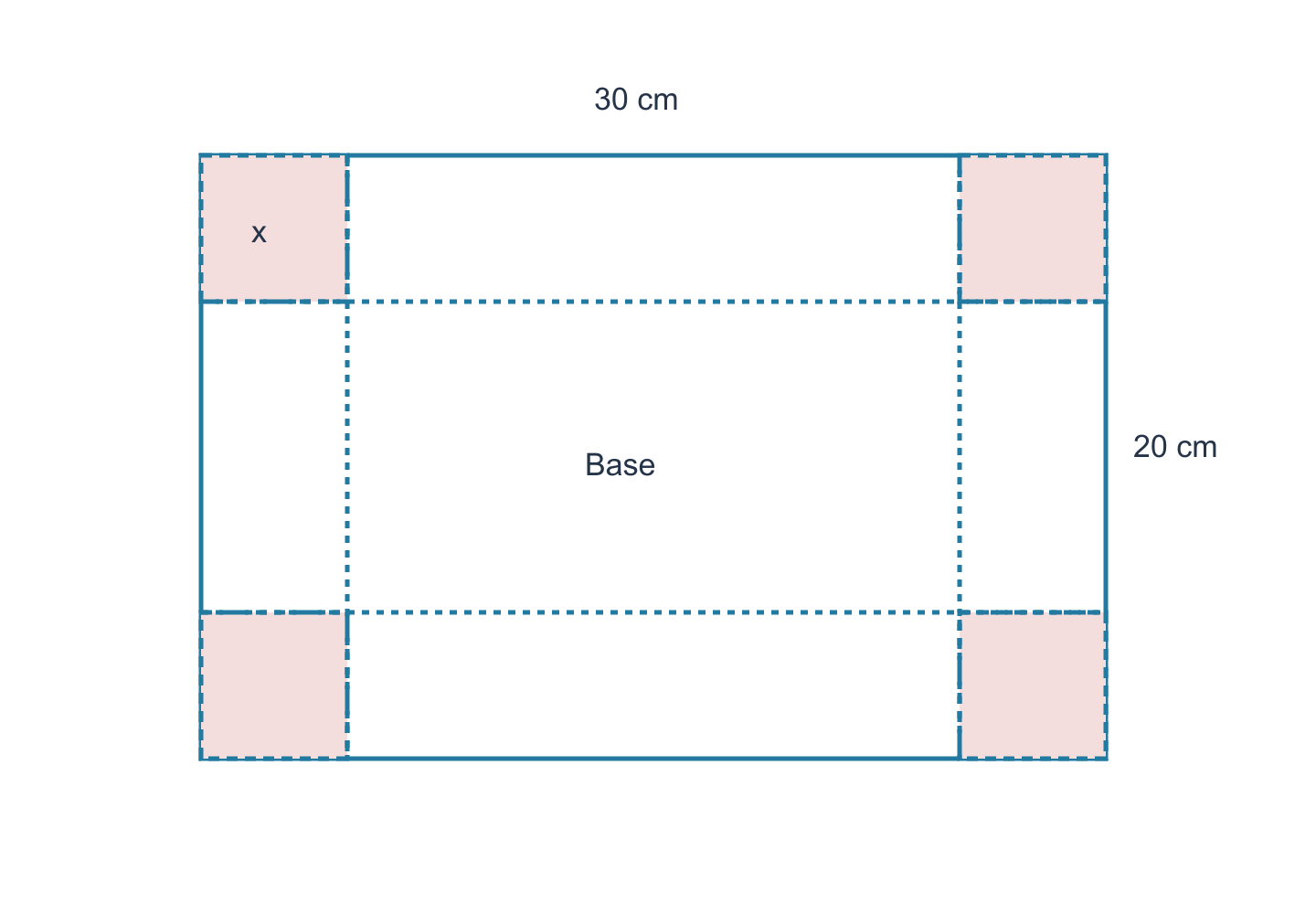
Card with four equal corner squares removed

(a) State the physical domain for xx and show that the box volume is V(x)=4x3−100x2+600xV(x)=4x^3-100x^2+600x.[3]

(b) Find the stationary values of VV and identify the physically admissible one.[3]

(c) Justify that this value gives the greatest volume, including the boundary behavior.[2]

(d) Give the optimal cut size and greatest volume, to three significant figures.[2]

Worked solution

Question 5 mark scheme

(a)

Positive height and base dimensions require 0<x<100<x<10. The height is xx and the base measures (30−2x)(30-2x) by (20−2x)(20-2x), hence V=x(30−2x)(20−2x)=4x3−100x2+600x.V=x(30-2x)(20-2x)=4x^3-100x^2+600x.

(b)

Differentiating, V′=12x2−200x+600V'=12x^2-200x+600. Solving V′=0V'=0 gives x=25±573.x=\frac{25\pm5\sqrt7}{3}. Only (25−57)/3≈3.92375(25-5\sqrt7)/3\approx3.92375 lies in (0,10)(0,10); the other root is approximately 12.742912.7429.

(c)

At the smaller root, V′′=24x−200=−407<0V''=24x-200=-40\sqrt7<0. This is the only stationary point in the physical domain, and VV tends to zero at both boundaries. It therefore gives the greatest volume.

(d)

The cut size is 3.923.92 cm, and substitution using the unrounded size gives a greatest volume of 1.06×103 cm31.06\times10^3\text{ cm}^3.

Volume curve on the physical domain with its maximum marked

Use the mark scheme after attempting the question yourself.

Question 6

MildNo calculator
[Maximum mark: 5]

A function satisfies f′(x)=4x3−6xf'(x)=4x^3-6x and f(1)=2f(1)=2.

(a) Find f(x)f(x).[3]

(b) Find its vertical-axis intercept.[2]

Worked solution

Question 6 mark scheme

(a)

Integration gives f(x)=x4−3x2+Cf(x)=x^4-3x^2+C. Using f(1)=2f(1)=2 gives 1−3+C=21-3+C=2, so C=4C=4 and f(x)=x4−3x2+4f(x)=x^4-3x^2+4.

(b)

At x=0x=0, f(0)=4f(0)=4, so the intercept is (0,4)(0,4).

Use the mark scheme after attempting the question yourself.

Question 7

MildNo calculator
[Maximum mark: 5]

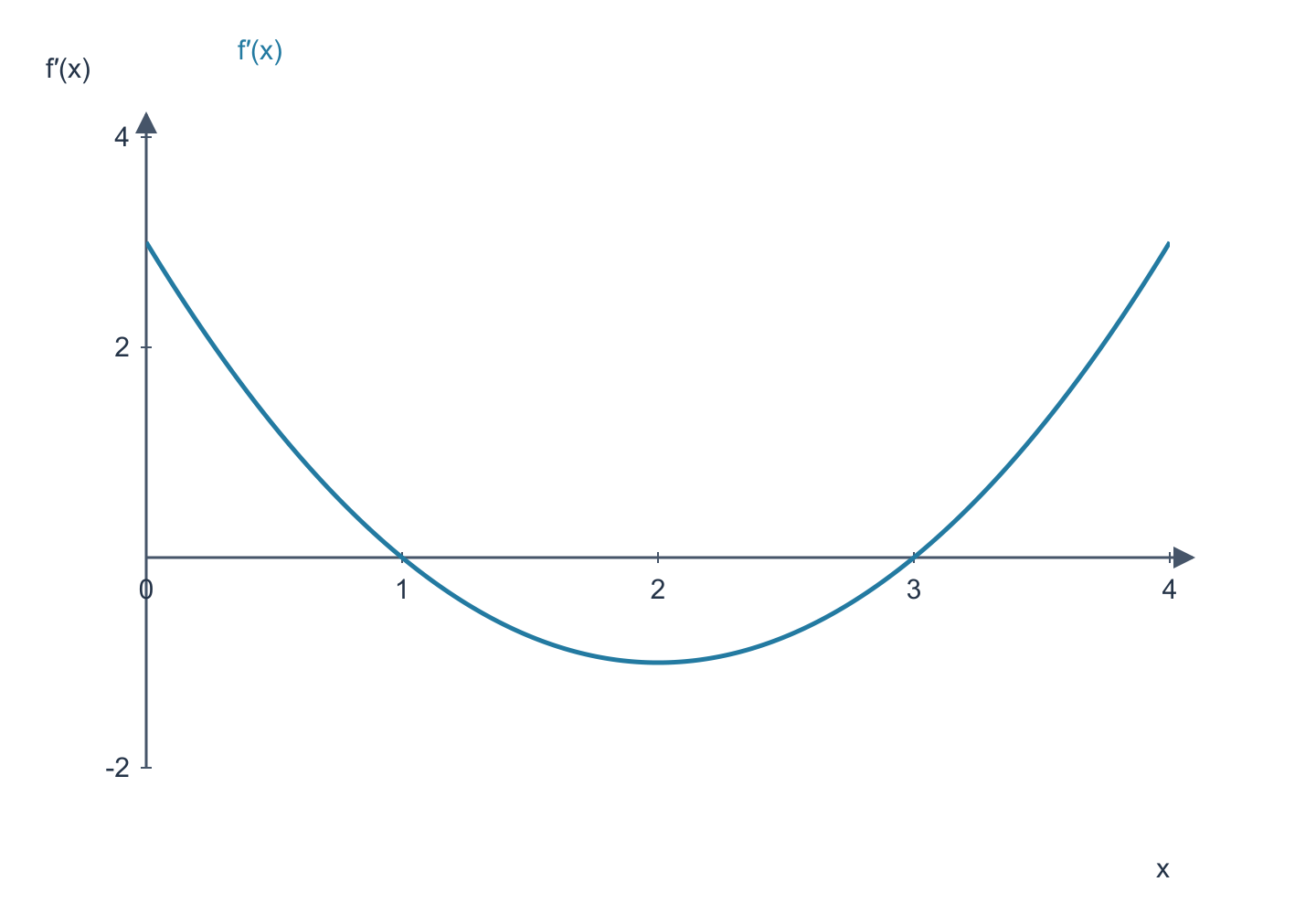
The diagram is the graph of f′(x)=(x−1)(x−3)f'(x)=(x-1)(x-3) on 0≤x≤40\leq x\leq4.

Derivative graph with zeros at one and three

(a) State the open intervals where ff is increasing.[2]

(b) Classify the stationary points of ff at x=1x=1 and x=3x=3, explaining your answer.[3]

Worked solution

Question 7 mark scheme

(a)

The derivative is positive on (0,1)(0,1) and (3,4)(3,4), so ff is increasing there.

(b)

At x=1x=1, f′f' changes from positive to negative, so ff has a local maximum. At x=3x=3, it changes from negative to positive, so ff has a local minimum. The plotted curve is the derivative, so its vertex is not itself a stationary point of ff.

Derivative graph with the corresponding maximum and minimum of f identified

Use the mark scheme after attempting the question yourself.

Question 8

MediumCalculator
[Maximum mark: 6]

Let f(x)=x2e−xf(x)=x^2e^{-x} for 0≤x≤50\leq x\leq5.

(a) Find f′(x)f'(x) and all stationary points in this interval.[3]

(b) Determine the greatest value of ff, to three significant figures, checking the endpoints.[3]

Worked solution

Question 8 mark scheme

(a)

Product differentiation gives f′(x)=e−x(2x−x2)=xe−x(2−x)f'(x)=e^{-x}(2x-x^2)=xe^{-x}(2-x). It vanishes at x=0x=0 and x=2x=2, giving (0,0)(0,0) and (2,4e−2)(2,4e^{-2}).

(b)

For 0<x<20<x<2 the derivative is positive, and for 2<x<52<x<5 it is negative. Comparing f(0)=0f(0)=0, f(2)=4e−2≈0.541341f(2)=4e^{-2}\approx0.541341 and f(5)=25e−5≈0.168449f(5)=25e^{-5}\approx0.168449, the greatest value is 0.5410.541, at x=2x=2.

Use the mark scheme after attempting the question yourself.

Question 9

MildNo calculator
[Maximum mark: 5]

Let f(x)=2sin⁡x+cos⁡xf(x)=2\sin x+\cos x, for 0≤x≤π/20\leq x\leq\pi/2.

(a) Find the exact value of tan⁡x\tan x at a stationary point.[2]

(b) Find the exact value of ff there and classify the point.[3]

Worked solution

Question 9 mark scheme

(a)

f′(x)=2cos⁡x−sin⁡x=0f'(x)=2\cos x-\sin x=0 gives tan⁡x=2\tan x=2.

(b)

In the first quadrant, cos⁡x=1/5\cos x=1/\sqrt5 and sin⁡x=2/5\sin x=2/\sqrt5. Thus f=5/5=5f=5/\sqrt5=\sqrt5. Since f′′=−2sin⁡x−cos⁡x=−5<0f''=-2\sin x-\cos x=-\sqrt5<0 there, the point is a local maximum, also the greatest value on the stated interval.

Use the mark scheme after attempting the question yourself.

Question 10

MediumNo calculator
[Maximum mark: 7]

Let f(x)=(x+a)exf(x)=(x+a)e^x, where aa is real. The tangent at x=0x=0 has gradient 44.

(a) Find aa.[3]

(b) Find the equation of that tangent.[2]

(c) Find the abscissa of the stationary point of ff.[2]

Worked solution

Question 10 mark scheme

(a)

The product rule gives f′(x)=ex(x+a+1)f'(x)=e^x(x+a+1). Thus f′(0)=a+1=4f'(0)=a+1=4, so a=3a=3.

(b)

f(0)=3f(0)=3, so the tangent is y=4x+3y=4x+3.

(c)

With a=3a=3, f′=ex(x+4)f'=e^x(x+4). As ex>0e^x>0, the stationary abscissa is x=−4x=-4.

Use the mark scheme after attempting the question yourself.

Question 11

SpicyCalculator
[Maximum mark: 10]

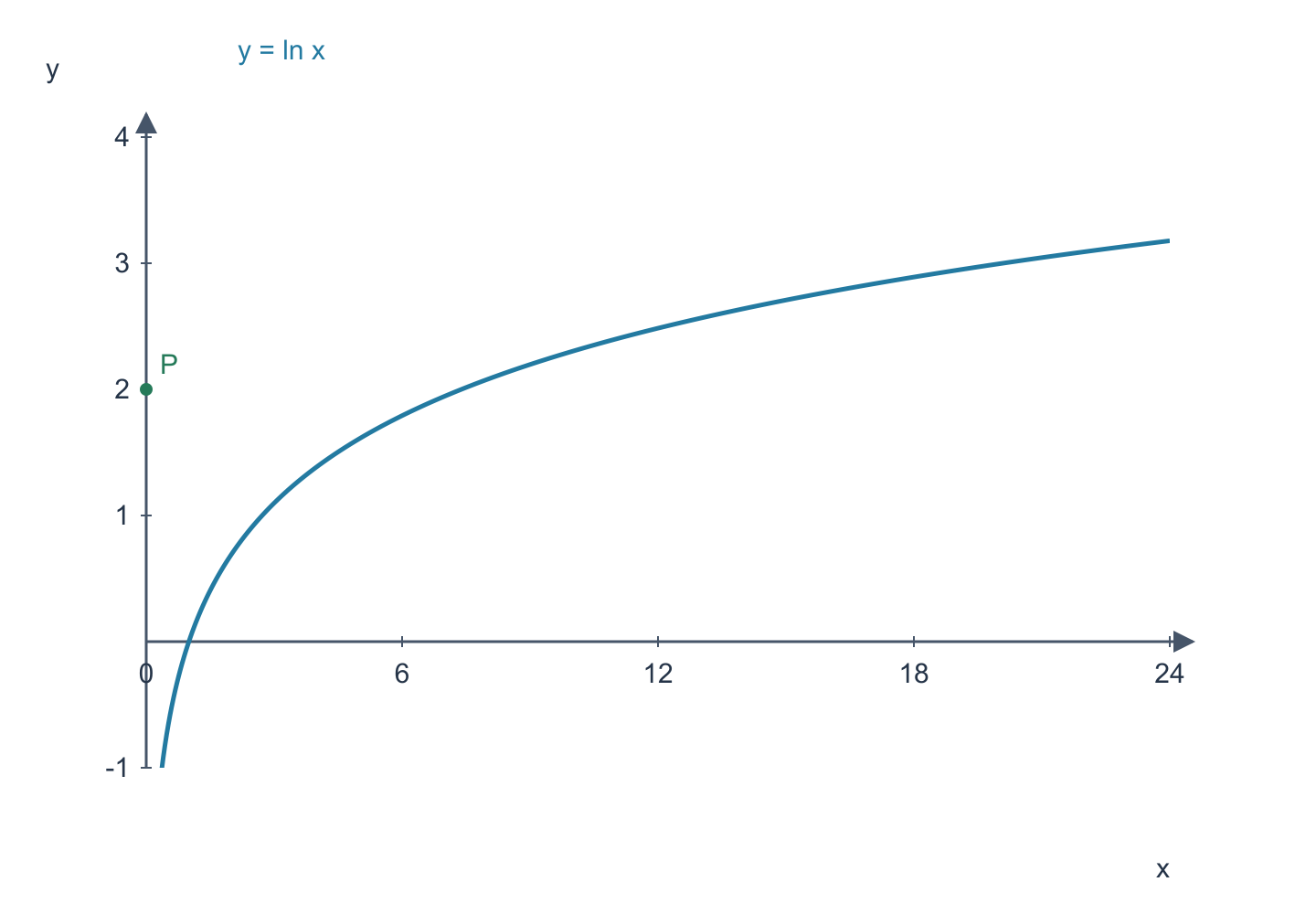
A tangent to y=ln⁡xy=\ln x, x>0x>0, passes through P(0,2)P(0,2) as shown schematically.

Logarithmic curve and external point P

(a) Write the tangent equation at the point with abscissa a>0a>0.[3]

(b) Find aa exactly by imposing passage through PP.[3]

(c) Find the tangent gradient and its horizontal-axis intercept, to three significant figures.[2]

(d) Explain why there is exactly one such tangent.[2]

Worked solution

Question 11 mark scheme

(a)

At (a,ln⁡a)(a,\ln a) the gradient is 1/a1/a, giving y−ln⁡a=(x−a)/ay-\ln a=(x-a)/a.

(b)

At PP, 2−ln⁡a=−12-\ln a=-1. Thus ln⁡a=3\ln a=3 and a=e3a=e^3.

(c)

The tangent is y=e−3x+2y=e^{-3}x+2. Its gradient is e−3≈0.0498e^{-3}\approx0.0498. Setting y=0y=0 gives x=−2e3≈−40.2x=-2e^3\approx-40.2.

(d)

The vertical intercept of the tangent at aa is ln⁡a−1\ln a-1. This is strictly increasing for a>0a>0, ranges over all real numbers, and equals 22 exactly once.

Unique tangent through P to the logarithmic curve

Use the mark scheme after attempting the question yourself.

Question 12

MediumNo calculator
[Maximum mark: 7]

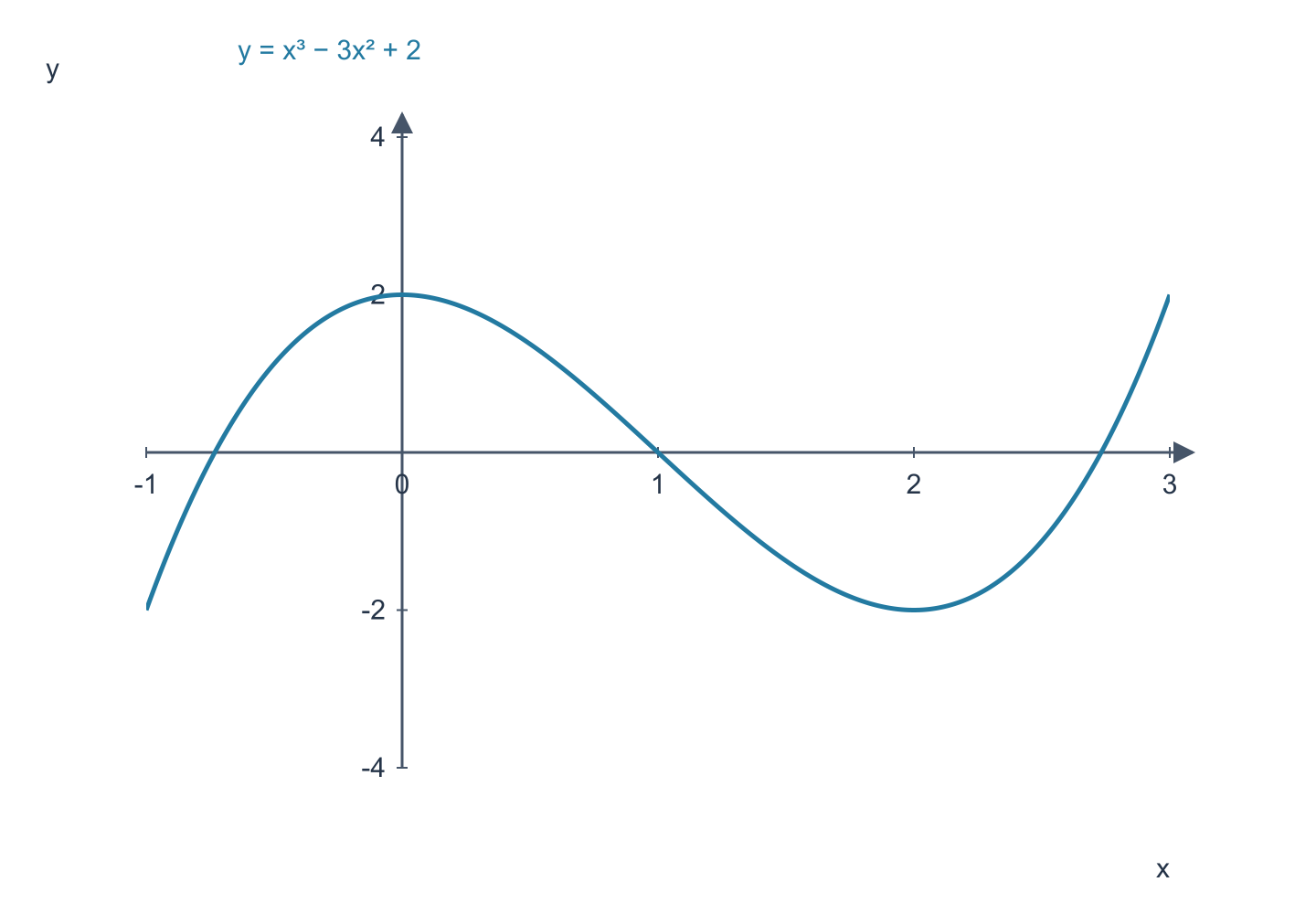
Let f(x)=x3−3x2+2f(x)=x^3-3x^2+2. Its graph is shown.

Cubic curve for concavity analysis

(a) Find f′′(x)f''(x) and the open intervals of concavity.[3]

(b) Find the point of inflection and its gradient.[3]

(c) Explain why this point is not stationary.[1]

Worked solution

Question 12 mark scheme

(a)

f′(x)=3x2−6xf'(x)=3x^2-6x and f′′(x)=6x−6f''(x)=6x-6. The graph is concave down on x<1x<1 and concave up on x>1x>1.

(b)

The second derivative changes sign at x=1x=1. Since f(1)=0f(1)=0, the inflection point is (1,0)(1,0). Its gradient is f′(1)=−3f'(1)=-3.

(c)

A stationary point requires zero first derivative. Here the gradient is −3-3, so the inflection is not stationary.

Cubic with its non-stationary inflection marked

Use the mark scheme after attempting the question yourself.

Question 13

SpicyCalculator
[Maximum mark: 10]

A rectangle is placed under y=9−x2y=9-x^2, above the horizontal axis, with its upper corners at (±x,9−x2)(\pm x,9-x^2). A design constraint requires 2≤x≤32\leq x\leq3.

(a) Show that the rectangle area is A(x)=18x−2x3A(x)=18x-2x^3.[2]

(b) Find the unconstrained positive stationary value of xx.[3]

(c) Determine the greatest area allowed by the design constraint, explaining why the optimum lies at an endpoint.[3]

(d) A prototype uses x=2.65x=2.65. Find the percentage increase in area obtained by the optimal allowed design, to three significant figures.[2]

Worked solution

Question 13 mark scheme

(a)

Width is 2x2x and height is 9−x29-x^2, so A=2x(9−x2)=18x−2x3A=2x(9-x^2)=18x-2x^3.

(b)

A′=18−6x2=0A'=18-6x^2=0 gives x=3x=\sqrt3 for positive xx. At this value A′′=−123<0A''=-12\sqrt3<0.

(c)

The stationary value 3\sqrt3 is below the allowed interval. On [2,3][2,3], A′<0A'<0, so the greatest allowed area occurs at x=2x=2. It is A(2)=20A(2)=20 square units; at x=3x=3 it is zero.

(d)

A(2.65)=10.48075A(2.65)=10.48075. The percentage increase is 20−10.4807510.48075×100≈90.8%.\frac{20-10.48075}{10.48075}\times100\approx90.8\%. The unrounded prototype area is used in the comparison.

Use the mark scheme after attempting the question yourself.

Question 14

SpicyCalculator
[Maximum mark: 10]

Consider fk(x)=x3−3kxf_k(x)=x^3-3kx, where k>0k>0.

(a) Find the stationary abscissae and classify the stationary points.[3]

(b) The difference between the local maximum value and local minimum value is 77. Find kk exactly and to three significant figures.[3]

(c) For this value of kk, give both stationary points to three significant figures.[2]

(d) Determine the number of real solutions of fk(x)=4f_k(x)=4, explaining your answer.[2]

Worked solution

Question 14 mark scheme

(a)

fk′=3(x2−k)f_k'=3(x^2-k), so the stationary abscissae are x=±kx=\pm\sqrt k. Since fk′′=6xf_k''=6x, the negative abscissa gives a maximum and the positive one a minimum. Their values are 2k3/22k^{3/2} and −2k3/2-2k^{3/2}.

(b)

The difference is 4k3/2=74k^{3/2}=7. Hence k=(7/4)2/3≈1.45k=(7/4)^{2/3}\approx1.45.

(c)

Here k=(7/4)1/3≈1.20507\sqrt k=(7/4)^{1/3}\approx1.20507, so the points are (−1.21,3.50)(-1.21,3.50) and (1.21,−3.50)(1.21,-3.50).

(d)

The horizontal line y=4y=4 lies above the local maximum 3.53.5. The left and middle branches never attain 44. The right branch is strictly increasing from −3.5-3.5 to infinity, so exactly one real solution exists.

Use the mark scheme after attempting the question yourself.