Question 1
MildNo calculatorAn arithmetic sequence has first term and common difference .
(a) Find the twelfth term.[2]
(b) Find the sum of the first twelve terms.[2]

AA · HL · Number & Algebra
Arithmetic/Geometric, Sigma notation, Financial Applications
An arithmetic sequence has first term and common difference .
(a) Find the twelfth term.[2]
(b) Find the sum of the first twelve terms.[2]
The fourth and ninth terms of an arithmetic sequence are and respectively.
(a) Find the first term and the common difference.[3]
(b) Find the fifteenth term.[2]
An arithmetic sequence has first term and common difference . Its terms are indexed by positive integers .
(a) Write down in terms of .[1]
(b) Determine which term is equal to .[2]
(c) Explain why is not a term of the sequence.[1]
A geometric sequence has first term and common ratio .
(a) Find the fifth term.[2]
(b) Find the sum of the first four terms.[2]
The first three terms of a geometric sequence are , and , where .
(a) Find .[2]
(b) Find the sum of these three terms.[2]
Consider the sum .
(a) State the first term, the last term and the number of terms.[3]
(b) Evaluate the sum.[2]
A designer makes T-shaped patterns from identical square tiles. The first three stages are shown.
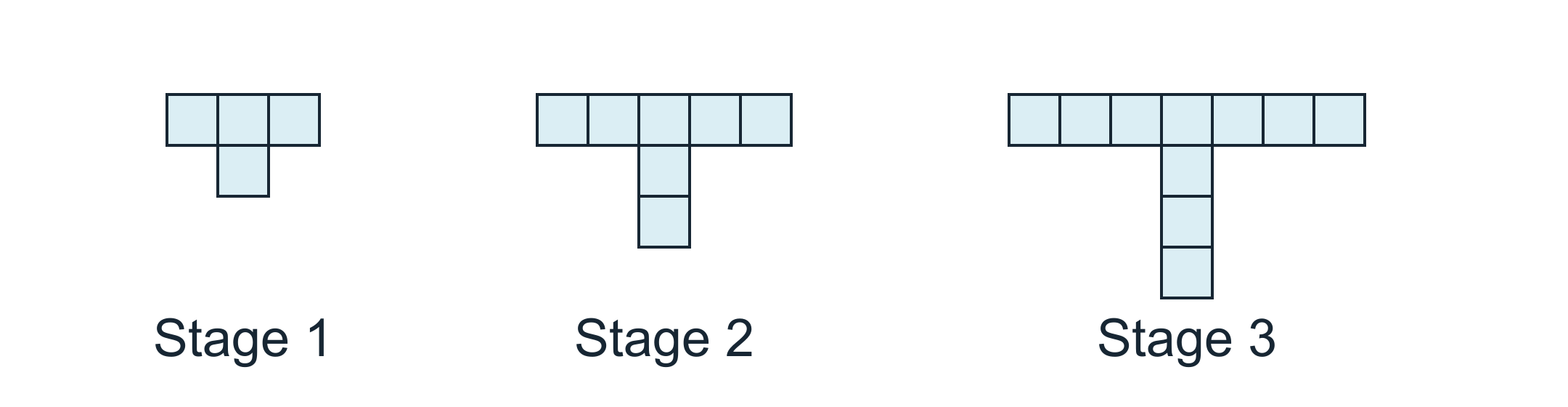
To obtain the next stage, one tile is added to each end of the horizontal bar and one tile is added to the bottom of the vertical stem. No tiles overlap. Let be the number of tiles in stage , with the first diagram representing stage .
(a) State the number of tiles in stage .[1]
(b) Find an expression for .[2]
(c) One separate pattern is made for each stage from to , with no tiles reused between patterns. Find the total number of tiles needed.[3]
(d) Find the first stage containing more than tiles.[2]
A geometric sequence has real, non-zero common ratio . Its third term is and its fifth term is .
(a) Find all possible values of .[3]
(b) Find the first term for each value of .[2]
(c) For each possible sequence, find the sum of the first four terms.[3]
At the start of an experiment, a sample contains mg of a substance. Its mass is multiplied by after each complete day. Let be the mass after complete days, so that .
(a) Find , in mg, correct to three significant figures.[2]
(b) Find the smallest whole number of complete days after which the mass is less than mg.[3]
Consider .
(a) State the first term and the number of terms.[2]
(b) Evaluate the sum exactly.[3]
An infinite geometric series has first term and common ratio . Let be the sum of its first terms.
(a) Explain why the infinite series converges.[1]
(b) Find its sum to infinity.[2]
(c) Express in terms of .[2]
(d) Find the least positive integer for which the difference between the sum to infinity and is less than .[3]
Let . For each positive integer , define .
(a) Write out the four terms in .[2]
(b) Using an infinite geometric series, show that .[3]
(c) Find an exact expression for in terms of .[3]
A saver invests CAD in an account paying a nominal annual interest rate of , compounded monthly. There are no deposits, withdrawals or fees. The annual inflation rate is constant at , compounded annually.
(a) State the monthly growth factor for the account balance.[1]
(b) Find the balance after four years, to the nearest cent.[3]
(c) Express this balance in today's purchasing power by adjusting for four years of inflation. Give your answer in CAD to the nearest cent.[3]
(d) State whether the investment has gained purchasing power over the four years. Justify your answer using your results.[1]
A machine is bought for CAD . Its value falls by at the end of each year. Let be its value immediately after the th annual reduction, with .
(a) Find to the nearest cent.[2]
(b) Find the first whole year for which .[3]
(c) Give one reason why a constant percentage reduction may be an imperfect model of the machine's actual resale value.[1]
Two accounts each receive an initial deposit of CAD , with no later deposits, withdrawals or fees. Account A pays simple interest at per year. Account B pays compound interest at per year, compounded annually. Interest is credited at each year-end.
(a) Write expressions for the balances and after complete years.[2]
(b) Find both balances after four years, to the nearest cent, and state which account has the larger balance.[3]
(c) For positive integers , find the first year-end at which Account B has a larger balance than Account A. Show sufficient numerical evidence that it is the first such year-end.[3]
A savings fund pays interest per year, credited at year-end. Immediately after each interest credit, a deposit of CAD is made. The fund starts with no money, and exactly five deposits are made, at the ends of years . Find values immediately after the fifth deposit, with no fees or withdrawals.
(a) State how many annual interest periods the first deposit and the fifth deposit have earned.[2]
(b) Write the fund's value as a sum of five geometric terms.[2]
(c) Calculate the fund's value to the nearest cent.[2]
(d) Calculate the total interest earned to the nearest cent.[1]
An arithmetic sequence has positive first term and positive common difference . The sum of its first ten terms is , and the sum of terms to inclusive is . Let be the sum of its first terms.
(a) Determine and .[4]
(b) Show that .[2]
(c) Find the least positive integer such that .[3]
(d) Using the value of from (c), find the sum of terms to inclusive.[2]
A geometric sequence has positive first term and positive common ratio . Its partial sums satisfy and .
(a) By grouping the first six terms into two blocks of three, show that .[3]
(b) Find and .[3]
(c) Find the smallest positive integer such that the individual term . Give an exact comparison with the preceding term.[2]
(d) Find the largest positive integer such that . Give an exact comparison with .[3]
For a real parameter , define a sequence by
Consider the infinite series .
(a) For , find all values of for which the series converges.[3]
(b) For values of in the interval found in (a), show that the sum to infinity is independent of , and find that sum.[3]
(c) Examine the series separately when and when . State whether it converges in each case and, if it does, give its sum.[3]
(d) Restrict to the interval in (a). Find all values of for which some finite partial sum , with positive integer , is already equal to the sum to infinity. Justify that there are no other such values.[3]
A fund contains CAD at time . At the end of each month, interest of of the balance is first added. A deposit of CAD is then made at each of the ends of months to inclusive. No further deposits are made after month . There are no fees or withdrawals. Use unrounded balances in all later calculations.
(a) For , express the balance immediately after the th deposit as a geometric sum, and simplify it to .[4]
(b) Find to the nearest cent.[2]
(c) Find the first month-end, counted from time , at which the balance is at least CAD . Justify your integer choice.[3]
(d) Find the total interest earned by the month-end in (c), to the nearest cent.[2]
(e) Suppose instead that the twelve deposits are made at the beginnings of months to , with all other conditions unchanged. Write an expression for the balance at the end of month under this alternative timing. You do not need to evaluate it.[2]