AA · HL · Geometry and Trigonometry

Geometry and Space

2D and 3D Shapes, Perimeter, Area, Surface Area, Volume

DifficultyAll difficulties
Exam modePaper 1 & 2

Question 1

MildNo calculator
[Maximum mark: 5]

In a three-dimensional coordinate system, A=(−2,1,3)A=(-2,1,3) and B=(4,5,15)B=(4,5,15). Coordinates are measured in centimetres.

(a) Find the length ABAB.[3]

(b) Find the midpoint of [AB][AB].[2]

Worked solution

Question 1 mark scheme

(a)

The coordinate differences are 66, 44 and 1212. Therefore AB=62+42+122=196=14 cm.AB=\sqrt{6^2+4^2+12^2}=\sqrt{196}=14\text{ cm}.

(b)

Average the corresponding coordinates: M=(−2+42,1+52,3+152)M=\left(\frac{-2+4}{2},\frac{1+5}{2},\frac{3+15}{2}\right) =(1,3,9).=(1,3,9).

Use the mark scheme after attempting the question yourself.

Question 2

MildNo calculator
[Maximum mark: 5]

The points P=(2,−1,k)P=(2,-1,k) and Q=(5,3,2)Q=(5,3,2) are 1313 units apart.

(a) Find both possible values of kk.[3]

(b) Given that PP is above the plane z=0z=0, determine PP.[2]

Worked solution

Question 2 mark scheme

(a)

The distance formula gives 132=(5−2)2+(3+1)2+(2−k)2.13^2=(5-2)^2+(3+1)^2+(2-k)^2. Thus (k−2)2=169−9−16=144(k-2)^2=169-9-16=144, so k−2=±12k-2=\pm12. Hence k=14k=14 or k=−10k=-10.

(b)

Being above the plane z=0z=0 requires positive third coordinate. Therefore k=14k=14, giving P=(2,−1,14)P=(2,-1,14). The other point has negative third coordinate and lies below the plane.

Use the mark scheme after attempting the question yourself.

Question 3

MediumCalculator
[Maximum mark: 8]

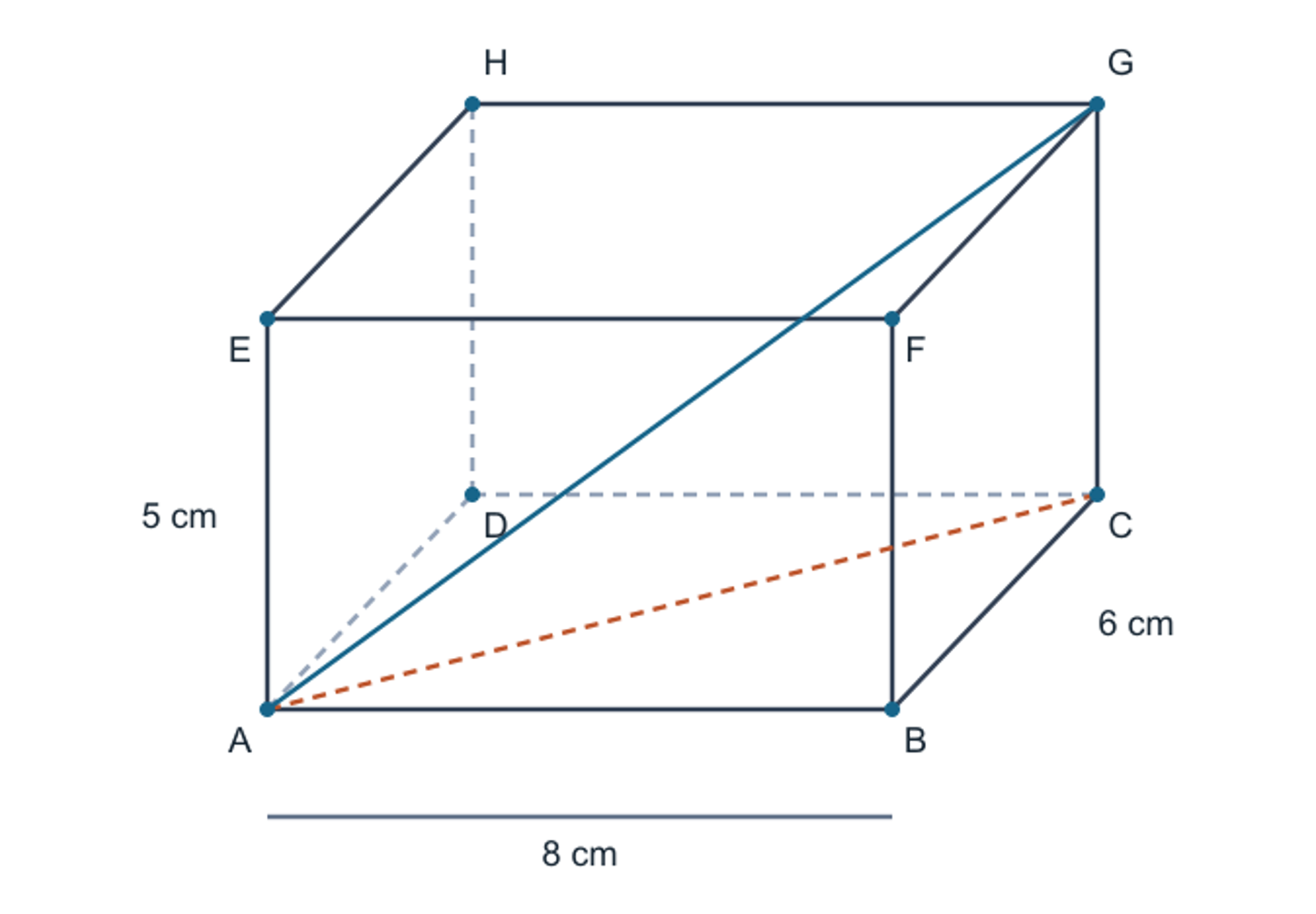
A cuboid has base ABCDABCD and top EFGHEFGH, with E,F,G,HE,F,G,H vertically above A,B,C,DA,B,C,D respectively. Its dimensions are AB=8 cmAB=8\text{ cm}, BC=6 cmBC=6\text{ cm} and AE=5 cmAE=5\text{ cm}.

Cuboid showing the space diagonal and its base projection

(a) Find the base diagonal ACAC.[2]

(b) Find the exact length AGAG.[2]

(c) Find the angle between AGAG and the base plane ABCDABCD, in degrees to one decimal place.[2]

(d) Find the angle between the intersecting lines AGAG and ABAB, in degrees to one decimal place.[2]

Worked solution

Question 3 mark scheme

(a)

Triangle ABCABC is right-angled at BB, so AC=82+62=10 cm.AC=\sqrt{8^2+6^2}=10\text{ cm}.

(b)

Triangle ACGACG is right-angled at CC, with CG=5 cmCG=5\text{ cm}. Hence AG=102+52=125=55 cm.AG=\sqrt{10^2+5^2}=\sqrt{125}=5\sqrt5\text{ cm}.

(c)

The orthogonal projection of AGAG onto the base is ACAC, so the line-plane angle is ∠GAC\angle GAC. Writing this as θ\theta, tan⁡θ=CGAC=510.\tan\theta=\frac{CG}{AC}=\frac5{10}. Thus θ=arctan⁡(1/2)≈26.6∘\theta=\arctan(1/2)\approx26.6^\circ.

(d)

The edge ABAB is perpendicular to the face BCGFBCGF, so triangle ABGABG is right-angled at BB. Therefore, for ϕ=∠GAB\phi=\angle GAB, cos⁡ϕ=ABAG=855.\cos\phi=\frac{AB}{AG}=\frac8{5\sqrt5}. Hence ϕ≈44.3∘\phi\approx44.3^\circ.

Cuboid with the two angle triangles distinguished

Use the mark scheme after attempting the question yourself.

Question 4

MediumNo calculator
[Maximum mark: 5]

The vertices of a trapezium, in order around its boundary, are A=(0,0)A=(0,0), B=(8,0)B=(8,0), C=(6,4)C=(6,4) and D=(2,4)D=(2,4). Coordinates are measured in metres.

(a) Find its area.[2]

(b) Find its exact perimeter.[3]

Worked solution

Question 4 mark scheme

(a)

The parallel sides are AB=8 mAB=8\text{ m} and CD=4 mCD=4\text{ m}, separated by height 4 m4\text{ m}. Thus Area=12(8+4)(4)=24 m2.\text{Area}=\frac12(8+4)(4)=24\text{ m}^2.

(b)

Each sloping side has horizontal displacement 22 and vertical displacement 44, so BC=DA=22+42=25 m.BC=DA=\sqrt{2^2+4^2}=2\sqrt5\text{ m}. The perimeter is therefore 8+4+2(25)=12+45 m.8+4+2(2\sqrt5)=12+4\sqrt5\text{ m}.

Use the mark scheme after attempting the question yourself.

Question 5

SpicyNo calculator
[Maximum mark: 10]

A right square-based pyramid has base side 10 cm10\text{ cm} and perpendicular height 12 cm12\text{ cm}. A sphere fits inside, tangent to the base and all four triangular faces, with its centre on the vertical axis.

The diagram is the axial section through the apex and the midpoints of two opposite base edges. It shows the circular section of the sphere. A radius to a point of tangency is perpendicular to that side of the triangle.
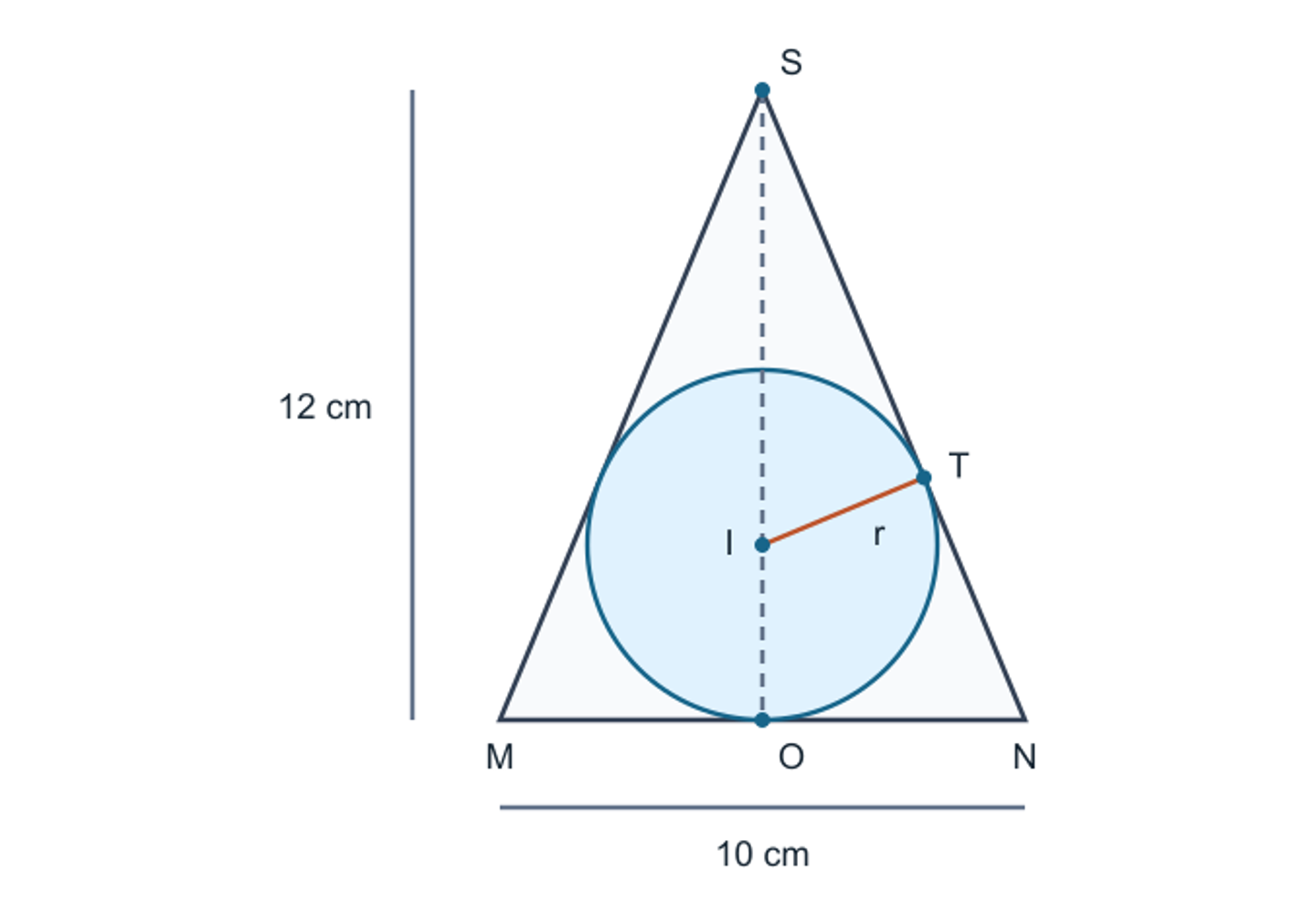
Axial pyramid section with an inscribed circular section

(a) Find the slant height of a triangular face.[2]

(b) Find the total surface area of the pyramid, including its base.[2]

(c) Find the volume of the pyramid.[2]

(d) Determine the exact radius of the sphere.[4]

Worked solution

Question 5 mark scheme

(a)

Half the base side is 5 cm5\text{ cm}. The right triangle from the apex through the base centre to a side midpoint gives slant height l=122+52=13 cm.l=\sqrt{12^2+5^2}=13\text{ cm}.

(b)

The four triangular faces have combined area 4(12×10×13)=260 cm24(\frac12\times10\times13)=260\text{ cm}^2. Adding the square base gives A=260+102=360 cm2.A=260+10^2=360\text{ cm}^2.

(c)

The volume is V=13(102)(12)=400 cm3.V=\frac13(10^2)(12)=400\text{ cm}^3.

(d)

Let the apex be SS, the base centre be OO, the sphere centre be II, and a side contact point in the section be TT. Write the radius as rr. The base tangency gives OI=rOI=r, so SI=12−rSI=12-r.

Let α\alpha be the angle at SS between the axis and the sloping side of the section. The large right triangle gives sin⁡α=5/13\sin\alpha=5/13. The right triangle SITSIT, with IT=rIT=r, gives sin⁡α=r12−r.\sin\alpha=\frac{r}{12-r}. Consequently r12−r=513⇒13r=60−5r.\frac{r}{12-r}=\frac5{13}\quad\Rightarrow\quad13r=60-5r. Thus 18r=6018r=60 and r=103 cmr=\frac{10}{3}\text{ cm}. This is positive and less than both the half-width 55 and the height 1212.

Pyramid section showing the perpendicular tangency radius and centre height

Use the mark scheme after attempting the question yourself.

Question 6

MildNo calculator
[Maximum mark: 5]

A cube has space diagonal 63 cm6\sqrt3\text{ cm}.

(a) Find its edge length.[2]

(b) Find the exact length of a face diagonal.[2]

(c) Find its volume.[1]

Worked solution

Question 6 mark scheme

(a)

If the edge is a>0a>0, applying Pythagoras in two perpendicular planes gives space diagonal a2+a2+a2=a3\sqrt{a^2+a^2+a^2}=a\sqrt3. Therefore a3=63a\sqrt3=6\sqrt3, so a=6 cma=6\text{ cm}.

(b)

A face diagonal has length 62+62=62 cm\sqrt{6^2+6^2}=6\sqrt2\text{ cm}.

(c)

The volume is 63=216 cm36^3=216\text{ cm}^3.

Use the mark scheme after attempting the question yourself.

Question 7

MediumCalculator
[Maximum mark: 7]

A straight cable joins A=(1.2,0.8,0)A=(1.2,0.8,0) to B=(6.5,4.4,2.7)B=(6.5,4.4,2.7) in a coordinate system measured in metres. The plane z=0z=0 is horizontal.

(a) Find the horizontal distance between the endpoints, to three significant figures.[2]

(b) Find the cable length, to three significant figures.[2]

(c) Find the acute angle of the cable to the horizontal plane, in degrees to one decimal place.[2]

(d) Explain why the horizontal distance alone underestimates the cable length.[1]

Worked solution

Question 7 mark scheme

(a)

The horizontal coordinate differences are 5.35.3 and 3.63.6. The horizontal distance is d=5.32+3.62=41.05d=\sqrt{5.3^2+3.6^2}=\sqrt{41.05} =6.407027… m≈6.41 m.=6.407027\ldots\text{ m}\approx6.41\text{ m}.

(b)

The vertical difference is 2.7 m2.7\text{ m}, so L=41.05+2.72=48.34L=\sqrt{41.05+2.7^2}=\sqrt{48.34} =6.952697… m≈6.95 m.=6.952697\ldots\text{ m}\approx6.95\text{ m}.

(c)

Using the unrounded horizontal distance, θ=arctan⁡(2.741.05)≈22.9∘.\theta=\arctan\left(\frac{2.7}{\sqrt{41.05}}\right)\approx22.9^\circ.

(d)

The cable is the hypotenuse of a right triangle with horizontal leg dd and positive vertical leg 2.72.7. Thus L2=d2+2.72>d2L^2=d^2+2.7^2>d^2, so L>dL>d.

Use the mark scheme after attempting the question yourself.

Question 8

MediumCalculator
[Maximum mark: 7]

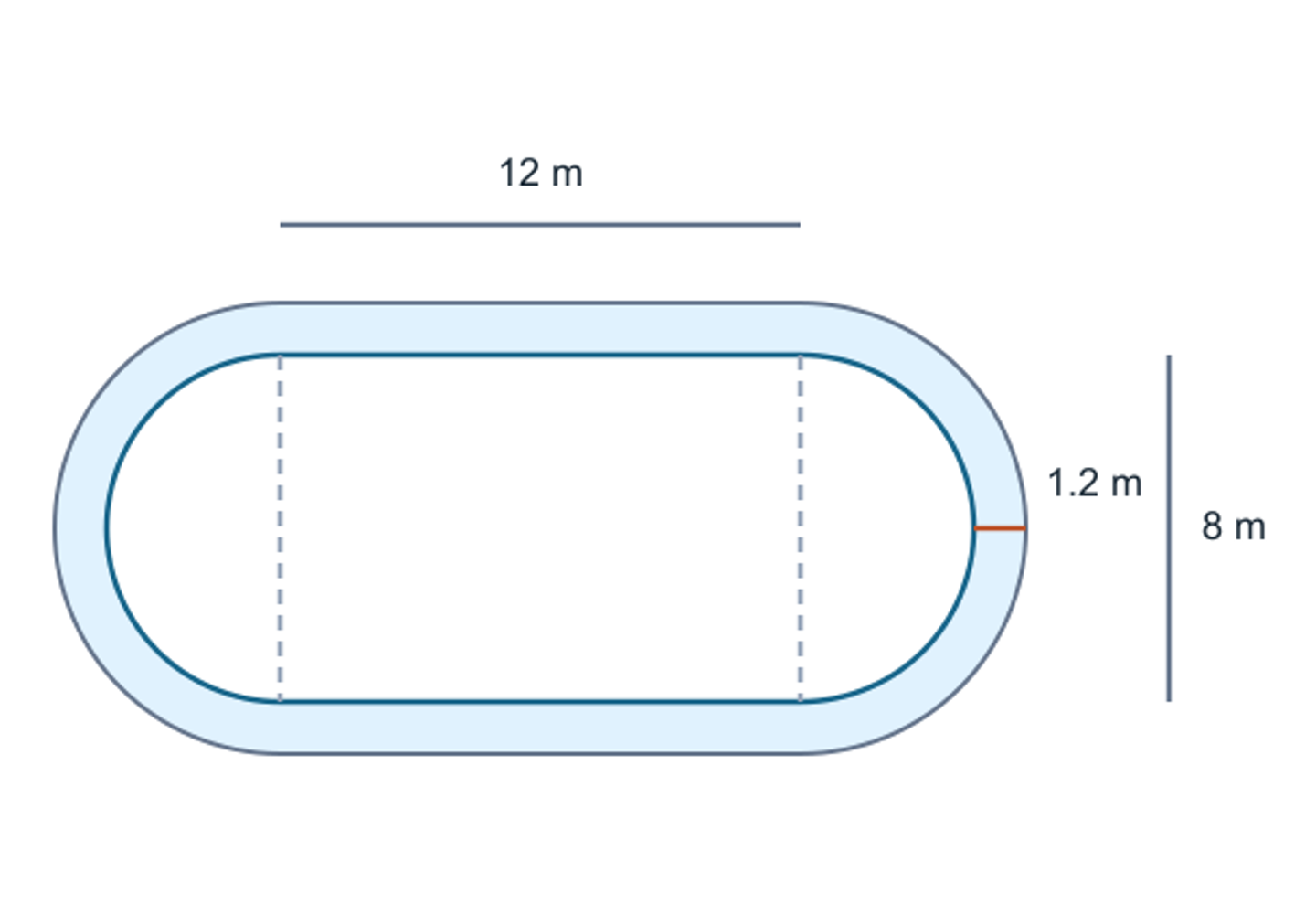
A stadium-shaped lawn consists of a 12 m12\text{ m} by 8 m8\text{ m} rectangle with a semicircle of diameter 8 m8\text{ m} attached to each short end. A path of uniform width 1.2 m1.2\text{ m} is built outside the lawn. The outer boundary is another stadium with the same 12 m12\text{ m} straight sections and semicircle radius 5.2 m5.2\text{ m}.

Stadium lawn and its uniform external path

(a) Find the exact lawn area.[2]

(b) Find the exact length of its boundary.[2]

(c) Find the path area to three significant figures.[3]

Worked solution

Question 8 mark scheme

(a)

The two semicircles form a circle of radius 4 m4\text{ m}. Hence Alawn=12(8)+π42=96+16π m2.A_{\text{lawn}}=12(8)+\pi4^2=96+16\pi\text{ m}^2.

(b)

The boundary contains two straight sections and two semicircular arcs, so P=2(12)+2π(4)=24+8π m.P=2(12)+2\pi(4)=24+8\pi\text{ m}.

(c)

The outer stadium has rectangular part 1212 by 10.410.4 and a combined circle of radius 5.25.2. Thus Aouter=124.8+27.04π.A_{\text{outer}}=124.8+27.04\pi. Subtracting the lawn gives Apath=28.8+11.04πA_{\text{path}}=28.8+11.04\pi =63.483182… m2≈63.5 m2.=63.483182\ldots\text{ m}^2\approx63.5\text{ m}^2.

External stadium radius used to calculate the path area

Use the mark scheme after attempting the question yourself.

Question 9

MildNo calculator
[Maximum mark: 4]

A rectangular panel has width 5 cm5\text{ cm} and diagonal 13 cm13\text{ cm}.

(a) Find its length.[2]

(b) Find its area and perimeter.[2]

Worked solution

Question 9 mark scheme

(a)

The diagonal is the hypotenuse of a right triangle with the length ll and width 55 as legs. Thus l=132−52=144=12 cm.l=\sqrt{13^2-5^2}=\sqrt{144}=12\text{ cm}.

(b)

The area is 12×5=60 cm212\times5=60\text{ cm}^2 and the perimeter is 2(12+5)=34 cm2(12+5)=34\text{ cm}.

Use the mark scheme after attempting the question yourself.

Question 10

MediumCalculator
[Maximum mark: 5]

A circular frame has inner radius 3.6 cm3.6\text{ cm}. The area of material in the frame is 41.2 cm241.2\text{ cm}^2.

(a) Find its outer radius to three significant figures.[4]

(b) Find the uniform width of the frame to three significant figures.[1]

Worked solution

Question 10 mark scheme

(a)

Let the outer radius be R>3.6R>3.6. Subtracting the inner disc from the outer disc gives πR2−π(3.6)2=41.2.\pi R^2-\pi(3.6)^2=41.2. Hence R=3.62+41.2πR=\sqrt{3.6^2+\frac{41.2}{\pi}} =5.106306… cm≈5.11 cm.=5.106306\ldots\text{ cm}\approx5.11\text{ cm}. The positive square root is required for a radius.

(b)

Using the unrounded outer radius, the width is R−3.6=1.506306… cm≈1.51 cmR-3.6=1.506306\ldots\text{ cm}\approx1.51\text{ cm}.

Use the mark scheme after attempting the question yourself.

Question 11

MediumCalculator
[Maximum mark: 6]

Two similar flat signs have area ratio Alarge:Asmall=2.25:1A_{\text{large}}:A_{\text{small}}=2.25:1. The smaller sign has perimeter 18.4 cm18.4\text{ cm} and area 18.8 cm218.8\text{ cm}^2.

(a) Find the linear scale factor from the smaller sign to the larger sign.[2]

(b) Find the perimeter and area of the larger sign.[3]

(c) Explain why multiplying the smaller perimeter by 2.252.25 would be incorrect.[1]

Worked solution

Question 11 mark scheme

(a)

If the positive linear factor is ss, area scales by s2s^2. Thus s2=2.25s^2=2.25 and s=1.5s=1.5.

(b)

Perimeter scales by 1.51.5, giving 18.4(1.5)=27.6 cm18.4(1.5)=27.6\text{ cm}. Area scales by 2.252.25, giving 18.8(2.25)=42.3 cm218.8(2.25)=42.3\text{ cm}^2.

(c)

A perimeter is a sum of lengths, so it scales by the linear factor 1.51.5. The factor 2.252.25 applies to areas, which involve two length dimensions.

Use the mark scheme after attempting the question yourself.

Question 12

MildNo calculator
[Maximum mark: 5]

A closed right circular cylinder has radius 3 cm3\text{ cm} and height 7 cm7\text{ cm}.

(a) Find its exact volume.[2]

(b) Find its exact total surface area, including both circular ends.[3]

Worked solution

Question 12 mark scheme

(a)

The volume is V=πr2h=π(32)(7)=63π cm3.V=\pi r^2h=\pi(3^2)(7)=63\pi\text{ cm}^3.

(b)

The curved area is 2πrh=2π(3)(7)=42π cm22\pi rh=2\pi(3)(7)=42\pi\text{ cm}^2. The two ends contribute 2πr2=18π cm22\pi r^2=18\pi\text{ cm}^2. Therefore the total is A=42π+18π=60π cm2.A=42\pi+18\pi=60\pi\text{ cm}^2.

Use the mark scheme after attempting the question yourself.

Question 13

MildNo calculator
[Maximum mark: 5]

A solid hemisphere has radius 6 cm6\text{ cm}. Give exact answers.

(a) Find its volume.[2]

(b) Find its curved surface area.[2]

(c) Find its total surface area, including the flat circular face.[1]

Worked solution

Question 13 mark scheme

(a)

A hemisphere has half the volume of a sphere: V=12(43π63)=144π cm3.V=\frac12\left(\frac43\pi6^3\right)=144\pi\text{ cm}^3.

(b)

Its curved area is half the surface area of a sphere: Acurved=12(4π62)=72π cm2.A_{\text{curved}}=\frac12(4\pi6^2)=72\pi\text{ cm}^2.

(c)

The flat face has area π62=36π cm2\pi6^2=36\pi\text{ cm}^2, so the total is 72π+36π=108π cm272\pi+36\pi=108\pi\text{ cm}^2.

Use the mark scheme after attempting the question yourself.

Question 14

MediumCalculator
[Maximum mark: 8]

A right rectangular-based pyramid has a base 8.4 cm8.4\text{ cm} by 5.6 cm5.6\text{ cm} and perpendicular height 9.2 cm9.2\text{ cm}. Its apex is directly above the centre of the base.

(a) Find the two different face slant heights to three significant figures. Identify which base edge belongs to each.[3]

(b) Find the total surface area to three significant figures.[3]

(c) Find the volume to three significant figures.[2]

Worked solution

Question 14 mark scheme

(a)

For a face with base edge 8.48.4, the horizontal distance from the base centre to that edge is 5.6/2=2.85.6/2=2.8. Its slant height is l1=9.22+2.82=9.616652… cml_1=\sqrt{9.2^2+2.8^2}=9.616652\ldots\text{ cm} ≈9.62 cm.\approx9.62\text{ cm}. For a face with base edge 5.65.6, the horizontal distance is 8.4/2=4.28.4/2=4.2, giving l2=9.22+4.22=10.113357… cml_2=\sqrt{9.2^2+4.2^2}=10.113357\ldots\text{ cm} ≈10.1 cm.\approx10.1\text{ cm}.

(b)

There are two triangular faces of each type. Using unrounded slant heights, A=8.4(5.6)+8.4l1+5.6l2A=8.4(5.6)+8.4l_1+5.6l_2 =184.454680… cm2≈184 cm2.=184.454680\ldots\text{ cm}^2\approx184\text{ cm}^2.

(c)

The perpendicular height, rather than a slant height, enters the volume formula: V=13(8.4)(5.6)(9.2)=144.256 cm3V=\frac13(8.4)(5.6)(9.2)=144.256\text{ cm}^3 ≈144 cm3.\approx144\text{ cm}^3.

Use the mark scheme after attempting the question yourself.

Question 15

MediumNo calculator
[Maximum mark: 6]

A right prism has a right-angled triangular cross-section with perpendicular sides 6 cm6\text{ cm} and 8 cm8\text{ cm}. Its length is 15 cm15\text{ cm}.

(a) Find its volume.[2]

(b) Find its total surface area.[3]

(c) Only the three rectangular faces are painted. Find the painted area.[1]

Worked solution

Question 15 mark scheme

(a)

The cross-sectional area is 12(6)(8)=24 cm2\frac12(6)(8)=24\text{ cm}^2, so V=24(15)=360 cm3.V=24(15)=360\text{ cm}^3.

(b)

The third triangle side is 62+82=10 cm\sqrt{6^2+8^2}=10\text{ cm}. The combined rectangular area is (6+8+10)(15)=360 cm2.(6+8+10)(15)=360\text{ cm}^2. The two triangular ends add 2(24)=48 cm22(24)=48\text{ cm}^2, giving total surface area 408 cm2408\text{ cm}^2.

(c)

Excluding the two triangular ends leaves painted area 360 cm2360\text{ cm}^2.

Use the mark scheme after attempting the question yourself.

Question 16

MediumCalculator
[Maximum mark: 7]

A solid metal sphere has volume 850 cm3850\text{ cm}^3.

(a) Find its radius to three significant figures.[2]

(b) Find its surface area to three significant figures.[2]

(c) The metal is melted and recast into complete spheres of radius 1.4 cm1.4\text{ cm}. Assuming no loss of metal, find the greatest number of complete smaller spheres that can be made.[3]

Worked solution

Question 16 mark scheme

(a)

From 43πr3=850\frac43\pi r^3=850, r=(3(850)4π)1/3r=\left(\frac{3(850)}{4\pi}\right)^{1/3} =5.876383… cm≈5.88 cm.=5.876383\ldots\text{ cm}\approx5.88\text{ cm}.

(b)

Using the unrounded radius, A=4πr2=433.940389… cm2≈434 cm2.A=4\pi r^2=433.940389\ldots\text{ cm}^2\approx434\text{ cm}^2.

(c)

Each smaller sphere requires v=43π(1.4)3=11.494040… cm3.v=\frac43\pi(1.4)^3=11.494040\ldots\text{ cm}^3. The available volume could make 850/v=73.951367…850/v=73.951367\ldots such volumes. Only whole spheres count, so the maximum is 7373. Indeed, 73v<850<74v73v<850<74v.

Use the mark scheme after attempting the question yourself.

Question 17

SpicyNo calculator
[Maximum mark: 10]

A closed tank consists of a vertical cylinder of radius 3 m3\text{ m} and height 8 m8\text{ m}, topped by a hemisphere of the same radius. The bottom is a flat circular disc. Wall thickness is negligible.

The diagram is an axial section. The circular join between the cylinder and dome is internal.
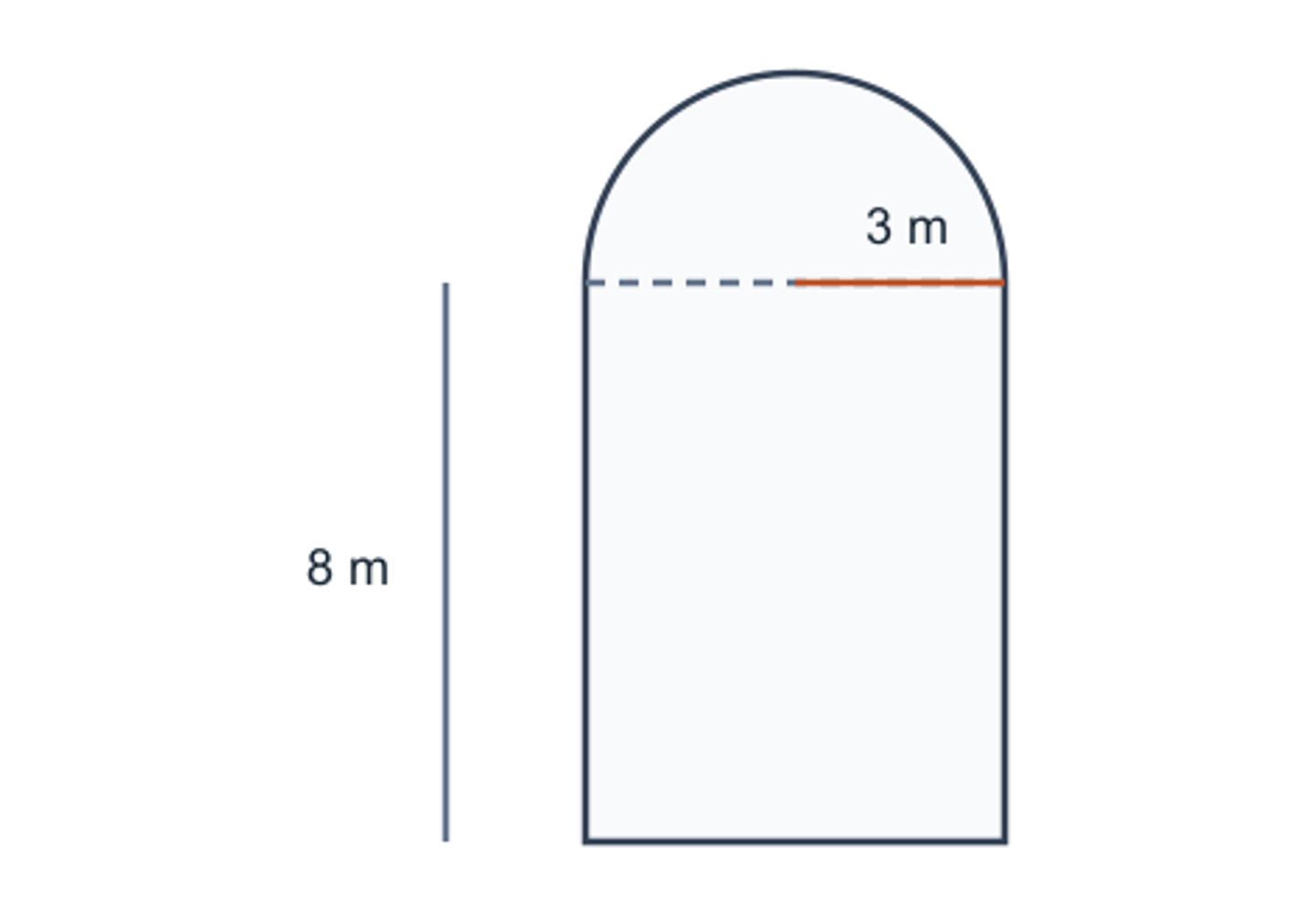
Axial section of a cylinder topped by a hemisphere

(a) Find the exact tank capacity.[3]

(b) Find the exact exposed surface area, including the bottom.[3]

(c) The tank is half full of water. Find the water depth from the bottom and justify which part of the tank contains the water.[2]

(d) Find the percentage of capacity used when the water reaches the circular join.[2]

Worked solution

Question 17 mark scheme

(a)

The cylinder volume is π(32)(8)=72π m3\pi(3^2)(8)=72\pi\text{ m}^3. The hemisphere adds 23π33=18π m3\frac23\pi3^3=18\pi\text{ m}^3. Thus the capacity is 90π m390\pi\text{ m}^3.

(b)

The exposed surfaces are the cylindrical wall, hemispherical roof and bottom disc. Their combined area is A=2π(3)(8)+2π(32)+π(32)A=2\pi(3)(8)+2\pi(3^2)+\pi(3^2) =48π+18π+9π=75π m2.=48\pi+18\pi+9\pi=75\pi\text{ m}^2. The join is not an exposed surface.

(c)

Half the capacity is 45π m345\pi\text{ m}^3, less than the cylinder's 72π m372\pi\text{ m}^3, so the water remains within the cylindrical part. Its depth dd satisfies 9πd=45π⇒d=5 m.9\pi d=45\pi\quad\Rightarrow\quad d=5\text{ m}.

Tank section showing the half-full water level within the cylinder

(d)

At the join the water occupies the whole cylinder, so the percentage is 72π90π×100%=80%.\frac{72\pi}{90\pi}\times100\%=80\%.

Use the mark scheme after attempting the question yourself.

Question 18

MediumCalculator
[Maximum mark: 7]

A hollow metal pipe has outer radius 4.8 cm4.8\text{ cm}, inner radius 4.1 cm4.1\text{ cm} and length 1.7 m1.7\text{ m}. The metal density is 7.85 g cm−37.85\text{ g cm}^{-3}. Give numerical answers to three significant figures.

(a) State the pipe length in centimetres and find the volume of metal in cubic centimetres.[3]

(b) Find the mass of the pipe in kilograms.[2]

(c) Find the area of the outer curved surface in square metres, excluding both annular ends and the inner surface.[2]

Worked solution

Question 18 mark scheme

(a)

The length is 170 cm170\text{ cm}. Subtracting the inner cylinder volume from the outer gives V=π(4.82−4.12)(170)=1059.1π cm3V=\pi(4.8^2-4.1^2)(170)=1059.1\pi\text{ cm}^3 =3327.260779… cm3≈3.33×103 cm3.=3327.260779\ldots\text{ cm}^3\approx3.33\times10^3\text{ cm}^3.

(b)

Using the unrounded volume, the mass is m=7.85V1000=26.118997… kg≈26.1 kg.m=\frac{7.85V}{1000}=26.118997\ldots\text{ kg}\approx26.1\text{ kg}.

(c)

The outer curved area is A=2π(4.8)(170)=1632π cm2.A=2\pi(4.8)(170)=1632\pi\text{ cm}^2. Since 1 m2=104 cm21\text{ m}^2=10^4\text{ cm}^2, A=1632π104=0.512707921… m2A=\frac{1632\pi}{10^4}=0.512707921\ldots\text{ m}^2 ≈0.513 m2.\approx0.513\text{ m}^2.

Use the mark scheme after attempting the question yourself.

Question 19

SpicyNo calculator
[Maximum mark: 12]

A solid right circular frustum has lower radius 6 cm6\text{ cm}, upper radius 3 cm3\text{ cm} and perpendicular height 8 cm8\text{ cm}. It is obtained by cutting a smaller cone from a larger similar cone, with the cut parallel to the base. The diagram is an axial section.
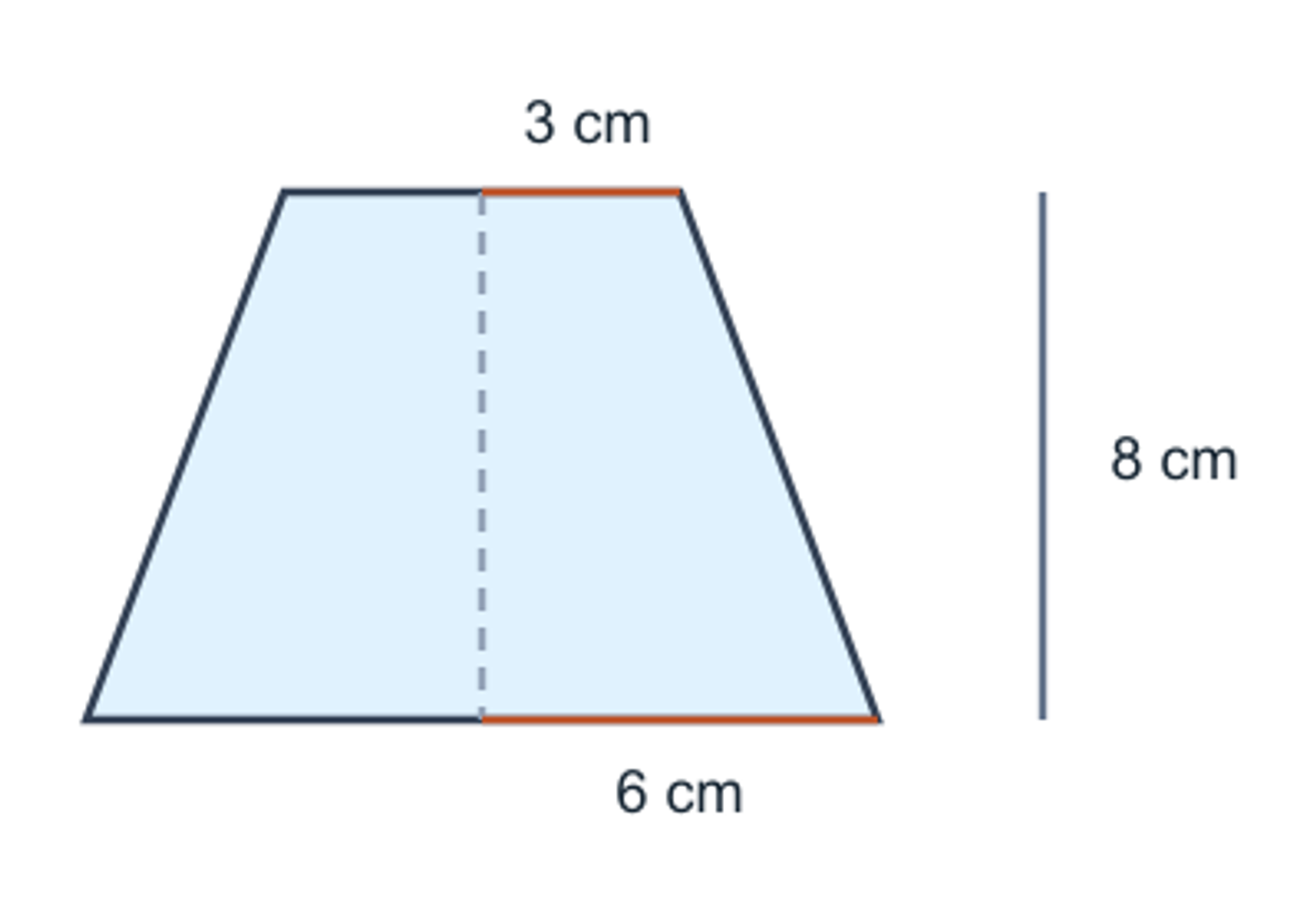
Axial section of a frustum with both radii and its perpendicular height

Give exact answers unless a percentage is requested.

(a) Find the perpendicular heights of the complete cone and the removed cone.[3]

(b) Find the frustum volume by subtraction.[3]

(c) Find the frustum's curved surface area by subtracting the cone curved areas.[3]

(d) Find the total surface area, including both circular faces.[2]

(e) What percentage of the complete cone's volume remains?[1]

Worked solution

Question 19 mark scheme

(a)

Similar cones have height ratio 6:3=2:16:3=2:1. If the small height is hh, the complete height is 2h2h. Their difference is the frustum height, so 2h−h=82h-h=8. The removed cone has height 8 cm8\text{ cm} and the complete cone has height 16 cm16\text{ cm}.

(b)

Their volumes are Vlarge=13π(62)(16)=192π,V_{\text{large}}=\frac13\pi(6^2)(16)=192\pi, Vsmall=13π(32)(8)=24π.V_{\text{small}}=\frac13\pi(3^2)(8)=24\pi. Thus Vfrustum=168π cm3V_{\text{frustum}}=168\pi\text{ cm}^3.

(c)

The removed cone's slant height is 32+82=73 cm\sqrt{3^2+8^2}=\sqrt{73}\text{ cm}; the complete cone's is 273 cm2\sqrt{73}\text{ cm}. Subtracting their curved areas gives Acurved=π(6)(273)−π(3)(73)A_{\text{curved}}=\pi(6)(2\sqrt{73})-\pi(3)(\sqrt{73}) =9π73 cm2.=9\pi\sqrt{73}\text{ cm}^2.

(d)

The circular faces contribute π62+π32=45π cm2\pi6^2+\pi3^2=45\pi\text{ cm}^2. Therefore Atotal=9π73+45π cm2.A_{\text{total}}=9\pi\sqrt{73}+45\pi\text{ cm}^2.

Extended cone section showing similar heights and the frustum slant

(e)

The remaining fraction is 168/192=7/8168/192=7/8, so 87.5%87.5\% remains.

Use the mark scheme after attempting the question yourself.

Question 20

SpicyNo calculator
[Maximum mark: 8]

A cylindrical container has positive radius r cmr\text{ cm} and positive height h cmh\text{ cm}. Its dimensions satisfy 2r+h=92r+h=9, and its volume is 20π cm320\pi\text{ cm}^3.

(a) State the possible interval for rr.[1]

(b) By substituting for hh and expanding the product, show that the volume condition is equivalent to (r−2)(2r2−5r−10)=0.(r-2)(2r^2-5r-10)=0.[3]

(c) Find all physically possible pairs (r,h)(r,h), giving exact answers.[4]

Worked solution

Question 20 mark scheme

(a)

Positive radius and height require r>0r>0 and 9−2r>09-2r>0, so 0<r<920<r<\frac92.

(b)

Substitute h=9−2rh=9-2r into πr2h=20π\pi r^2h=20\pi. Cancelling π\pi gives r2(9−2r)=20r^2(9-2r)=20, or 2r3−9r2+20=0.2r^3-9r^2+20=0. Expansion verifies (r−2)(2r2−5r−10)=2r3−9r2+20,(r-2)(2r^2-5r-10)=2r^3-9r^2+20, so the factored equation follows directly from the volume condition.

(c)

Either r=2r=2 or r=5±25+804=5±1054.r=\frac{5\pm\sqrt{25+80}}4=\frac{5\pm\sqrt{105}}4. The minus sign gives negative radius and is rejected. The plus sign lies in (0,9/2)(0,9/2), since 10<105<1310<\sqrt{105}<13. Using h=9−2rh=9-2r, the two designs are (r,h)=(2,5)(r,h)=(2,5) and (5+1054,13−1052).\left(\frac{5+\sqrt{105}}4,\frac{13-\sqrt{105}}2\right). Both dimensions in each pair are positive and satisfy the original volume equation.

Use the mark scheme after attempting the question yourself.

Question 21

MildCalculator
[Maximum mark: 4]

A plan uses scale 1:12501:1250.

(a) A straight fence is 6.4 cm6.4\text{ cm} long on the plan. Find its actual length in metres.[2]

(b) A rectangular plot measures 3.2 cm3.2\text{ cm} by 2.7 cm2.7\text{ cm} on the plan. Find its actual area in square metres.[2]

Worked solution

Question 21 mark scheme

(a)

The actual fence length is 6.4(1250)=8000 cm=80 m6.4(1250)=8000\text{ cm}=80\text{ m}.

(b)

The actual rectangle sides are 3.2(1250)/100=40 m3.2(1250)/100=40\text{ m} and 2.7(1250)/100=33.75 m2.7(1250)/100=33.75\text{ m}. Thus its area is 40(33.75)=1350 m2.40(33.75)=1350\text{ m}^2.

Use the mark scheme after attempting the question yourself.

Question 22

SpicyCalculator
[Maximum mark: 11]

Two right circular cones have the same apex, vertical axis and base plane. The outer cone has half-angle 42∘42^\circ and the inner cone has half-angle 27∘27^\circ, each measured between the vertical axis and a sloping side in an axial section.

The inner cone is removed from the outer cone, leaving a conical shell of material of volume 1200 cm31200\text{ cm}^3. The common perpendicular height is hh, the outer base radius is RR, and the inner base radius is rr. Both conical surfaces and the annular base are exposed.

(a) Express RR and rr in terms of hh.[2]

(b) Find hh to three significant figures.[3]

(c) Find RR and rr to three significant figures.[2]

(d) Find the total exposed surface area to three significant figures.[4]

Worked solution

Question 22 mark scheme

(a)

The right triangles in an axial section give R=htan⁡42∘,r=htan⁡27∘.R=h\tan42^\circ,\qquad r=h\tan27^\circ.

(b)

The material volume is the outer cone volume minus the inner cone volume: 1200=13πh(R2−r2).1200=\frac13\pi h(R^2-r^2). Substituting part (a) gives h3=3600π(tan⁡242∘−tan⁡227∘).h^3=\frac{3600}{\pi(\tan^2 42^\circ-\tan^2 27^\circ)}. Taking the positive cube root, h=12.763539… cm≈12.8 cm.h=12.763539\ldots\text{ cm}\approx12.8\text{ cm}.

(c)

Using the unrounded height, R=11.492342… cm≈11.5 cm,R=11.492342\ldots\text{ cm}\approx11.5\text{ cm}, r=6.503348… cm≈6.50 cm.r=6.503348\ldots\text{ cm}\approx6.50\text{ cm}.

(d)

The outer and inner slant heights are L=h/cos⁡42∘L=h/\cos42^\circ and l=h/cos⁡27∘l=h/\cos27^\circ. The exposed area is A=πRL+πrl+π(R2−r2).A=\pi RL+\pi rl+\pi(R^2-r^2). The first two terms cover the outer and inner conical surfaces; the last term is the annular base. Evaluating with unrounded dimensions gives A=1194.814615… cm2≈1.19×103 cm2.A=1194.814615\ldots\text{ cm}^2\approx1.19\times10^3\text{ cm}^2.

Use the mark scheme after attempting the question yourself.

Question 23

MildNo calculator
[Maximum mark: 4]

A plane cuts a sphere of radius 5 cm5\text{ cm}. The perpendicular distance from the sphere centre to the plane is 4 cm4\text{ cm}.

(a) Find the radius of the circular section.[2]

(b) Find its exact area and circumference.[2]

Worked solution

Question 23 mark scheme

(a)

Let the sphere centre be OO, its perpendicular projection onto the plane be MM, and a point on the circular section be PP. Triangle OMPOMP is right-angled at MM, with OP=5OP=5 and OM=4OM=4. Thus MP=52−42=3 cm.MP=\sqrt{5^2-4^2}=3\text{ cm}.

(b)

The circle has area π32=9π cm2\pi3^2=9\pi\text{ cm}^2 and circumference 2π(3)=6π cm2\pi(3)=6\pi\text{ cm}.

Use the mark scheme after attempting the question yourself.

Question 24

SpicyNo calculator
[Maximum mark: 10]

A cuboid occupies 0≤x≤80\leq x\leq8, 0≤y≤60\leq y\leq6, 0≤z≤30\leq z\leq3, with all lengths in centimetres. A route joins opposite vertices A=(0,0,0)A=(0,0,0) and G=(8,6,3)G=(8,6,3) along the surface. Each permitted route is confined to two adjacent faces sharing one edge.

Unfolding those faces produces one of three distinct rectangle dimensions: 88 by (6+3)(6+3), 66 by (8+3)(8+3), or 33 by (8+6)(8+6).

(a) Explain why a straight diagonal in an unfolded rectangle gives the shortest route for that pair of faces.[2]

(b) Find the three exact candidate route lengths.[3]

(c) Determine the shortest permitted route and its length.[2]

(d) For the shortest route using the base z=0z=0 followed by the face y=6y=6, find the exact coordinates of the point where the route crosses their shared edge.[3]

Worked solution

Question 24 mark scheme

(a)

Unfolding rotates a face without changing lengths measured on it. In the resulting plane, a straight segment between the endpoint images is shorter than any bent route between those points. The rectangle diagonal crosses the shared edge within the edge, so it gives a valid two-face route.

(b)

Pythagoras gives d1=82+92=145 cm,d_1=\sqrt{8^2+9^2}=\sqrt{145}\text{ cm}, d2=62+112=157 cm,d_2=\sqrt{6^2+11^2}=\sqrt{157}\text{ cm}, d3=32+142=205 cm.d_3=\sqrt{3^2+14^2}=\sqrt{205}\text{ cm}.

(c)

Since 145<157<205145<157<205, the shortest permitted route comes from an 88 by 99 unfolding and has length 145 cm\sqrt{145}\text{ cm}. One such route uses the base z=0z=0 and the face y=6y=6.

(d)

In this unfolding, the base spans unfolded vertical distance 66 and the vertical face spans a further 33, giving total 99. The diagonal travels horizontal distance 88 over that total. By similar triangles, at the shared edge its horizontal coordinate is x=8(69)=163.x=8\left(\frac69\right)=\frac{16}{3}. The shared edge has y=6y=6 and z=0z=0, so the crossing point is (163,6,0)(\frac{16}{3},6,0). Since 0<163<80<\frac{16}{3}<8, it lies within the edge.

Use the mark scheme after attempting the question yourself.