Question 1
MildNo calculatorThe straight line passes through and .
(a) Find an equation of in the form .[3]
(b) Find its -intercept.[1]

AA · HL · Functions
Key Features, Forms of equations, Graphs, Domain and Range, Quadratic Formula, Discriminant, Equations, Inequalities, Inverse Funtions
The straight line passes through and .
(a) Find an equation of in the form .[3]
(b) Find its -intercept.[1]
A line is perpendicular to and passes through .
(a) Find an equation of .[3]
(b) Find the exact coordinates where meets .[2]
The function is linear, with and .
(a) Find .[3]
(b) Solve exactly.[2]
Two transport companies quote the following prices, in USD, for a journey of distance kilometres:
The model applies for . The diagram shows part of this domain.
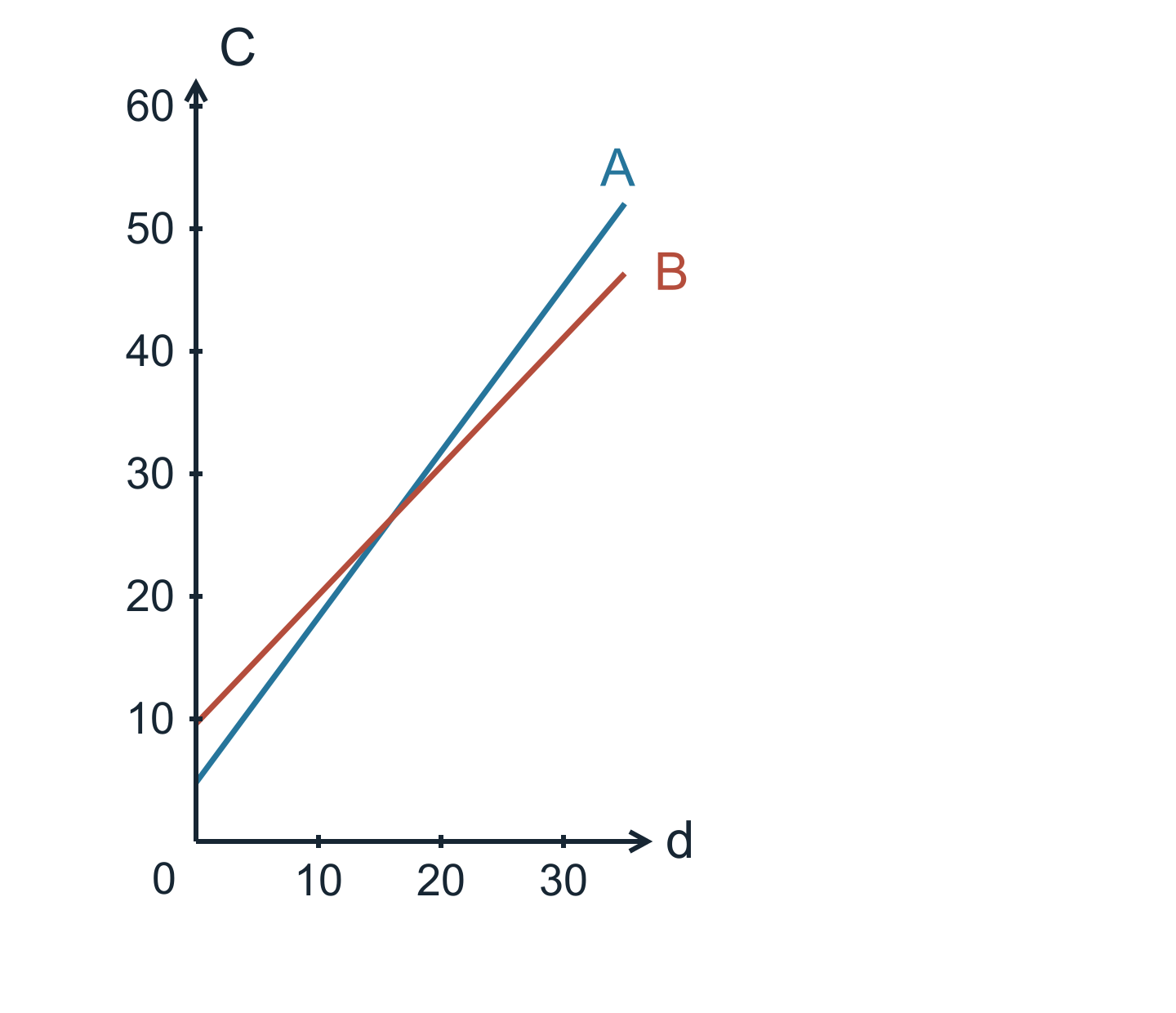
(a) Find the distance and price at which the two quotes are equal.[2]
(b) For a km journey, determine the cheaper company and the saving, to the nearest cent.[2]
(c) State the distances in the modelling domain for which A is strictly cheaper than B.[1]
Let for .
(a) Express in completed-square form.[2]
(b) State the vertex of its graph.[1]
(c) Find the exact zeros of .[2]
The graph of a quadratic has zeros at and and passes through , as shown. Its domain is .
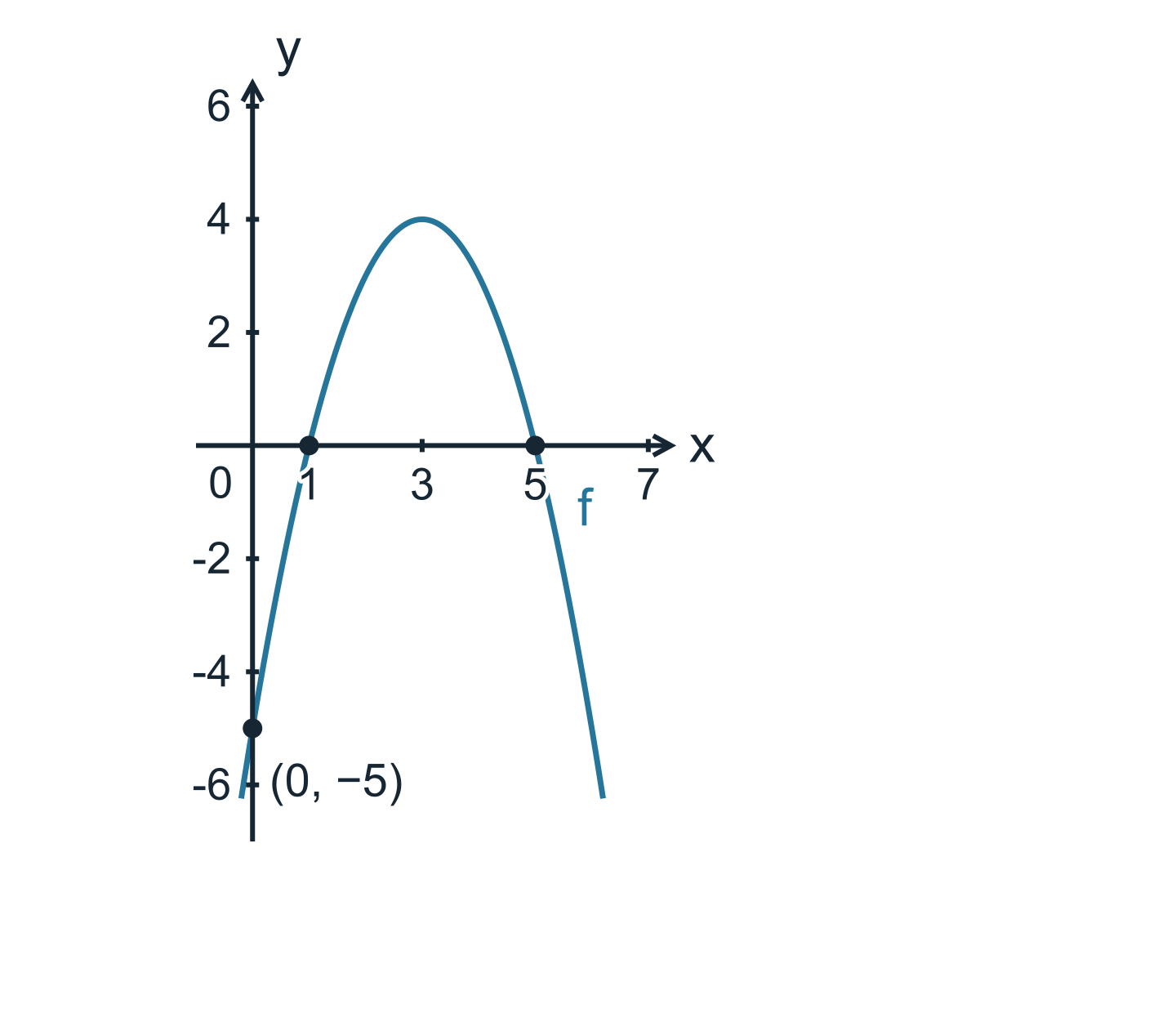
(a) Find in expanded form.[2]
(b) Find the axis of symmetry and the maximum value of .[2]
(c) State the range of .[1]
Consider .
(a) Calculate the discriminant and state the number of real roots.[1]
(b) Use the quadratic formula to find both roots to three significant figures. Show the substitution into the formula.[4]
A quadratic has zeros and , and its graph passes through .
(a) Find in factor form.[2]
(b) Find its expanded and completed-square forms.[2]
(c) State its vertex and range for domain .[2]
A ball's height above level ground is modelled by
where is in metres and is in seconds after release. The physical domain starts at and ends when the ball first reaches the ground. Give calculated times and heights to three significant figures.
(a) Find the time and height of the maximum.[3]
(b) Find the time at which the ball reaches the ground, rejecting any nonphysical root.[2]
(c) Find the interval of times during which the ball is at least metres above ground.[2]
The quadratic has its minimum at the middle entry of this table:
(a) Find in completed-square form, treating the data as exact.[2]
(b) Find both zeros to three significant figures.[2]
(c) Find exactly, explaining your answer using symmetry.[2]
For a real parameter , consider .
(a) Express the discriminant as a product of linear factors in .[2]
(b) Find the values of giving two distinct real roots.[2]
(c) Find the values of giving a repeated real root and state that root in each case.[2]
Let and , where . The diagram shows the case .
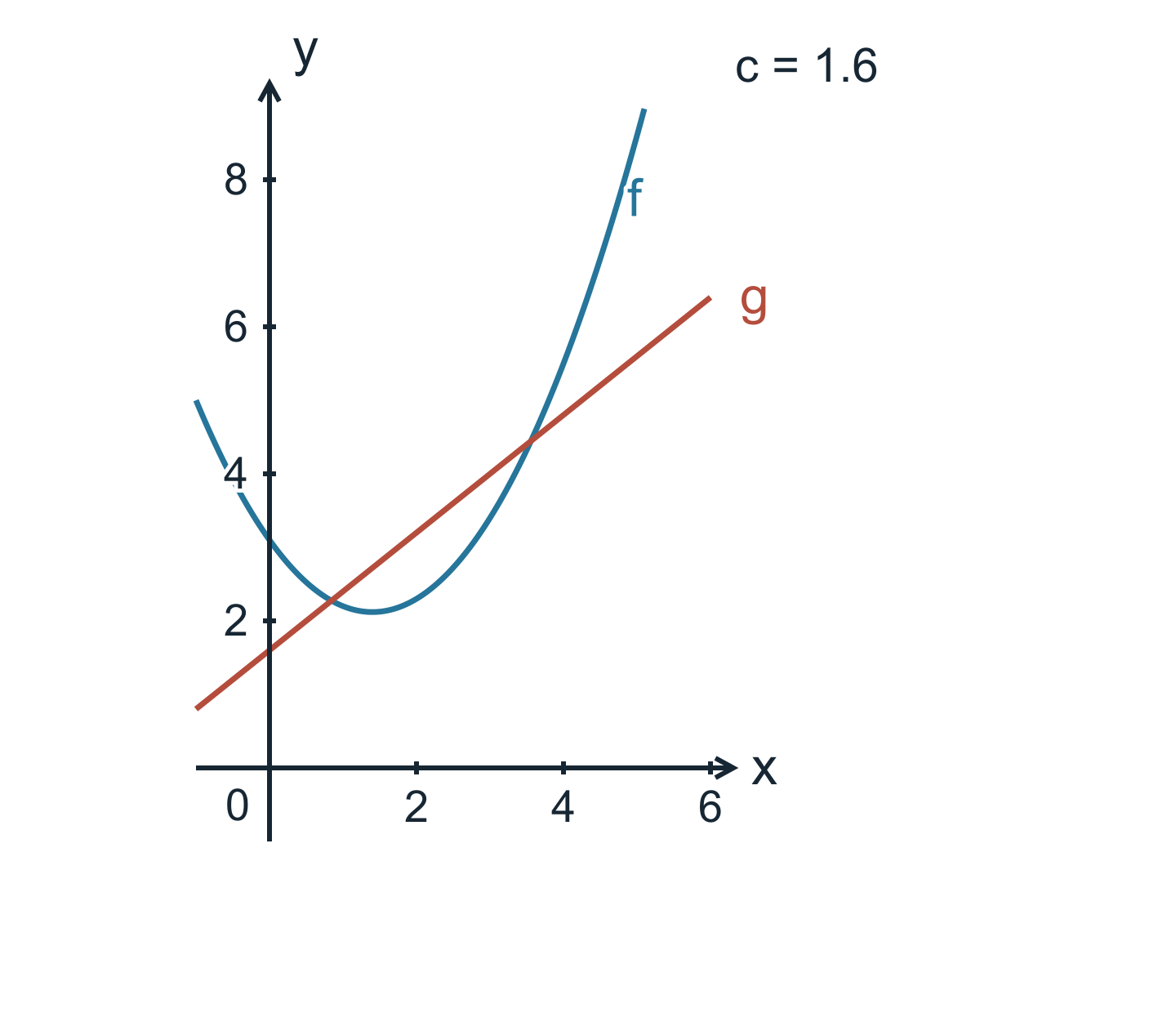
(a) Find the exact value of for which the graphs are tangent, using a discriminant argument.[2]
(b) Find the coordinates of the tangency point exactly.[2]
(c) For , find both intersection points to three significant figures in each coordinate.[3]
For real parameter , consider .
(a) Solve the equation when .[1]
(b) Classify the number of real roots for every .[3]
(c) Give the repeated root for each parameter value at which one occurs.[2]
Let on , where is real.
(a) Find the minimum value of in terms of , and state where it occurs.[2]
(b) Find all for which throughout the stated domain.[2]
(c) For , solve in the domain, giving your answers to three significant figures.[2]
For real parameter , define on .
(a) Find the attained minimum of in terms of .[2]
(b) Determine exactly the values of for which for every real .[2]
(c) How does the answer change if is required instead? At the newly included parameter values, state the input where equality occurs.[2]
The function has domain .
(a) State its range.[1]
(b) Find and state its domain.[3]
(c) Explain why the restriction selects the positive square-root branch, and why the same formula would not invert on all of .[2]
Let and , both restricted to .
(a) Find the exact intersection points of their graphs.[3]
(b) Find the inputs in the stated domain for which .[3]
(c) On the interval from (b), find the greatest vertical gap and the input where it occurs. Use algebra, without differentiation.[3]
(d) Restrict both functions further to the interval from (b). State the range of each, explaining why the two ranges are equal.[3]
The function is restricted to . The endpoints are included in the graph.
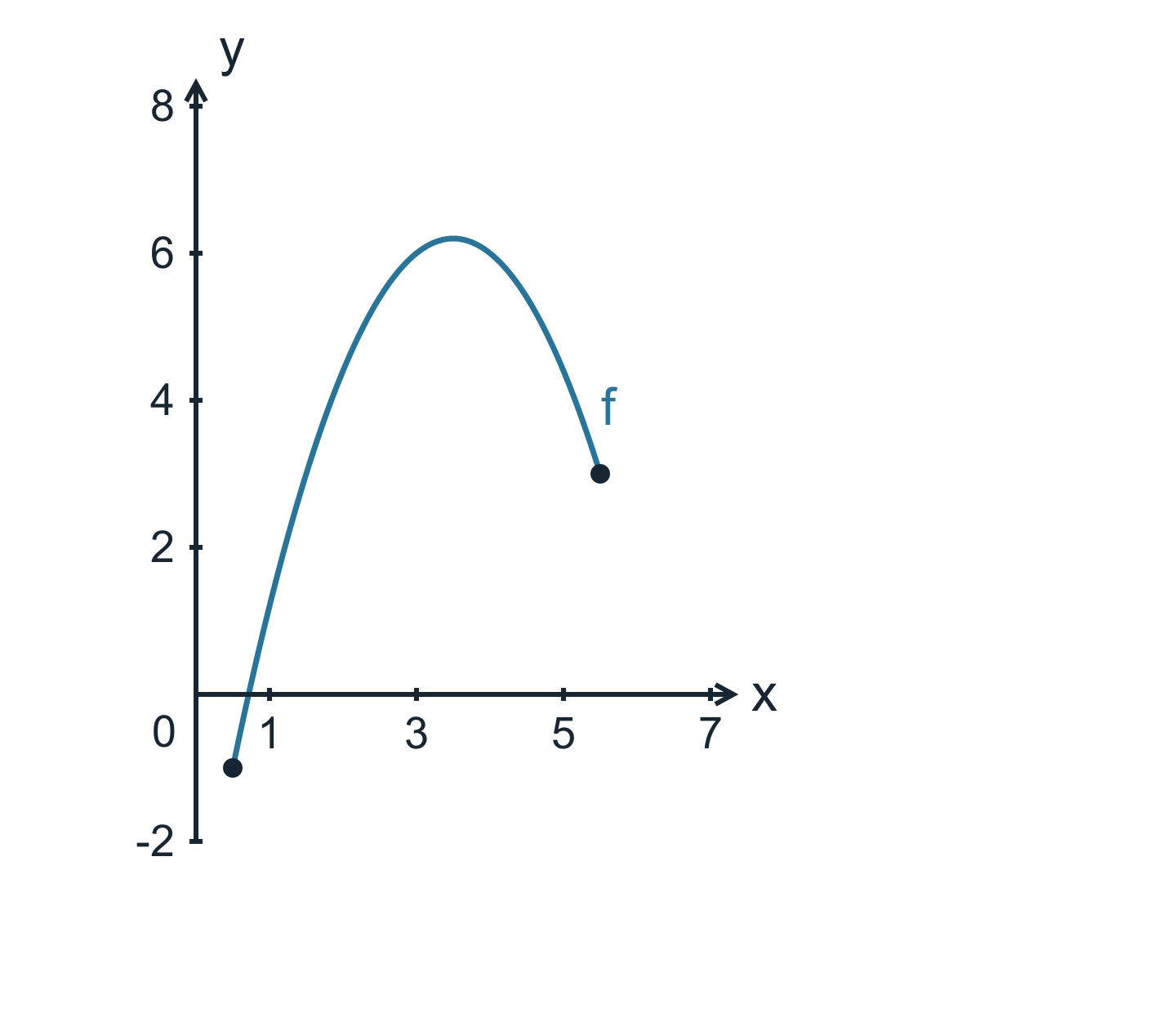
(a) Complete the table exactly.[3]
(b) State the range of on its full restricted domain.[2]
(c) For every real , state the number of distinct solutions of in this domain. Include all boundary cases.[4]
(d) Restrict further to . Find its inverse function and the domain of that inverse.[3]
Let for , and let for . Define on its largest possible real domain.
(a) Find the domain of and give its rule.[2]
(b) Find and its domain.[3]
(c) Find and and verify the identity , including its domain.[3]
(d) Determine whether has any real solutions in the domain of . Justify your conclusion without relying on a graph.[4]
A rectangular enclosure is built against a straight wall. The wall forms one side, and metres of fencing forms the other three sides. Let be the length of each fenced side perpendicular to the wall, and let be the fenced side parallel to it. Both dimensions must be positive.
(a) Express the area in terms of and state the physical domain of .[3]
(b) Find the largest possible area and its corresponding width, using algebra without differentiation.[2]
(c) Find the widths giving an area of at least . Give the boundary widths to three decimal places.[3]
(d) Restrict the area function to its larger-width branch, starting at the maximizing width and ending before . Find its inverse and state the domain of the inverse, with endpoint inclusion made explicit.[4]