Question 1
MildNo calculatorLet .
(a) Find .[2]
(b) Find the gradient of the curve at and interpret it geometrically.[3]

AA · HL · Calculus
Rules, Tangents/Normals, Limits, Optimization, Gradients, L’Hopital’s Rule
Let .
(a) Find .[2]
(b) Find the gradient of the curve at and interpret it geometrically.[3]
The point lies on .
(a) Find the gradient of the tangent at .[2]
(b) Find the equation of the normal at .[3]
Let , with angles in radians.
(a) Find .[3]
(b) Find the gradient at , to three significant figures.[2]
Let for .
(a) Use differentiation to find .[3]
(b) Determine the intervals where is decreasing and increasing.[2]
(c) Find and classify its stationary point.[2]
A rectangular card measures cm by cm. Squares of side cm are cut from its corners and the remaining sides folded to form an open box. The diagram shows the uncut central base and corner cuts.
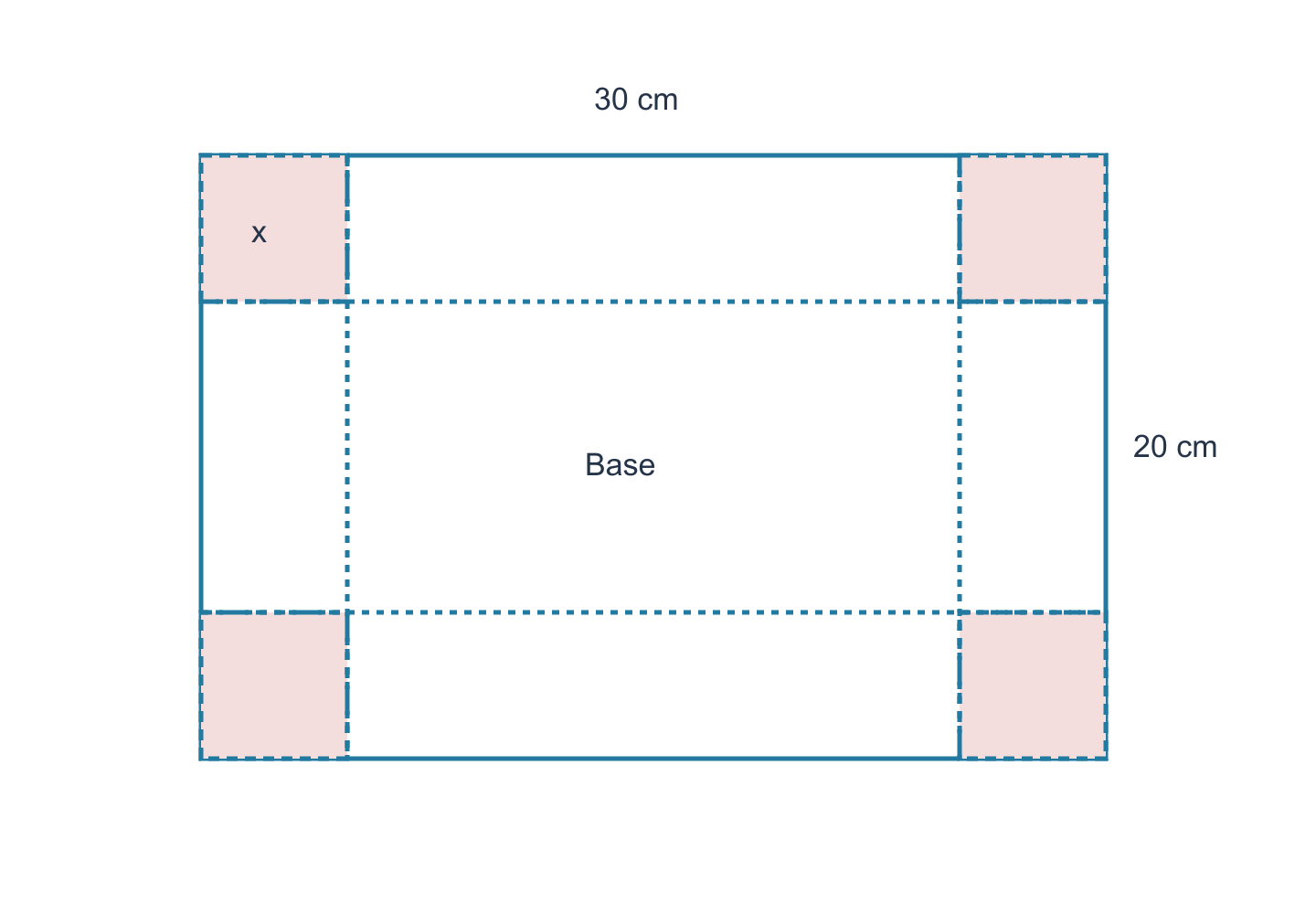
(a) State the physical domain for and show that the box volume is .[3]
(b) Find the stationary values of and identify the physically admissible one.[3]
(c) Justify that this value gives the greatest volume, including the boundary behavior.[2]
(d) Give the optimal cut size and greatest volume, to three significant figures.[2]
A function satisfies and .
(a) Find .[3]
(b) Find its vertical-axis intercept.[2]
The diagram is the graph of on .
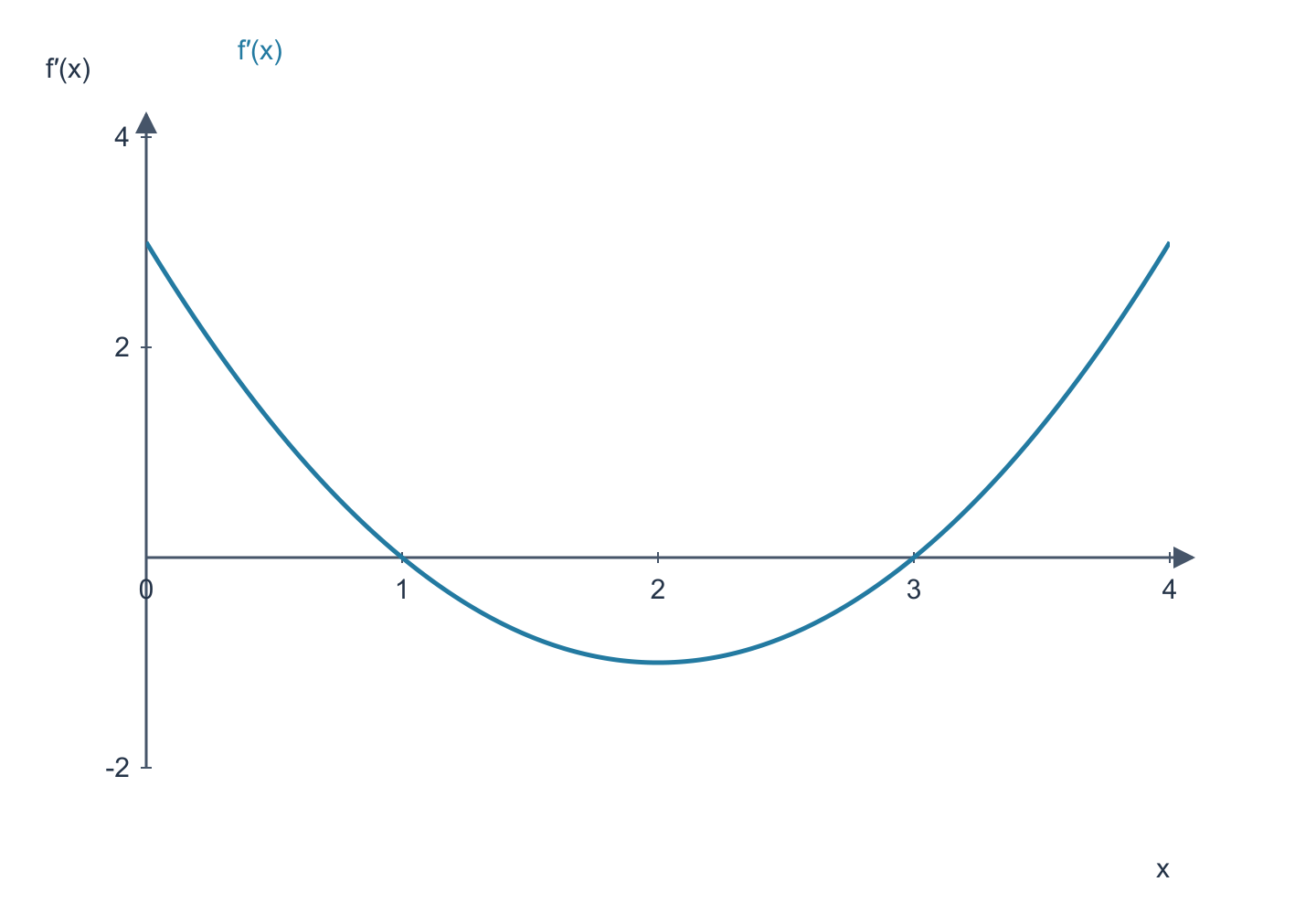
(a) State the open intervals where is increasing.[2]
(b) Classify the stationary points of at and , explaining your answer.[3]
Let for .
(a) Find and all stationary points in this interval.[3]
(b) Determine the greatest value of , to three significant figures, checking the endpoints.[3]
Let , for .
(a) Find the exact value of at a stationary point.[2]
(b) Find the exact value of there and classify the point.[3]
Let , where is real. The tangent at has gradient .
(a) Find .[3]
(b) Find the equation of that tangent.[2]
(c) Find the abscissa of the stationary point of .[2]
A tangent to , , passes through as shown schematically.
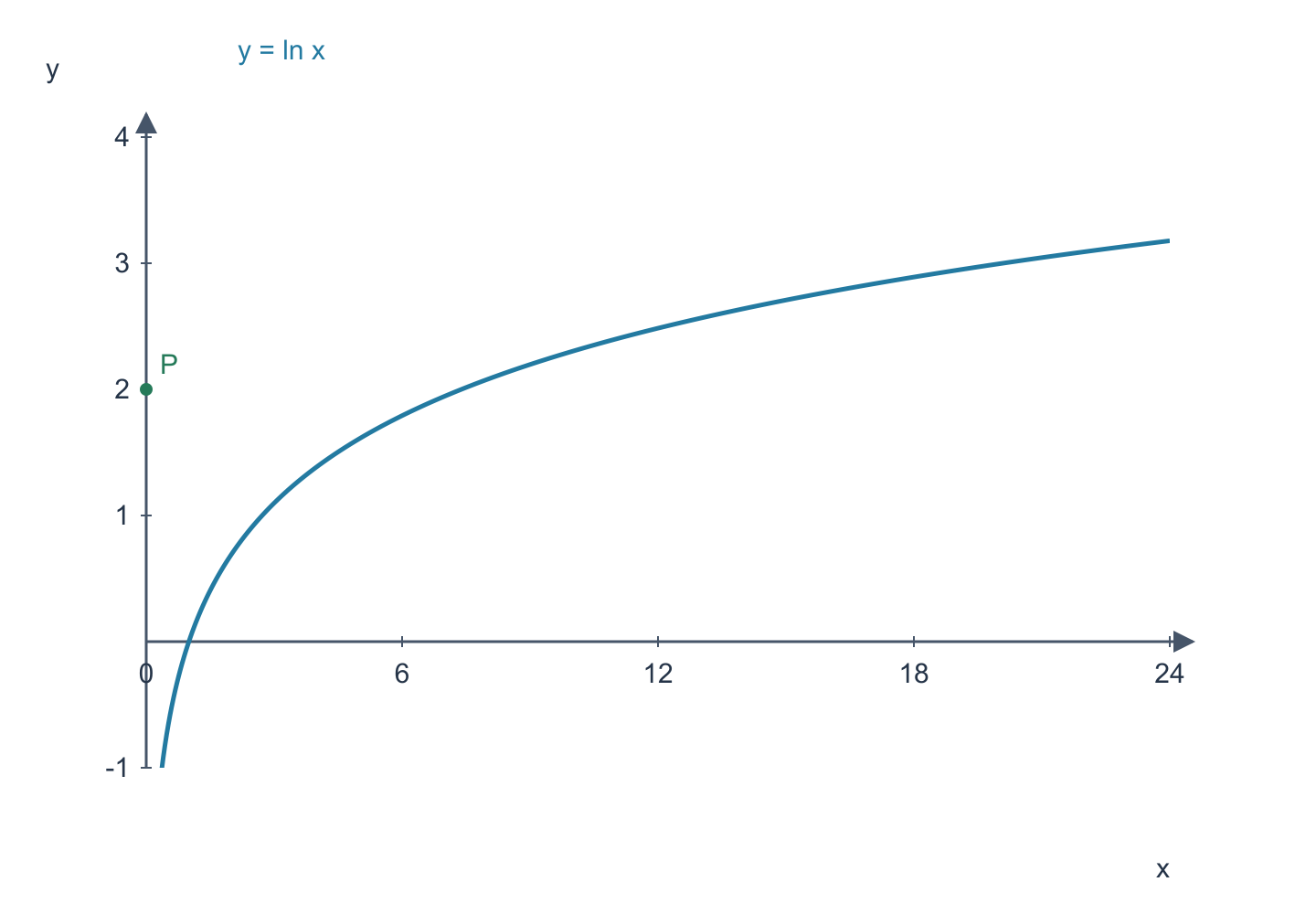
(a) Write the tangent equation at the point with abscissa .[3]
(b) Find exactly by imposing passage through .[3]
(c) Find the tangent gradient and its horizontal-axis intercept, to three significant figures.[2]
(d) Explain why there is exactly one such tangent.[2]
Let . Its graph is shown.
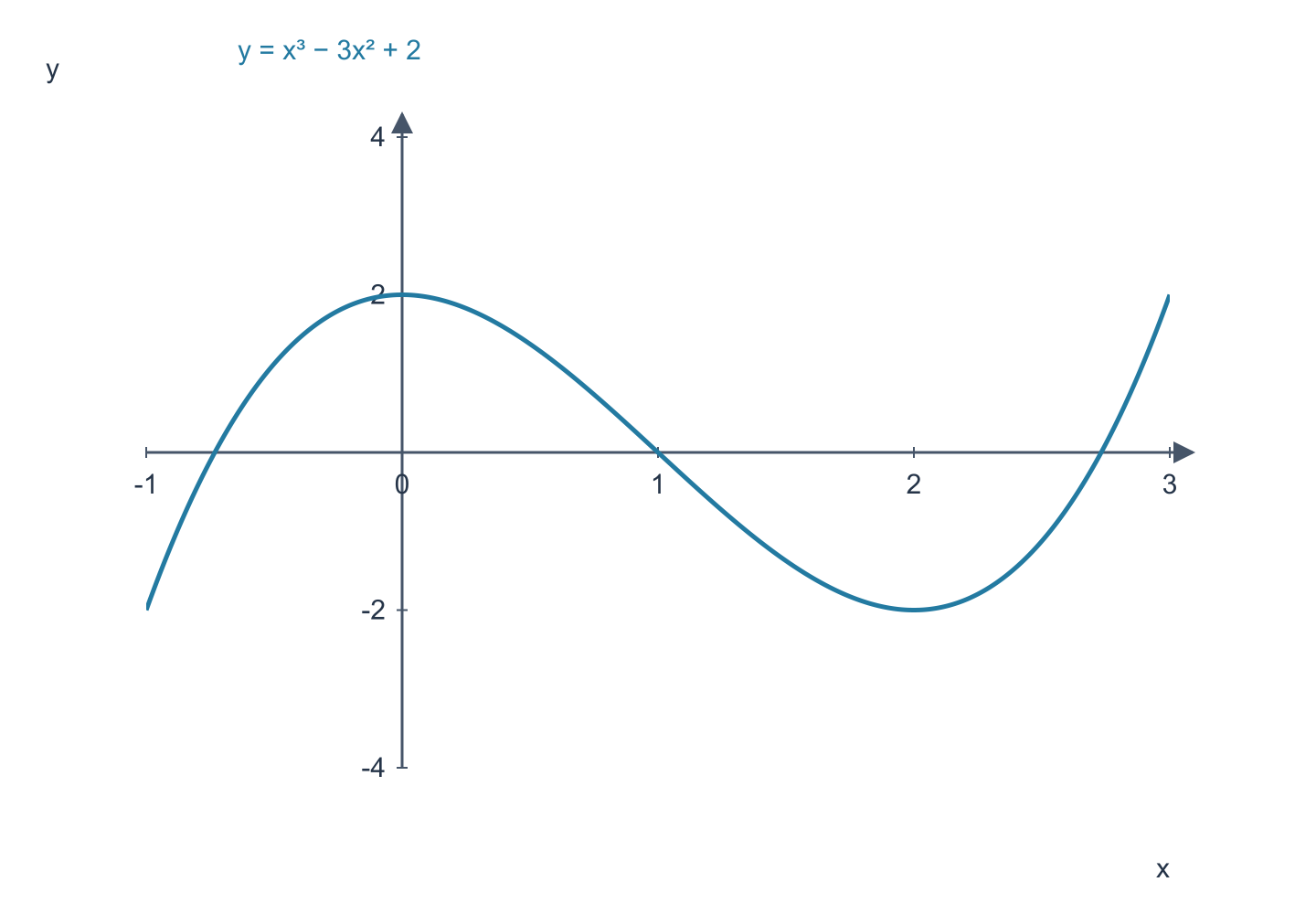
(a) Find and the open intervals of concavity.[3]
(b) Find the point of inflection and its gradient.[3]
(c) Explain why this point is not stationary.[1]
For , use the first-principles limit
(a) Simplify the difference quotient for .[3]
(b) Hence find .[2]
The point lies on .
(a) Use implicit differentiation to find .[3]
(b) Find the tangent equation at .[2]
(c) Find the acute angle between this tangent and the horizontal, to three significant figures.[2]
A spherical balloon has radius cm and volume cm. Air enters at cm s.
(a) Relate to .[3]
(b) Find when cm, to three significant figures.[2]
(c) Explain how changes as increases while the inflow stays constant.[2]
A rectangle is placed under , above the horizontal axis, with its upper corners at . A design constraint requires .
(a) Show that the rectangle area is .[2]
(b) Find the unconstrained positive stationary value of .[3]
(c) Determine the greatest area allowed by the design constraint, explaining why the optimum lies at an endpoint.[3]
(d) A prototype uses . Find the percentage increase in area obtained by the optimal allowed design, to three significant figures.[2]
Evaluate
(a) Identify the indeterminate form.[1]
(b) Use l'Hôpital's rule to obtain the limit.[4]
Let .
(a) Find .[3]
(b) Find the exact tangent equation at .[3]
Let .
(a) Find the first three derivatives and state a formula for for positive integers .[4]
(b) Find the least positive integer such that .[2]
Consider , where .
(a) Find the stationary abscissae and classify the stationary points.[3]
(b) The difference between the local maximum value and local minimum value is . Find exactly and to three significant figures.[3]
(c) For this value of , give both stationary points to three significant figures.[2]
(d) Determine the number of real solutions of , explaining your answer.[2]